Learning to play the piano becomes much easier when you understand how chords work. A Piano Chord Chart provides a simple visual reference that helps you identify notes, build chords, and play your favorite songs with greater confidence. Instead of memorizing every combination from scratch, you can use a chart to find the notes you need quickly.
Whether you are a complete beginner or an experienced musician who wants a convenient reference, a piano chord chart can save time during practice. It also helps you understand the relationship between individual notes and the harmony they create together.
In this guide, you will discover the most common piano chords, learn how to read a chord chart, and explore practical techniques for improving your playing. By the end, you will have a clear starting point for practicing chords and creating your own musical arrangements.
What Is a Piano Chord Chart?
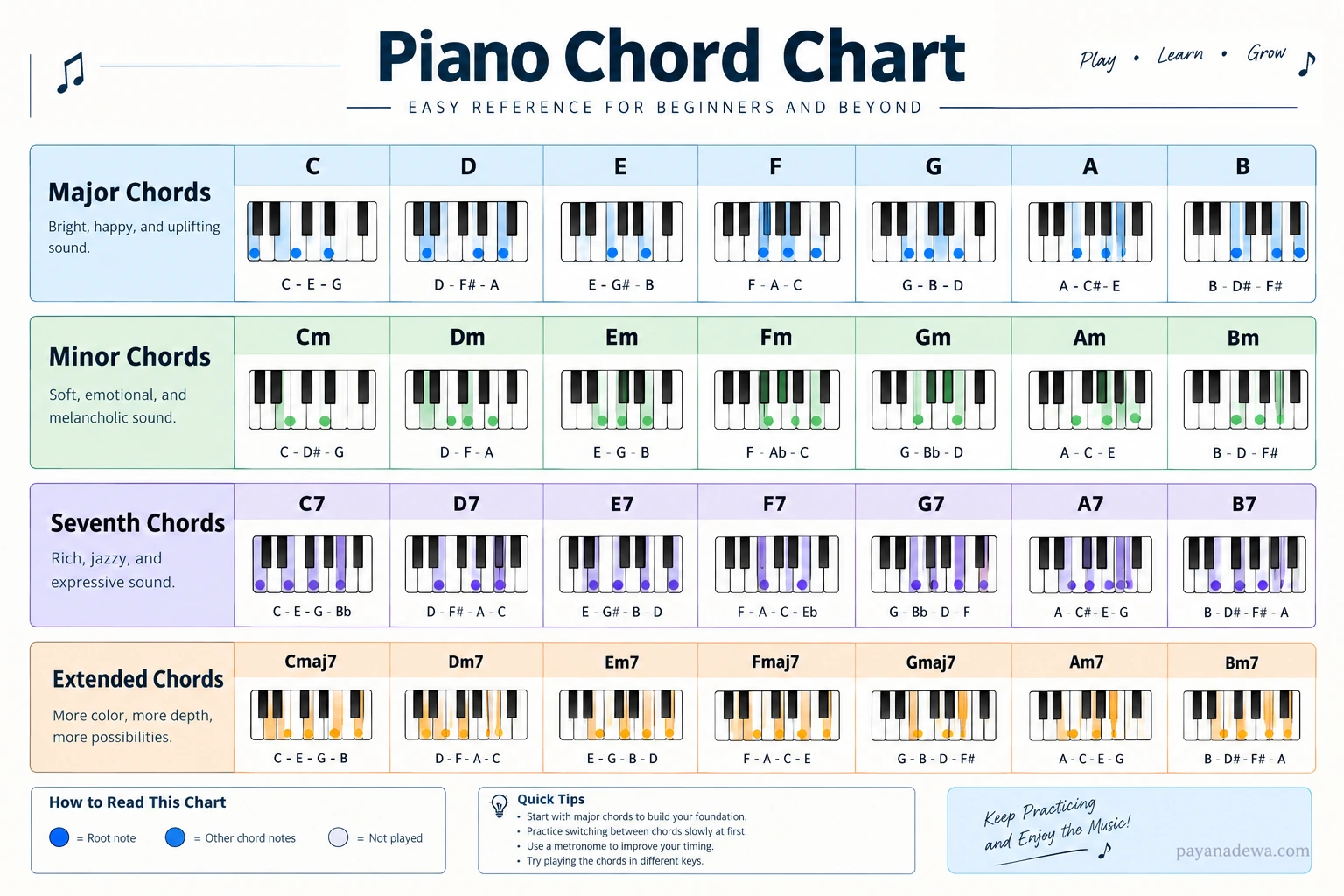
A piano chord chart is a visual guide that shows the notes used to form different chords. Depending on its design, it may display chord names, keyboard diagrams, note names, and formulas that explain how each chord is constructed.
For example, a C major chord contains three notes: C, E, and G. When you play these notes together, they produce a bright, stable sound that appears in countless songs. A chord chart helps you locate these notes without having to work out the entire combination yourself.
Many charts include major, minor, seventh, and extended chords. Some also show inversions and common chord progressions. Therefore, one well-organized chart can serve as a useful reference for learning, songwriting, and accompaniment.
How to Read a Piano Chord Chart
Reading a piano chord chart is straightforward once you understand a few basic musical concepts. Start by identifying the chord name. Next, find the notes listed beneath it and locate those notes on your keyboard.
Understand Piano Keys and Note Names
The piano uses seven natural note names: A, B, C, D, E, F, and G. These notes repeat across the keyboard in different octaves. The black keys represent sharps or flats, depending on the musical context.
To find your way around the keyboard, look for groups of two and three black keys. The white key immediately to the left of a group of two black keys is C. From there, you can identify the remaining notes in sequence.
Identify the Notes in Each Chord
Most beginner piano chords contain three notes. These are called triads. For example, C major contains C, E, and G, while A minor contains A, C, and E.
When a chart displays three highlighted keys, play those notes together to produce the chord. Practice slowly at first. Once your fingers become familiar with the shapes, you can switch between chords more smoothly.
Common Piano Chords Every Beginner Should Learn
Starting with a small collection of chords makes learning more manageable. These basic shapes appear in many popular songs, so mastering them gives you a useful foundation.
Major Piano Chords
Major chords often sound bright, cheerful, or resolved. They are built from a root note, a major third, and a perfect fifth.
- C major: C – E – G
- D major: D – F# – A
- E major: E – G# – B
- F major: F – A – C
- G major: G – B – D
- A major: A – C# – E
- B major: B – D# – F#
Begin with C major because its notes are easy to locate on the keyboard. After that, practice the other major chords one at a time. Pay attention to the spaces between notes, since these intervals determine the chord’s sound.
Minor Piano Chords
Minor chords often sound reflective, gentle, or emotional. They contain a root note, a minor third, and a perfect fifth. Compared with a major chord, the third note is lowered by one semitone.
- C minor: C – Eb – G
- D minor: D – F – A
- E minor: E – G – B
- F minor: F – Ab – C
- G minor: G – Bb – D
- A minor: A – C – E
- B minor: B – D – F#
Minor chords are especially useful when learning ballads, pop songs, and emotional piano arrangements. Practice moving between major and minor chords to hear how changing just one note can affect the mood.
Seventh Chords
Seventh chords add another note to a basic triad, creating a richer sound. They are common in jazz, blues, soul, and many contemporary songs.
- C7: C – E – G – Bb
- D7: D – F# – A – C
- E7: E – G# – B – D
- Fmaj7: F – A – C – E
- G7: G – B – D – F
- Am7: A – C – E – G
Notice that seventh chords can have different qualities. For example, a dominant seventh chord such as G7 sounds different from a major seventh chord such as Fmaj7. Learning these differences will help you choose chords that match the music you want to play.
How to Use a Piano Chord Chart to Play Songs
Once you know several basic chords, you can start using them to accompany songs. A practical approach is to learn a few common chord progressions before attempting more complicated arrangements.
Practice Common Chord Progressions
A chord progression is a sequence of chords played in a particular order. Many songs use familiar progressions that repeat throughout a verse or chorus.
- C – G – Am – F: A popular progression for pop songs.
- Am – F – C – G: A useful sequence for learning minor-key colors.
- C – F – G – C: A simple progression for beginners.
- G – D – Em – C: Another common progression in contemporary music.
First, play each chord as a block, pressing its notes together. Next, switch between chords without stopping. When the changes feel comfortable, experiment with different rhythms or play the notes separately as broken chords.
Use Both Hands Effectively
Beginners can start by playing chords with the right hand while the left hand plays single root notes. For example, play C major with the right hand and a low C with the left hand.
As your coordination improves, try playing octaves, alternating bass notes, or simple rhythmic patterns with the left hand. This approach creates a fuller sound without requiring complicated techniques.
Tips for Learning Piano Chords Faster
Consistent practice is more valuable than trying to learn every chord in one session. Use these practical tips to build confidence and develop better technique.
- Start small: Learn three or four chords before moving to more advanced shapes.
- Practice slowly: Focus on accurate notes and relaxed fingers before increasing your speed.
- Use a metronome: A steady beat helps you develop timing and consistent chord changes.
- Repeat transitions: Practice moving between two chords until the change feels natural.
- Learn inversions: Chord inversions rearrange the same notes, helping your hands move shorter distances.
- Play real songs: Applying chords to familiar music makes practice more enjoyable and meaningful.
Additionally, keep your piano chord chart near your keyboard. Checking the notes when necessary is perfectly fine. Over time, repeated practice will help you recognize common chord shapes without relying on the chart as often.
Common Mistakes to Avoid When Using a Piano Chord Chart
Although a chord chart is a helpful learning tool, a few common mistakes can slow your progress. Recognizing them early will make your practice more effective.
Trying to Memorize Too Many Chords
Learning dozens of chords immediately can feel overwhelming. Instead, focus on the major and minor chords used in your favorite songs. Expand your collection gradually as your understanding improves.
Ignoring Smooth Chord Changes
Playing each chord correctly is only part of the process. You also need to move between chords without unnecessary pauses. Practice slowly and look for notes that stay the same or can be reached with minimal finger movement.
Relying on the Chart Without Understanding It
A chord chart should support your learning rather than replace musical understanding. Take time to learn how chord formulas work and how major, minor, and seventh chords differ. This knowledge makes it easier to learn unfamiliar chords in the future.
Frequently Asked Questions About Piano Chord Charts
What is the easiest piano chord to learn?
C major is a good starting point because it uses three white keys: C, E, and G. Its simple shape makes it easy to identify and practice.
Can beginners learn piano using only a chord chart?
A chord chart is an excellent starting resource, especially for playing songs and accompanying singers. However, beginners will benefit from learning basic rhythm, finger technique, note reading, and simple music theory as well.
How many piano chords should I learn first?
Start with five to eight frequently used major and minor chords. Once you can switch between them comfortably, add more chords, inversions, and seventh chords.
Is a printable piano chord chart useful?
Yes. A printable chart provides a convenient reference during practice, especially when learning new chord shapes. Choose one with clear labels and readable keyboard diagrams so you can identify notes quickly.
Conclusion
A Piano Chord Chart is a practical resource for anyone who wants to learn chords, accompany songs, or develop a stronger understanding of music. By starting with major and minor chords, practicing common progressions, and gradually exploring seventh chords, you can build a solid foundation for playing the piano.
Remember that progress comes from consistent practice rather than memorizing everything at once. Keep your chart nearby, practice smooth transitions, and apply what you learn to songs you enjoy.
Ready to improve your piano skills? Start with a few chords today and build your collection step by step. Which piano chord or progression are you learning first? Share your experience and favorite practice tips with other music learners.