A case study is a powerful way to explain a real-world situation, explore a challenge, and demonstrate how a solution works. Businesses, students, researchers, and professionals use case studies to turn complex information into practical lessons. Whether you want to improve a business strategy, complete an academic assignment, or showcase a successful project, understanding how to write a case study can help you communicate your findings clearly.
A well-structured case study goes beyond presenting facts. It explains the background, identifies the main problem, examines possible solutions, and evaluates the results. This approach helps readers understand not only what happened but also why it happened and what they can learn from the experience.
In this guide, you will discover what a case study is, explore common types, learn the essential steps for writing one, and find practical tips for creating a clear and effective case study. You will also learn how a case study template can simplify the writing process.
What Is a Case Study?
A case study is a detailed examination of a particular person, organization, project, event, or situation. It uses relevant information and evidence to explain a problem, investigate its causes, and evaluate the outcomes of specific actions or decisions.
Case studies are common in business, education, healthcare, marketing, and social research. Each field uses this method differently, but the central purpose remains similar: to understand a specific situation in depth and identify lessons that may be useful in other circumstances.
Key Characteristics of a Case Study
An effective case study usually includes several important characteristics:
- A clear objective: It identifies the question, challenge, or situation being examined.
- Relevant background: It provides enough context for readers to understand the circumstances.
- Evidence-based analysis: It uses reliable information, observations, interviews, or measurable data.
- A practical approach: It explains the decisions, methods, or actions taken.
- Meaningful conclusions: It identifies the results, lessons, and possible future improvements.
These characteristics help transform a collection of facts into a useful explanation. Instead of simply describing an event, a case study connects evidence, decisions, and outcomes in a logical way.
Common Types of Case Studies
There are several types of case studies, and the right format depends on your purpose. Before writing, consider what you want readers to understand and what information will best support your objective.
1. Business Case Study
A business case study examines a company’s challenge, strategy, or performance. It may explore how an organization improved its operations, entered a new market, managed a crisis, or increased customer satisfaction.
Business case studies are useful for understanding decision-making and evaluating management strategies. They can also help companies identify opportunities for improvement by learning from previous experiences.
2. Marketing Case Study
A marketing case study explains how a campaign, product launch, or promotional strategy achieved particular results. It may include information about the target audience, campaign objectives, marketing channels, budget, and performance indicators.
For example, a company might analyze how an email marketing campaign increased customer engagement. By comparing campaign performance before and after implementation, the case study can explain which tactics were effective and what could be improved.
3. Academic Case Study
An academic case study investigates a specific subject using structured research and critical analysis. Students and researchers may examine historical events, educational practices, social issues, or organizational behavior.
This type of case study typically includes a research question, supporting evidence, analysis, and a conclusion. Depending on the discipline, it may also include a literature review and a discussion of research limitations.
4. Customer Success Case Study
A customer success case study demonstrates how a product or service helped a customer address a particular challenge. It often describes the customer’s initial situation, the solution provided, and the measurable improvements achieved.
Businesses use these case studies to build credibility and help prospective customers understand the practical value of an offering. Accurate results and authentic customer experiences make this format especially useful.
How to Write a Case Study Step by Step
Writing a case study becomes easier when you follow a consistent process. A clear structure keeps your research focused and helps readers follow the connection between the original problem, the chosen solution, and the final outcome.
Step 1: Define Your Objective
Start by identifying the main purpose of your case study. Decide whether you want to investigate a problem, evaluate a strategy, document a project, or demonstrate a successful outcome.
Write a focused question to guide your research. For example, you might ask, “How did a small business improve customer retention through personalized communication?” A specific question helps you collect relevant evidence and avoid unnecessary information.
Step 2: Gather Reliable Information
Collect information that directly supports your objective. Depending on the subject, useful sources may include interviews, surveys, internal reports, published research, performance data, and direct observations.
Check the accuracy of your sources before drawing conclusions. Record important dates, figures, and references so you can verify your findings later. If the case study involves people or private business information, obtain appropriate permission and protect confidential details.
Step 3: Identify the Main Problem
Explain the situation before the solution was introduced. Describe the relevant background, the challenges involved, and the reasons the problem required attention.
Use specific evidence wherever possible. For example, instead of saying that customer satisfaction was low, explain which feedback, survey findings, or service indicators revealed the issue. Concrete details make the analysis more convincing.
Step 4: Explain the Solution or Approach
Describe the strategy, method, or intervention used to address the problem. Explain why the approach was selected and how it was expected to produce an improvement.
If several alternatives were considered, briefly explain the most relevant options and the reasons for choosing the final approach. This gives readers a clearer understanding of the decision-making process.
Step 5: Describe the Implementation
Outline the actions taken to put the solution into practice. Include the sequence of activities, resources required, people involved, and important milestones.
Be honest about obstacles encountered during implementation. Challenges such as limited budgets, staff training, technical issues, or changing priorities can provide valuable context for readers who want to apply similar methods.
Step 6: Measure and Analyze the Results
Evaluate what happened after the solution was implemented. Use relevant indicators to compare the results with the original objectives or baseline measurements.
Depending on the project, these indicators might include revenue, conversion rates, customer satisfaction, completion time, error rates, or operational costs. Explain the significance of the findings instead of simply listing numbers.
When the evidence supports only a limited conclusion, acknowledge that limitation. A case study should distinguish between a measured result and an assumption about what caused it.
Step 7: Present the Key Lessons
Conclude the analysis by explaining what the findings reveal. Identify the most important lessons, discuss what worked well, and suggest changes that could improve future results.
Connect each recommendation to the evidence presented earlier. This makes the case study more practical and helps readers understand how the findings may apply to similar situations.
Essential Sections of a Case Study Template
A case study template provides a consistent structure for organizing research and presenting findings. It is especially helpful when you need to create multiple reports or collaborate with other people.
The following sections provide a practical starting point for a business, academic, or project-based case study.
- Title and basic information: Identify the subject, author, date, and project details.
- Introduction: Explain the background, context, and objective.
- Problem or challenge: Describe the main issue and why it matters.
- Solution or approach: Present the selected strategy and supporting reasons.
- Implementation: Document the actions, methods, and resources involved.
- Results: Present the findings and relevant performance measurements.
- Key takeaways: Summarize the lessons and practical recommendations.
- Conclusion: Reinforce the overall significance of the case study.
Use the printable case study template below to organize these sections and prepare your report more efficiently.
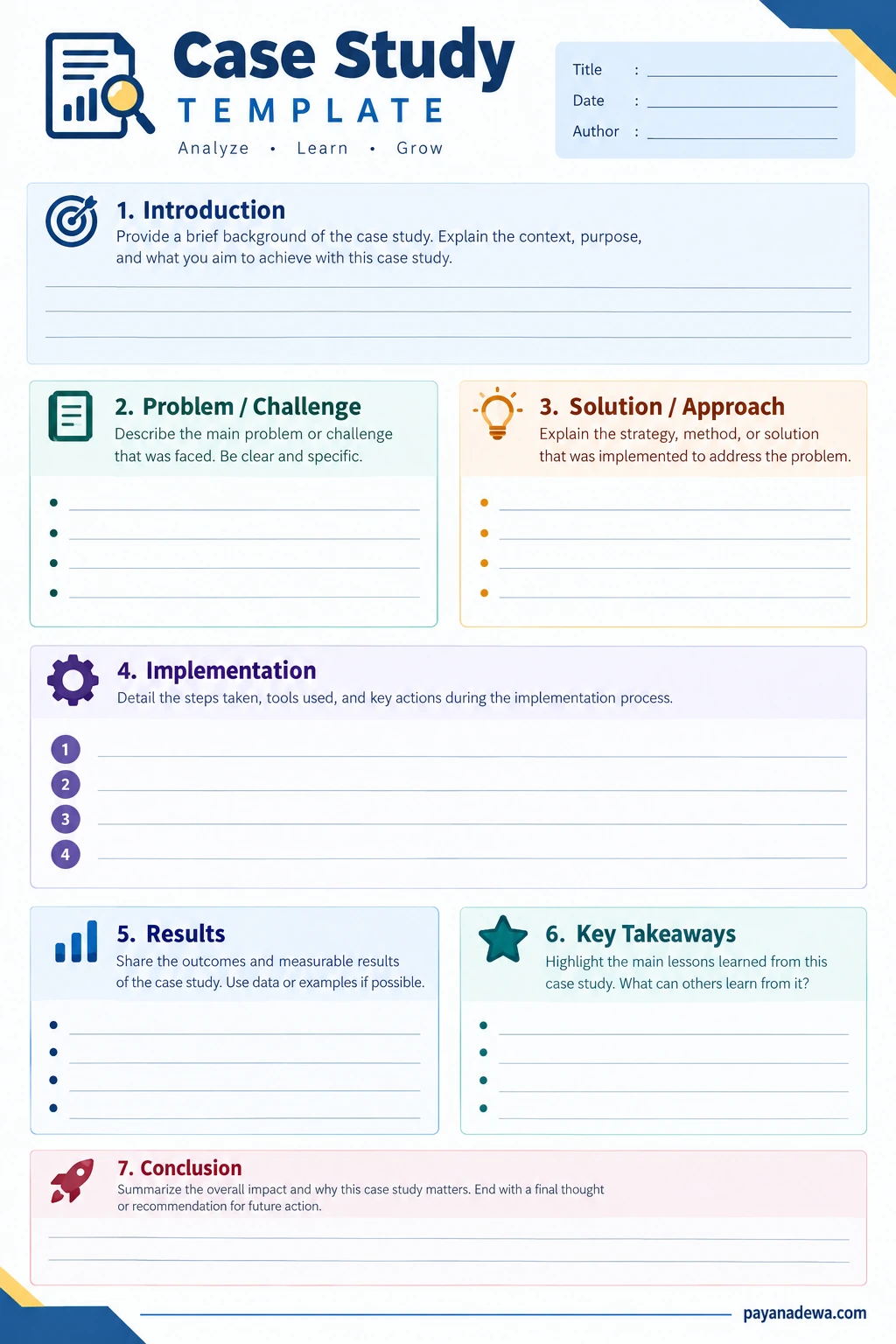
A template is a starting point rather than a rigid rule. Adjust the headings to match your topic, research requirements, and intended audience. Some projects may need a methodology section, while others may benefit from a budget summary, timeline, or customer testimonial.
Practical Tips for Creating an Effective Case Study
A strong case study should be informative, easy to navigate, and supported by credible evidence. The following tips can help you improve its quality.
Use Clear and Specific Language
Write in straightforward language and explain technical terms when necessary. Keep each paragraph focused on one main idea. Readers should be able to understand the situation without having to interpret unnecessarily complicated sentences.
Support Claims with Evidence
Include relevant statistics, quotations, observations, or documented outcomes. Verify important claims and explain where the information came from. If a result is estimated rather than measured, identify it clearly.
Include Visual Elements When Useful
Charts, tables, timelines, and photographs can make complex information easier to understand. Choose visuals that support the analysis rather than simply decorate the page. Add descriptive captions and alternative text to improve accessibility.
Keep the Story Focused
Organize the report around a clear progression: situation, challenge, response, results, and lessons. Remove details that do not contribute to the main objective. A focused narrative helps readers understand the significance of each decision.
Review the Final Draft
Check the report for accuracy, grammar, consistency, and logical flow. Confirm that all important claims are supported and that the conclusion answers the original objective. Ask another reader to review the document if possible.
Common Case Study Mistakes to Avoid
Even a well-researched case study can become less effective when important details are missing or conclusions are overstated. Avoid these common mistakes:
- Unclear objectives: A report without a focused question can become too broad and difficult to follow.
- Insufficient evidence: Unsupported claims weaken the credibility of the analysis.
- Missing context: Readers need to understand the original situation before evaluating the solution.
- Confusing correlation with causation: An improvement after an intervention does not automatically prove that the intervention caused it.
- Ignoring limitations: Research constraints and unexpected factors should be acknowledged.
- Unrealistic recommendations: Suggestions should reflect the evidence, available resources, and circumstances of the case.
Addressing these issues will help you produce a more balanced, transparent, and useful report. Remember that an honest explanation of limitations can strengthen a case study rather than undermine it.
Conclusion
A case study is an effective way to investigate real-world challenges, evaluate solutions, and communicate practical lessons. By defining a clear objective, gathering reliable information, analyzing the problem, documenting the implementation, and measuring the results, you can create a report that is both informative and actionable.
Using a case study template can make this process more organized and consistent. Whether you are preparing an academic assignment, developing a business report, or showcasing customer success, choose a structure that supports your goals and your audience’s needs.
Start with a specific question, support your analysis with credible evidence, and finish with lessons that readers can apply. What type of case study are you planning to create? Share your ideas or experiences to help others learn from real-world examples.