A Subscription Agreement is a written contract that defines the relationship between a service provider and a subscriber. It explains what the subscriber receives, how much the service costs, when payments are due, how long the subscription lasts, and what happens if either party wants to cancel the arrangement.
Subscription agreements are widely used for software, memberships, digital products, online services, professional services, publications, educational platforms, and other recurring services. A clear agreement helps both parties understand their responsibilities before the subscription begins.
Whether you operate a subscription-based business or are considering subscribing to a service, understanding the essential terms can help prevent confusion later.
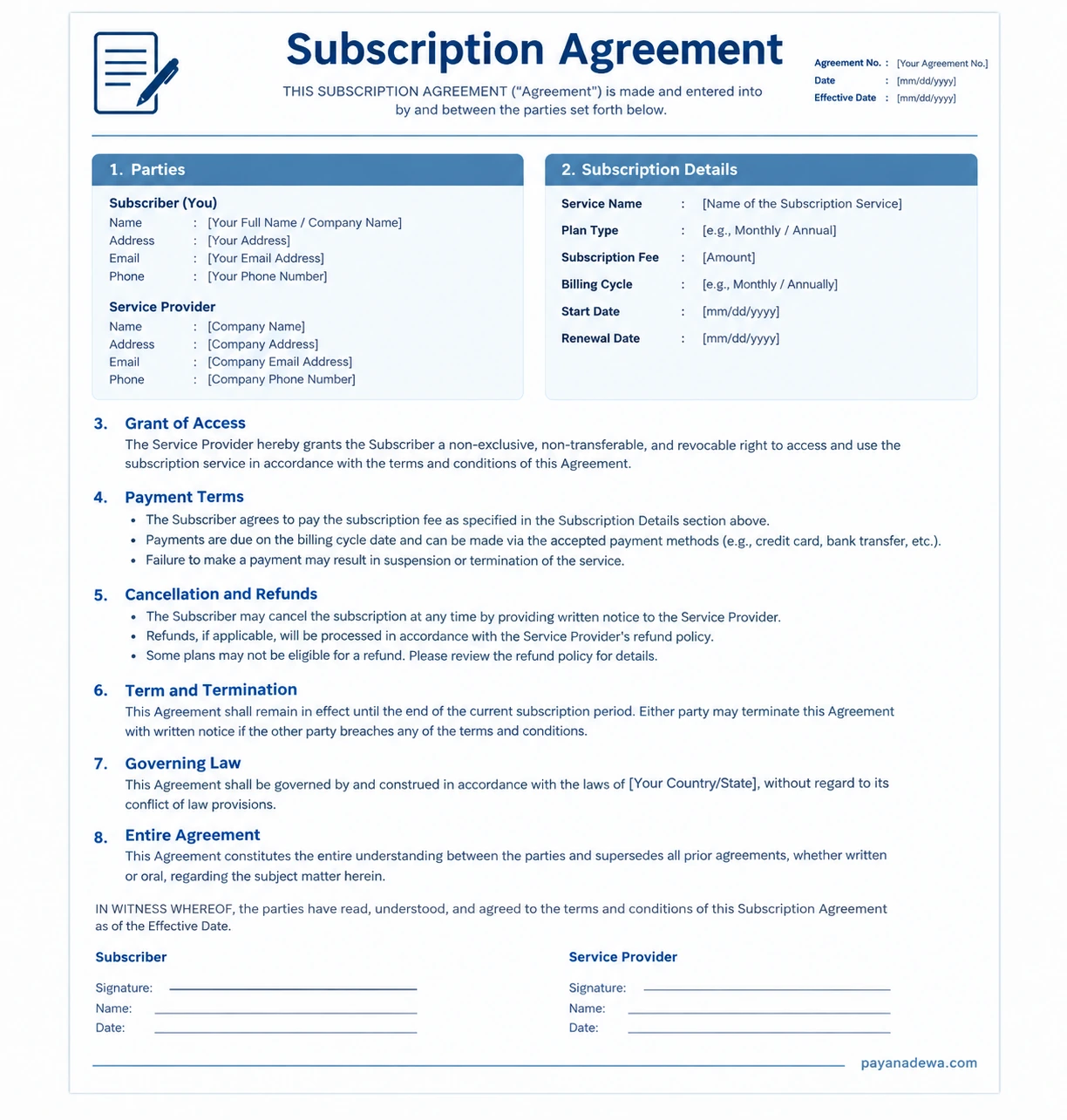
What Is a Subscription Agreement?
A Subscription Agreement is a legal document between a provider and a subscriber. The provider agrees to deliver specific services, products, content, or access for a defined period. In return, the subscriber agrees to pay the required subscription fee and follow the stated terms.
The agreement can apply to monthly, quarterly, annual, or other recurring subscription arrangements. Depending on the business model, it may also explain automatic renewal, payment processing, refunds, account suspension, termination, and service limitations.
A well-written subscription contract should make the commercial relationship easy to understand. Both parties should be able to identify what is being purchased, what is included, and what obligations apply throughout the subscription period.
Why Is a Subscription Agreement Important?
A subscription agreement provides a clear framework for an ongoing business relationship. Instead of relying only on verbal promises or general website information, the parties can refer to a written document that explains their rights and responsibilities.
For businesses, a subscription contract can help establish consistent terms for customers. For subscribers, it provides important information about pricing, renewal, cancellation, and service access.
Key benefits include:
- Clear expectations: Both parties understand what the subscription includes.
- Payment clarity: The agreement explains fees, billing dates, and accepted payment methods.
- Renewal transparency: Subscribers can see whether the service renews automatically.
- Cancellation guidance: The agreement explains how and when a subscription can be canceled.
- Better record keeping: A signed agreement provides written evidence of the agreed terms.
- Reduced misunderstandings: Important obligations are documented before the subscription begins.
What Should a Subscription Agreement Include?
Every subscription business has different requirements. However, most effective subscription agreements contain several core sections.
1. Information About the Parties
The agreement should identify the provider and subscriber. Include legal names, business names where applicable, addresses, email addresses, and other information needed to identify the parties.
Clearly defining the parties avoids uncertainty about who is responsible for the obligations described in the contract.
2. Description of Subscription Services
The agreement should explain exactly what the subscriber receives. This section may describe access to software, digital content, membership benefits, physical products, consulting services, educational materials, or other offerings.
Specific descriptions are generally more useful than vague statements. If the subscription includes limitations, usage allowances, support levels, or premium features, those details should also be explained.
3. Subscription Term
The subscription term identifies when the agreement starts and how long it remains active. For example, a service might operate on a monthly or annual subscription cycle.
The agreement should also explain what happens at the end of the initial term. Some subscriptions expire automatically, while others renew for another period unless canceled.
4. Payment and Billing Terms
Payment terms are one of the most important parts of a subscription agreement. Subscribers should know the amount they will pay and how frequently they will be charged.
Consider including:
- Subscription price
- Billing frequency
- Payment method
- Billing date
- Applicable taxes or additional charges
- Late payment procedures
- Failed payment procedures
- Conditions for price changes
If payments are processed automatically, the agreement should clearly explain the recurring billing arrangement.
5. Automatic Renewal
Automatic renewal should be presented clearly. The agreement can state whether the subscription automatically renews and identify the renewal period.
It is also helpful to explain how a subscriber can stop renewal. Depending on the service and applicable law, cancellation may need to occur before a particular renewal date.
6. Cancellation and Termination
A subscription agreement should explain the cancellation process in simple language. For example, it may identify whether cancellation can be completed through an online account, email request, customer support, or another method.
The agreement should also distinguish between ordinary cancellation and termination for reasons such as non-payment or material breach of the agreement.
7. Refund Policy
If refunds are available, explain when a subscriber may qualify for one. The agreement can also identify circumstances where payments are non-refundable, subject to applicable consumer protection laws and other mandatory requirements.
A clear refund policy can reduce disputes because subscribers know the applicable rules before purchasing the subscription.
Common Types of Subscription Agreements
Subscription agreements can be adapted to many different business models. The basic structure remains similar, but the service-specific terms can vary significantly.
- Software Subscription Agreement: Used for SaaS platforms, applications, and cloud-based software.
- Membership Agreement: Used by clubs, online communities, professional organizations, and membership programs.
- Digital Content Subscription: Used for newsletters, courses, publications, videos, music, and other digital content.
- Service Subscription Agreement: Used for recurring professional or business services.
- Product Subscription Agreement: Used when customers receive physical products on a recurring schedule.
How to Create a Subscription Agreement
Creating a subscription contract does not need to be complicated. Start by identifying the service and the relationship between the provider and subscriber.
Step 1: Identify the Parties
Enter the legal information for the provider and subscriber. Make sure names and contact details are accurate.
Step 2: Describe the Subscription
Explain the products, services, content, or access included in the subscription. State important limitations where necessary.
Step 3: Define Pricing and Billing
Specify the subscription fee, billing frequency, payment method, and relevant charges. Make recurring payments easy to understand.
Step 4: Explain Renewal and Cancellation
State whether the subscription automatically renews. Then explain how subscribers can cancel and whether advance notice is required.
Step 5: Add General Terms
Depending on the service, consider provisions covering intellectual property, confidentiality, acceptable use, account suspension, data handling, limitation of liability, governing law, dispute resolution, and changes to the agreement.
Step 6: Review Before Signing
Both parties should review the document carefully before accepting the terms. Check names, prices, dates, renewal provisions, cancellation rules, and other important details.
Tips for Writing a Clear Subscription Contract
A subscription agreement should be detailed enough to protect the interests of the parties while remaining easy to understand.
- Use plain language: Avoid unnecessary legal jargon when a simpler explanation is available.
- Define important terms: Explain words that could have multiple meanings.
- Make recurring charges obvious: Clearly identify the amount and frequency of payments.
- Explain cancellation procedures: Tell subscribers exactly how cancellation works.
- Separate important policies: Use headings and short paragraphs for easier reading.
- Keep records: Store the signed agreement and relevant subscription records securely.
- Review the agreement regularly: Update it when pricing, services, or business practices change.
Subscription Agreement vs. Terms and Conditions
A Subscription Agreement and general Terms and Conditions can serve different purposes, although they may overlap.
A subscription agreement typically focuses on the specific relationship between the provider and subscriber. It may contain information about the selected plan, subscription price, payment schedule, term, and signatures.
Terms and Conditions are often broader. They may apply to everyone who uses a website, application, or service and can cover general rules such as acceptable use, intellectual property, privacy, account responsibilities, and limitations of liability.
Businesses sometimes use both documents. In that situation, the subscription agreement can address customer-specific commercial terms while the general terms provide broader rules for using the service.
When Should You Use a Subscription Agreement?
A written subscription agreement can be particularly useful when customers pay regularly for continuing access to a service or product.
It may be appropriate when the subscription involves:
- Recurring payments
- Long-term service commitments
- Business-to-business subscriptions
- Premium memberships
- Software or SaaS access
- Recurring delivery of products
- Professional services
- Paid digital content
For simple consumer subscriptions, an online checkout process combined with clearly presented terms may sometimes be used instead. However, the appropriate structure depends on the nature of the transaction and applicable laws.
Common Mistakes to Avoid
Even a basic subscription contract can create problems if important terms are unclear.
- Failing to identify the parties correctly
- Not explaining automatic renewal
- Leaving the subscription price unclear
- Using vague cancellation procedures
- Failing to explain refund conditions
- Ignoring failed or late payments
- Making important terms difficult to find
- Using outdated business information
- Changing important terms without proper notice or agreement
Reviewing these areas before publishing or signing the agreement can make the subscription relationship more predictable.
Using a Subscription Agreement Template
A Subscription Agreement template can provide a useful starting structure. A typical template includes sections for the parties, subscription services, term and renewal, payment terms, cancellation, general conditions, and signatures.
However, a template should be customized to match the actual subscription model. The business should not simply copy a generic document without checking whether its provisions accurately describe the service.
For more complex arrangements, professional legal advice may be appropriate. This is especially important when the agreement involves significant financial commitments, regulated services, international customers, sensitive information, or complex termination provisions.
Final Thoughts on Subscription Agreements
A well-prepared Subscription Agreement gives providers and subscribers a clear understanding of their ongoing relationship. It can define the service, price, payment schedule, renewal process, cancellation rights, refund rules, and other important conditions.
The most effective agreement is not necessarily the longest one. Instead, it should clearly explain the terms that matter to the particular subscription. Use organized headings, straightforward language, accurate pricing information, and practical cancellation instructions.
Whether you are creating a software subscription, membership program, digital content service, or recurring product business, a carefully prepared subscription contract can provide a strong foundation for a transparent and well-documented customer relationship.