A well-designed Landscape Brochure can be a powerful marketing tool for landscaping companies, garden designers, outdoor living businesses, and creative professionals. Unlike a simple flyer, a brochure gives you enough space to present your services, showcase completed projects, explain your process, and encourage potential customers to take action.
The landscape format also provides a wide visual area that works particularly well for photographs of gardens, outdoor spaces, architectural landscapes, parks, and property transformations. With the right combination of images, typography, colors, and content, a landscape brochure can communicate your brand message quickly and professionally.
Whether you are promoting landscape design services, garden maintenance, lawn care, outdoor construction, or a landscaping portfolio, choosing an effective brochure layout can make your marketing material more memorable. A strong design should not only look attractive but also make important information easy to find.
This guide explains how to create an effective landscape brochure, what information to include, how to organize the layout, and how to make the finished design suitable for both digital sharing and professional printing.
What Is a Landscape Brochure?
A landscape brochure is a marketing document designed in a horizontal or wide-page orientation. It can be used to introduce a company, promote services, display project portfolios, or provide useful information to potential customers.
Because the format is wider than a traditional portrait brochure, it provides excellent opportunities for large photographs and horizontal compositions. This makes it especially suitable for industries where visual presentation is important.
For landscaping businesses, for example, a wide photograph of a completed garden can create an immediate visual impact. The image can then be supported by short descriptions, service information, project details, and contact information.
Why Choose a Landscape Format?
The horizontal layout gives designers more flexibility when arranging photographs and text. Images can stretch across large sections of a page without being heavily cropped.
A landscape brochure can also create a modern and spacious appearance. When the layout includes sufficient white space, readers can move through the information naturally without feeling overwhelmed.
- Excellent for showcasing wide landscape photographs.
- Provides flexible space for text and images.
- Creates a modern and professional appearance.
- Works well for portfolios and service presentations.
- Can be adapted for print and digital marketing.
What Should a Landscape Brochure Include?
An effective brochure should provide enough information to help readers understand the business and decide what to do next. However, every section should have a clear purpose rather than simply filling available space.
The most important information should appear where readers can find it quickly. A strong hierarchy helps visitors identify the company name, main service, benefits, supporting information, and contact details within seconds.
Company Introduction
Start with a short introduction that explains who you are and what your business offers. Keep the wording concise and customer-focused.
Instead of using a long corporate history, explain what makes your company useful. For example, a landscaping company could mention its experience in garden design, outdoor construction, landscape maintenance, or residential landscaping.
Services and Solutions
Use a dedicated section to explain your primary services. Icons or short descriptions can make this information easier to scan.
- Landscape design
- Garden installation
- Lawn care
- Garden maintenance
- Outdoor living design
- Landscape consultation
- Commercial landscaping
- Residential landscaping
Project Portfolio
Photography is one of the most important elements of a landscaping brochure. Use high-quality photographs that demonstrate the quality and variety of your work.
Instead of showing many unrelated photographs, select images that support your strongest selling points. A before-and-after comparison, completed garden, modern backyard, or carefully designed outdoor living area can help prospective customers understand your capabilities.
How to Design an Effective Landscape Brochure
Good brochure design starts with a clear visual structure. Every element should guide the reader toward the information that matters most.
Before adding decorative elements, establish the basic layout. Decide where the headline, primary photograph, service information, company introduction, portfolio, and contact details will appear.
Create a Strong Visual Hierarchy
Visual hierarchy determines which information readers notice first. Your company name and main message should receive stronger visual emphasis than secondary information.
Use different font sizes, weights, spacing, and positioning to establish importance. Avoid making every heading large or bold because this reduces the distinction between major and minor information.
Use High-Quality Photography
Photography can determine whether a landscape brochure looks professional or amateur. Use sharp, well-lit photographs that accurately represent the services or projects being promoted.
For landscaping businesses, natural lighting often works particularly well because it reveals plant textures, garden colors, outdoor structures, and spatial relationships.
Choose a Consistent Color Palette
Green, earthy neutrals, white, gray, and natural tones are popular choices for landscape-related designs. However, your color palette should ultimately reflect your brand rather than follow a fixed formula.
Use one or two primary colors and a small number of supporting colors. Consistency across headings, icons, backgrounds, and decorative elements creates a more professional appearance.
Landscape Brochure Layout Ideas
There are many ways to organize a horizontal brochure. The best layout depends on the purpose of the document and the amount of information that needs to be presented.
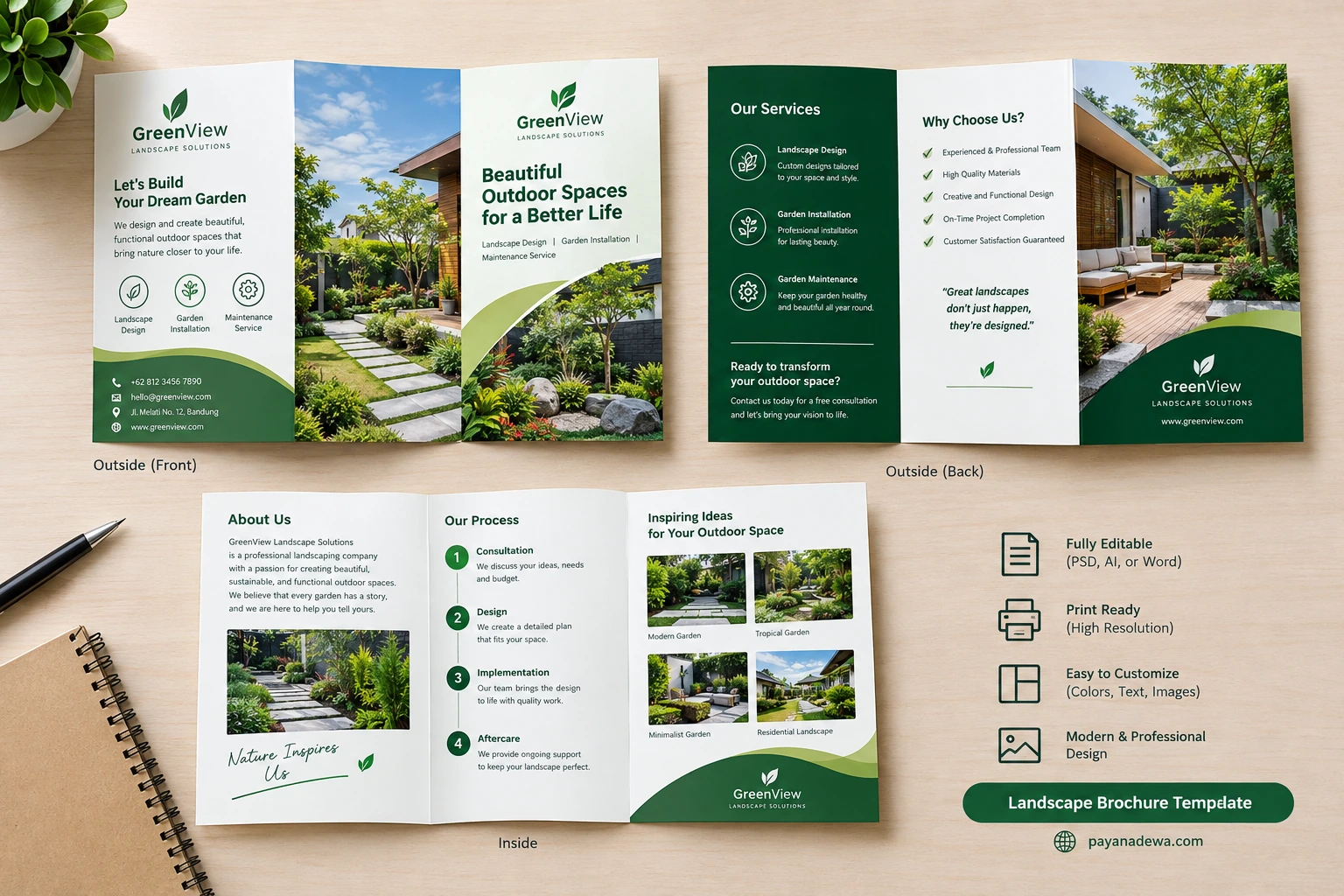
Tri-Fold Landscape Brochure
A tri-fold layout divides the brochure into multiple panels. This makes it easy to create a logical reading sequence.
The front panel can introduce the company and primary message. Interior panels can explain services, projects, benefits, and the working process. The final panel can contain contact information and a call to action.
Portfolio-Focused Layout
A portfolio-style brochure gives photographs a dominant role. This format works particularly well for landscape architects, garden designers, contractors, and creative studios.
Keep written descriptions short and allow completed projects to become the main visual story. Captions can provide useful context without competing with the photographs.
Service-Focused Layout
A service-focused brochure is ideal when the main objective is to generate inquiries. Each major service can have its own section containing a short explanation, supporting image, and customer benefit.
This approach helps readers quickly identify the solution they need and understand why they should contact the business.
Tips for Writing Landscape Brochure Content
Brochure content should be concise, useful, and easy to scan. Readers rarely want to study large blocks of text when reviewing marketing material.
Use short paragraphs and descriptive headings. Put the most important benefit near the beginning of each section.
Focus on Customer Benefits
Instead of only describing what your company does, explain how the service helps the customer. For example, a landscaping business can emphasize improved curb appeal, easier garden maintenance, better outdoor usability, or a more enjoyable living environment.
Benefits make the brochure more persuasive because they connect the service to a real customer need.
Use Clear Calls to Action
Every promotional brochure should give readers a simple next step. A call to action can encourage them to request a consultation, visit a website, call the company, send an email, or ask for a quotation.
Examples include Request a Free Consultation, Explore Our Services, Contact Our Team, and Get a Landscaping Quote.
How to Make a Landscape Brochure Look Professional
Professional design is not necessarily about adding more elements. In many cases, simplicity produces a stronger result.
Leave enough space around text and images so the page can breathe. Avoid overcrowding the layout with too many fonts, colors, icons, or decorative shapes.
Keep Typography Consistent
Choose a primary font for headings and a complementary font for body text if necessary. Limit the number of typefaces so the brochure maintains a unified visual identity.
Make sure the body text is large enough to read comfortably when printed. Contrast between the text and background should also remain strong.
Use White Space Effectively
White space is an important part of professional brochure design. It separates different sections and makes important content easier to identify.
A common mistake is trying to use every available area. A cleaner design with fewer elements can communicate more effectively than a crowded page.
Landscape Brochure Templates for Faster Design
A Landscape Brochure Template can significantly reduce the time required to create marketing material. Instead of designing every element from scratch, users can begin with an organized structure and customize it to match their brand.
A good template should provide editable areas for headings, descriptions, photographs, logos, colors, icons, and contact information. This makes it suitable for businesses that need professional marketing materials without spending excessive time on layout development.
What to Look for in a Template
- Clean and professional layout.
- Easy-to-edit text areas.
- Replaceable image placeholders.
- Well-organized design elements.
- Consistent typography.
- Print-ready dimensions.
- High-resolution graphics.
- Flexible color customization.
Templates are especially useful when a company needs several brochures for different services. The same visual structure can be reused while changing photographs, descriptions, colors, and service information.
Preparing a Landscape Brochure for Printing
Digital design and professional printing require careful preparation. A brochure that looks excellent on a computer screen can produce unexpected results if the file is not prepared correctly.
Use high-resolution images and appropriate print dimensions. If the printer requires bleed, extend backgrounds and images beyond the final trim area according to the printer’s specifications.
Check Before Exporting
- Proofread all text and contact information.
- Check image resolution.
- Confirm the document dimensions.
- Check margins and safe areas.
- Review colors and contrast.
- Confirm that logos are correctly positioned.
- Inspect every panel before printing.
Always review a proof copy before ordering a large quantity. A physical sample can reveal spacing, readability, and color issues that may not be obvious on screen.
Using a Landscape Brochure for Digital Marketing
A brochure does not have to be limited to physical printing. A properly designed document can also be exported for websites, email campaigns, social media, presentations, and online catalogs.
For digital distribution, optimize the file size while maintaining sufficient image quality. Make sure important contact information remains readable on smaller screens.
You can also convert individual brochure sections into social media graphics. A service panel, project photograph, or customer benefit can become a standalone promotional post.
Common Landscape Brochure Design Mistakes
Even attractive brochures can lose effectiveness when the design focuses too heavily on appearance and not enough on communication.
Too Much Information
Trying to include every detail can make a brochure difficult to read. Select the information that is most useful to your target audience and provide additional details through your website or sales team.
Low-Quality Images
Blurry or poorly cropped photographs can reduce trust in the business. Since landscaping is highly visual, professional imagery should be treated as an important investment.
Weak Contact Information
A beautiful brochure is ineffective if readers cannot determine how to contact the business. Make your phone number, email address, website, social media details, or QR code easy to locate.
Inconsistent Branding
Fonts, colors, logos, and visual elements should work together. Consistent branding helps readers recognize the company and makes marketing materials feel more established.
Final Thoughts on Landscape Brochure Design
A well-planned Landscape Brochure combines strong photography, clear messaging, consistent branding, and an organized layout. The horizontal format is particularly effective for landscaping businesses because it provides generous space for wide project photographs and visual storytelling.
Whether you are creating a printed brochure for local customers or a digital brochure for online marketing, focus on clarity and usefulness first. Present your strongest services, show examples of your work, communicate customer benefits, and make the next step easy.
Using a professional Landscape Brochure Template can make the design process faster while providing a reliable structure for your content. With the right images, typography, colors, and call to action, your brochure can become an effective extension of your brand and a valuable tool for attracting new customers.