Human resources plays a central role in building healthy, productive, and sustainable workplaces. From recruiting new talent to developing employees and maintaining workplace culture, HR professionals manage many responsibilities that directly influence organizational success. A well-designed HR Professional Infographic Poster can make these responsibilities easier to understand by presenting important HR concepts in a clear and visual format.
Unlike long documents filled with technical information, an infographic poster can communicate key HR responsibilities, processes, skills, and outcomes at a glance. This makes it useful for offices, HR departments, training sessions, employee orientation programs, educational environments, and professional presentations.
A useful HR infographic should do more than look attractive. It should organize information logically, use readable typography, highlight important ideas, and help viewers understand how different HR activities connect. When these elements are combined effectively, an HR poster becomes a practical communication tool rather than simply a decorative workplace graphic.
The modern HR function has also expanded considerably. HR professionals may work with talent acquisition, employee engagement, learning and development, performance management, workplace policies, compliance, employee wellbeing, and organizational culture. A visual summary can bring these areas together and show how they support both employees and business objectives.
This guide explains the important elements of an HR Professional Infographic Poster, how organizations can use one effectively, and what information should be included when creating a professional HR infographic template.
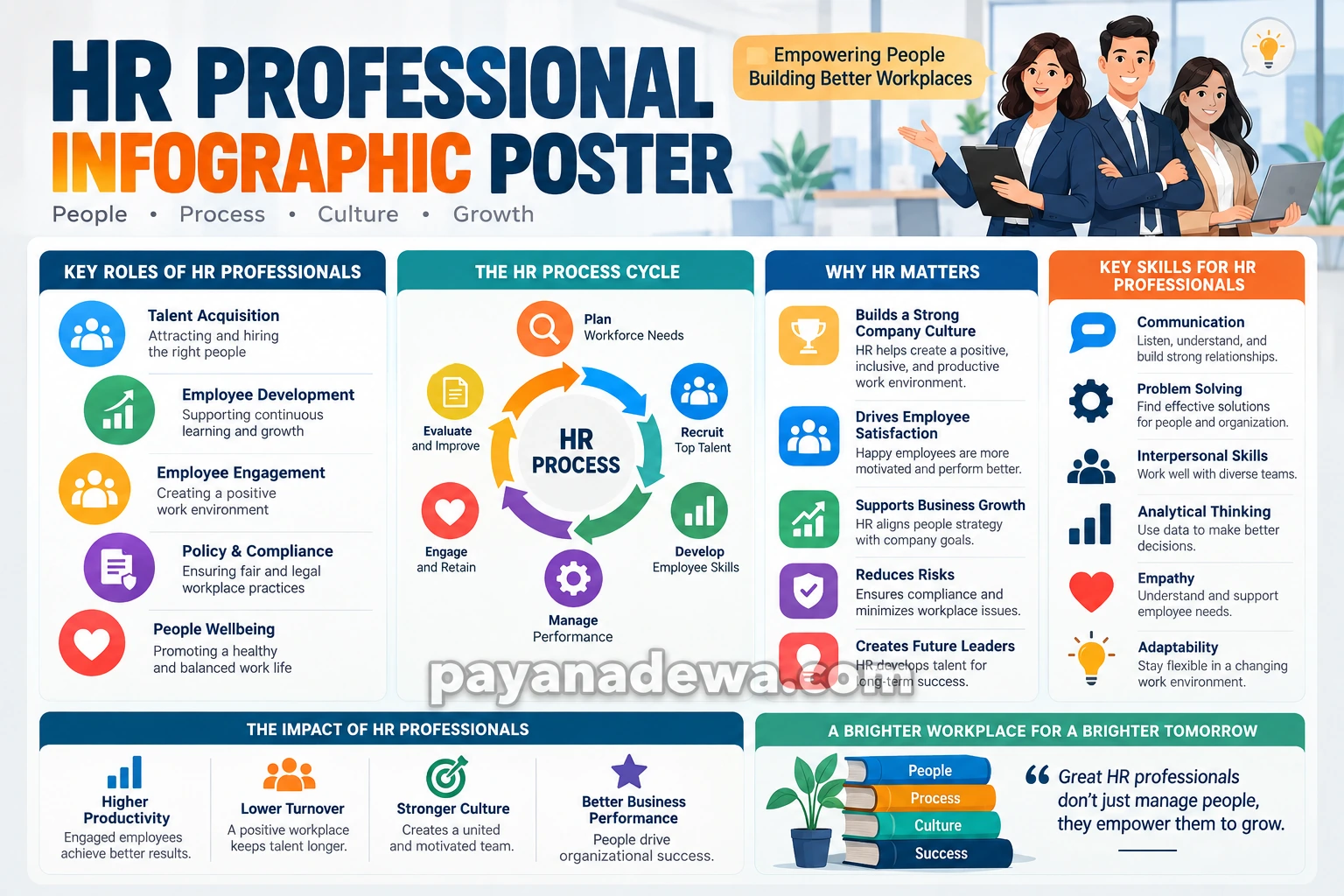
What Is an HR Professional Infographic Poster?
A Visual Overview of Human Resources
An HR Professional Infographic Poster is a visual communication resource designed to summarize important human resources concepts in an easy-to-read format. It can combine short descriptions, icons, charts, diagrams, headings, and structured sections to explain complex HR information without overwhelming the reader.
The format is particularly useful when information needs to be understood quickly. Employees may see the poster in an office, training room, reception area, meeting space, or digital workplace platform. Instead of reading several pages, they can scan the main sections and identify the information that matters to them.
Why Visual Communication Matters in HR
Human resources information can sometimes involve policies, procedures, employee development, recruitment processes, and organizational expectations. Presenting these subjects visually can improve accessibility and make important concepts easier to remember.
A strong infographic also creates a consistent way to communicate HR priorities. For example, a company can use one poster to explain its approach to employee development while another visual focuses on workplace culture or recruitment.
Key Roles of Modern HR Professionals
Talent Acquisition and Recruitment
One of the most recognizable HR responsibilities is attracting and hiring suitable employees. HR professionals help define recruitment requirements, communicate job opportunities, coordinate interviews, and support candidates throughout the hiring process.
An infographic can present the recruitment journey as a simple sequence, such as workforce planning, sourcing candidates, screening, interviewing, selection, onboarding, and follow-up. This gives employees and hiring managers a clear overview of how talent acquisition works.
Employee Development and Engagement
HR responsibilities continue after an employee joins the organization. Training, career development, performance conversations, mentoring, and employee engagement can all contribute to a stronger workplace experience.
A useful HR poster can show these activities as connected parts of an employee development cycle. This helps communicate that professional growth is an ongoing process rather than a single training event.
Policies, Compliance, and Wellbeing
HR teams also help organizations establish workplace policies and promote fair, consistent practices. Depending on the organization, this can include employee guidelines, workplace conduct, documentation, benefits information, and other HR procedures.
Employee wellbeing is another important area. A visual HR resource can encourage healthy workplace practices while reminding employees where they can find support, guidance, or relevant organizational resources.
Essential Sections to Include in an HR Infographic
HR Process Cycle
A process cycle is an effective way to show how HR activities connect. For example, an infographic can illustrate a cycle that begins with workforce planning, continues through recruitment and employee development, moves into performance management and engagement, and ends with evaluation and improvement.
This circular structure emphasizes that HR is an ongoing function. Organizations continuously evaluate their people processes and adjust them as workforce needs change.
Key HR Skills
An effective HR Professional Infographic Poster can also highlight the skills required by HR professionals. These may include communication, interpersonal skills, problem-solving, analytical thinking, empathy, adaptability, organization, and conflict-resolution skills.
- Communication: Sharing information clearly and listening carefully to employees.
- Problem-solving: Identifying workplace challenges and developing practical solutions.
- Interpersonal skills: Building productive relationships with people across different roles.
- Analytical thinking: Using workforce information and data to support informed decisions.
- Empathy: Understanding different employee perspectives and experiences.
- Adaptability: Responding effectively to changing workplace needs.
HR Impact and Business Value
Another valuable section can explain how HR activities contribute to organizational performance. Rather than presenting HR as an administrative function alone, the infographic can connect people-focused activities with outcomes such as employee development, stronger workplace culture, productivity, retention, and organizational capability.
How to Design a Professional HR Infographic Poster
Use a Clear Visual Hierarchy
A professional poster should guide the reader naturally from one section to another. The main title should be prominent, while section headings should clearly separate different HR topics. Short text blocks are generally easier to scan than large paragraphs.
Icons and simple illustrations can reinforce important concepts. For example, a group icon can represent employees, a chart can represent performance, a lightbulb can represent ideas, and a shield can represent policies or compliance.
Choose Readable Typography and Layout
Readability is especially important when an infographic will be printed. Text should remain legible from a reasonable viewing distance, and there should be enough spacing between sections to prevent the design from feeling crowded.
Consistent font sizes, headings, alignment, and spacing can make the poster appear more professional. A limited color palette can also help establish visual consistency while allowing important information to stand out.
Keep Information Concise
An infographic should summarize information rather than reproduce an entire HR manual. Each section should answer a specific question or communicate one central idea.
For example, instead of explaining every detail of employee onboarding, the poster could show five key stages: prepare, welcome, orient, develop, and follow up. Employees who need more information can then be directed to the organization’s detailed HR resources.
Practical Uses for an HR Professional Infographic Poster
Employee Training and Orientation
HR posters can be displayed during onboarding sessions to introduce new employees to the role of HR. A visual guide can explain where employees can go for assistance, how development programs work, and what general HR processes they may encounter.
The same resource can be included in digital onboarding materials. This makes the information available even when employees work remotely or across multiple locations.
Office and Workplace Displays
Printed posters can also be placed in HR offices, training rooms, employee common areas, and meeting spaces. A well-designed poster can reinforce organizational messages without requiring employees to attend a formal presentation.
Presentations and Internal Communication
HR professionals can adapt infographic content for presentations, internal newsletters, intranet pages, or employee communication platforms. Because the information is already organized visually, it can be easier to repurpose for different communication formats.
Tips for Creating an Effective HR Infographic Template
Start With the Audience
Before creating an HR infographic, identify who will use it. An infographic for new employees may focus on onboarding and workplace resources, while an infographic for managers may emphasize recruitment, performance management, employee development, and team leadership.
Understanding the audience helps determine the appropriate level of detail, terminology, visual style, and communication tone.
Organize Information Before Designing
Begin with the content structure rather than immediately choosing colors and graphics. List the most important ideas, group related information together, and remove details that do not support the main purpose of the poster.
Once the information is organized, the visual layout becomes easier to develop. This approach also reduces the risk of creating a visually attractive poster that lacks useful information.
Make the Poster Easy to Update
HR information can change as organizations update policies, programs, training opportunities, and workplace procedures. A reusable HR infographic template should therefore be easy to edit.
Keeping sections modular makes it possible to replace outdated information without redesigning the entire poster. This is particularly useful for HR departments that create recurring employee communication materials.
Benefits of Using an HR Professional Infographic Poster
Faster Information Discovery
Employees can scan a visual poster and quickly identify the information they need. This is particularly helpful when the poster is used to introduce several HR functions at once.
More Consistent Communication
A standardized infographic can help different departments communicate HR concepts using the same terminology and visual structure. Consistency can reduce confusion and make internal communication more recognizable.
Better Engagement With HR Content
Visual content can make workplace information feel more approachable. When an infographic combines concise explanations with relevant icons and diagrams, employees may be more willing to explore the subject than they would be when presented with a long block of text.
Conclusion
Build Clearer HR Communication With Visual Content
An HR Professional Infographic Poster provides a practical way to communicate human resources responsibilities, processes, skills, and organizational impact. By combining concise information with structured visuals, it can help employees understand HR concepts more quickly and remember important ideas.
The most effective HR infographic is not simply attractive. It is organized around a clear purpose, written for a specific audience, and designed so that important information can be understood at a glance. Recruitment, employee development, engagement, workplace policies, wellbeing, and HR skills can all be presented in a logical visual framework.
Whether used for employee onboarding, professional training, office displays, internal presentations, or digital communication, a well-designed HR infographic template can become a reusable communication asset. With clear typography, concise content, consistent visual elements, and an easy-to-follow structure, HR professionals can turn complex people-related information into practical and engaging workplace communication.