A professional doctor letterhead is more than just a decorative document header. It represents a medical professional’s identity, builds trust with patients, and gives official correspondence a consistent and professional appearance. Whether you run a private medical practice, work in a hospital, or operate a healthcare clinic, a well-designed letterhead can make your documents look organized and credible.
Creating a medical letterhead does not have to be complicated. With the right layout, typography, colors, and contact information, you can create a clean design that works for medical certificates, referral letters, patient correspondence, and administrative documents. In this guide, you will discover the essential elements of a doctor letterhead, popular design ideas, practical formatting tips, and ways to create a template that suits your medical practice.
What Is a Doctor Letterhead?
A doctor letterhead is a professionally formatted document header that identifies a physician, medical specialist, healthcare provider, or medical facility. It usually includes the doctor’s name, professional title, clinic information, contact details, and sometimes a medical logo.
Medical professionals use letterheads to make their written communications recognizable and consistent. They also help recipients identify the organization or healthcare provider responsible for a document.
A typical medical letterhead can be used for:
- Patient correspondence and administrative letters.
- Medical referral letters between healthcare providers.
- Professional communication with hospitals and laboratories.
- Clinic announcements and informational documents.
- Business correspondence and healthcare administration.
- Other authorized medical documents.
Although a letterhead creates a professional appearance, it does not automatically make a document medically valid or legally authorized. Official medical documents must still follow applicable professional standards and local regulations.
Essential Elements of a Professional Doctor Letterhead
A good medical letterhead should communicate important information without making the page look crowded. Every element should have a clear purpose and contribute to a consistent visual identity.
1. Doctor’s Name and Professional Title
The doctor’s name should be one of the most noticeable elements. Use a readable font and make the name slightly larger than the supporting information.
Include relevant professional credentials, qualifications, and specialty titles where appropriate. For example, a general practitioner may display a professional title such as General Physician, while a specialist may include their recognized medical specialty.
2. Medical Practice or Clinic Logo
A logo helps patients and professional contacts recognize the medical practice. It can appear in the upper-left corner or alongside the doctor’s name.
Choose a simple medical symbol, such as a healthcare cross or another appropriately licensed clinic logo. Avoid unnecessary decorative graphics that compete with important information.
3. Contact Information
Make it easy for patients and other healthcare professionals to contact the practice. Include relevant details such as:
- Clinic or practice address.
- Official telephone number.
- Professional email address.
- Website address, if available.
- Clinic opening hours, when useful.
Keep contact information accurate and updated. Incorrect details can create confusion and make professional communication difficult.
4. Professional Design and Layout
The overall layout should look clean, balanced, and easy to read. A simple header with a thin divider line and a coordinated footer is often sufficient.
Leave enough blank space for the main letter content. This is especially important when the letterhead will be used for longer medical correspondence.
Popular Doctor Letterhead Design Ideas
There are several ways to design a medical letterhead. The best choice depends on the doctor’s specialty, practice identity, and intended use.
Minimalist Medical Letterhead
A minimalist design uses limited colors, clean typography, and plenty of white space. This approach creates a modern and professional appearance. It is particularly suitable for independent physicians and private medical practices.
Blue and White Doctor Letterhead
Blue and white are popular choices for healthcare stationery. Blue provides a calm visual appearance, while white space keeps the document looking clean.
You can combine dark blue headings with light blue decorative accents. However, keep the contrast strong enough to ensure that all text remains readable when printed.
Modern Clinic Letterhead
A modern clinic letterhead may include a custom logo, subtle geometric shapes, and a structured information layout. It works well for healthcare organizations that want a consistent brand identity across different documents.
Traditional Medical Letterhead
A traditional design usually features formal typography, a centered doctor name, and a simple border. It can be a good option for established medical practices that prefer a classic appearance.
Doctor Letterhead Template: What to Look For
Using a ready-made doctor letterhead template can save time and simplify the design process. Instead of building everything from scratch, you can start with an existing layout and customize it with your own professional information.
When choosing a template, consider the following features:
- Editable layout: Choose a template that allows you to change names, titles, logos, and contact details.
- Print-friendly design: Make sure the layout looks good on standard paper sizes.
- Readable typography: Select fonts that remain clear at normal printing sizes.
- Professional appearance: Avoid excessive colors, decorative elements, and unnecessary graphics.
- Flexible spacing: Ensure there is enough room for the actual letter content.
- High-quality output: Use a suitable resolution and file format for printing.
A template should serve as a starting point rather than a substitute for professional review. Always replace sample information with accurate details and verify that the finished design meets the requirements of your practice.
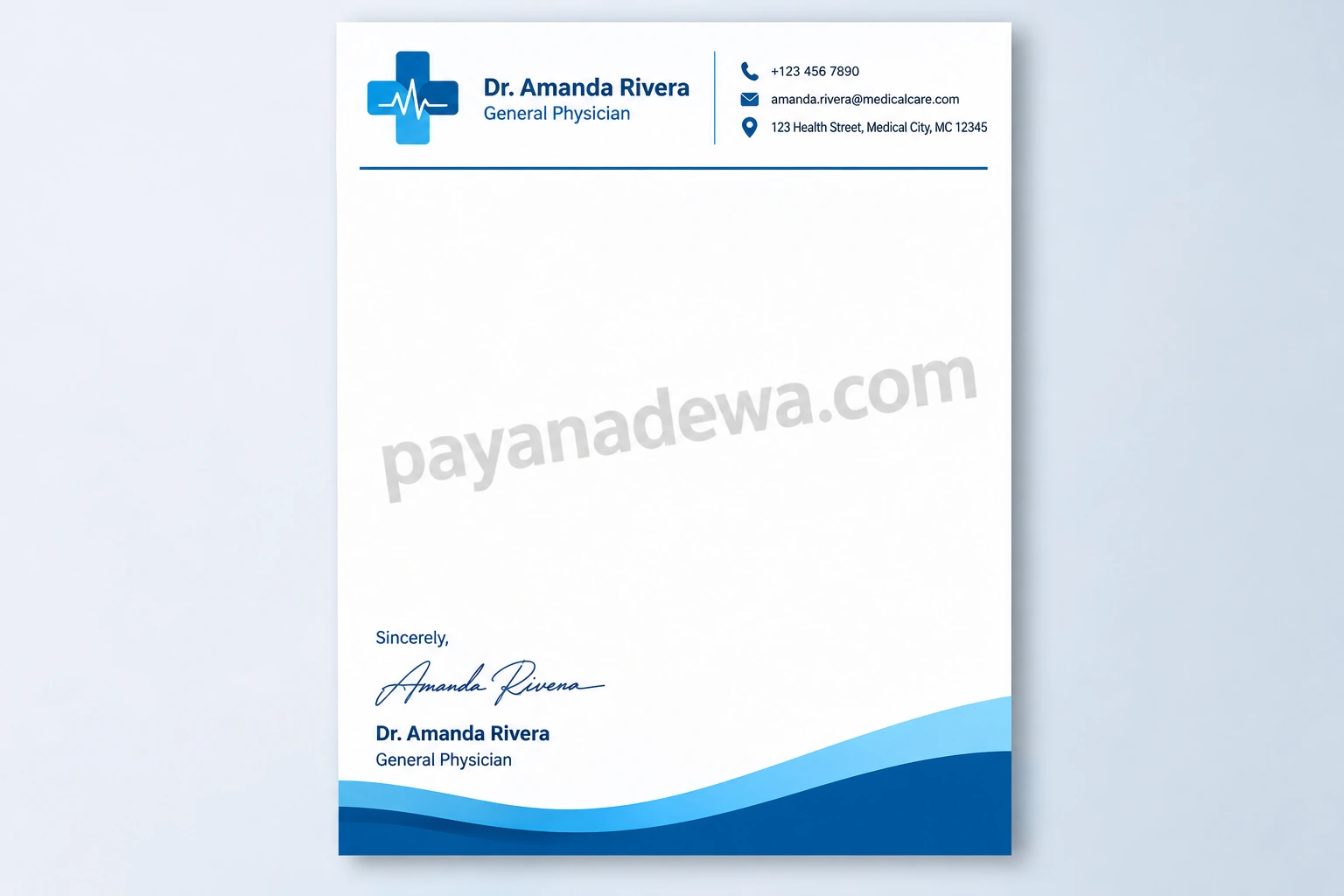
How to Create Your Own Doctor Letterhead
You do not need advanced graphic design skills to create a professional medical letterhead. A word processor or graphic design application can provide everything you need for a simple and effective layout.
Step 1: Choose a Document Size
Start by selecting a standard paper size. A4 is commonly used in many countries, while US Letter is widely used in the United States. Choosing the correct size helps prevent unwanted layout changes during printing.
Step 2: Arrange the Header
Place the doctor’s name, professional title, and logo near the top of the page. Position contact information beside or below the main identity section.
Use consistent spacing and alignment to make the header easy to scan.
Step 3: Select Suitable Colors and Fonts
Choose one primary color and one or two supporting colors. Blue, navy, gray, and white are practical options for medical stationery.
For typography, use professional and readable fonts. Avoid overly decorative scripts for important information. A simple combination of a heading font and a body font is usually enough.
Step 4: Design the Footer
A footer can contain the clinic address, website, additional contact details, or a subtle decorative element. Keep it simple so it does not distract from the main letter.
Step 5: Review and Export
Before using the design, check every detail carefully. Confirm spelling, contact information, credentials, logo quality, and alignment.
Save an editable version for future changes. You can also export a PDF version to preserve the formatting when sharing or printing the document.
Best Practices for Printing Medical Letterheads
A design that looks attractive on a computer screen may not always print correctly. Therefore, test your doctor letterhead before ordering large quantities of stationery.
Follow these practical printing recommendations:
- Use high-resolution logos and graphics to avoid blurry printing.
- Choose paper with a professional appearance and suitable thickness.
- Check the printer margins before finalizing the layout.
- Use colors that remain readable in both color and grayscale printing.
- Print a sample page to check spacing and alignment.
- Keep important information away from the paper edges.
For digital correspondence, PDF is generally a convenient format because it helps preserve the document layout across devices. For physical stationery, ask your printing provider about suitable paper and color settings.
Common Mistakes to Avoid When Designing a Doctor Letterhead
Even a simple medical document can look unprofessional if the layout is poorly organized. Fortunately, most design problems are easy to prevent.
Here are some common mistakes to avoid:
- Too much information: Include only relevant professional and contact details.
- Inconsistent fonts: Limit the number of font styles to maintain a cohesive appearance.
- Low-quality logos: Use clear, high-resolution graphics.
- Excessive decoration: Keep borders, icons, and background elements subtle.
- Incorrect contact details: Verify all information before printing or distributing documents.
- Insufficient writing space: Do not let the header or footer take up too much of the page.
Another important consideration is authenticity. Only authorized medical professionals and healthcare organizations should use their own official letterheads for professional correspondence. Never use another practitioner’s identity, credentials, or branding without permission.
Digital Doctor Letterhead vs Printed Letterhead
Both digital and printed medical letterheads have practical advantages. The right option depends on how the document will be distributed and used.
Digital Letterhead
A digital letterhead is useful for electronic correspondence and document management. It can be incorporated into editable documents or exported as a PDF.
Its main advantages include:
- Easy editing and updating.
- Convenient electronic distribution.
- Reduced printing costs.
- Consistent formatting across digital documents.
Printed Letterhead
Printed letterheads are useful for physical correspondence, office administration, and documents that need to be presented on paper.
They provide a tangible and consistent stationery format. However, printed supplies should be updated whenever contact details, branding, or professional information changes.
For many practices, maintaining both digital and printed versions is a practical solution.
Conclusion
A professional doctor letterhead helps establish a consistent identity for medical practices and makes official correspondence easier to recognize. By including the doctor’s name, professional title, clinic logo, and accurate contact information, you can create stationery that looks organized and trustworthy.
Whether you choose a minimalist layout, a modern blue and white design, or a traditional medical format, focus on readability, simplicity, and accuracy. A well-designed doctor letterhead template can save time while helping your medical practice maintain a professional appearance across printed and digital documents.
Start with a suitable template, customize it with authorized information, and review the final design before using it in your professional correspondence.