A well-designed Consultant Brochure can do much more than list your services. It can introduce your expertise, communicate your value, build trust, and give potential clients a clear reason to contact your consulting business. Whether you work in business strategy, management, finance, marketing, human resources, technology, or another professional field, the right brochure can become an effective marketing and sales tool.
A professional consulting brochure should combine persuasive messaging with a clean visual structure. It needs to explain what you do, who you help, what makes your approach different, and how prospective clients can take the next step. When designed correctly, a brochure can support client presentations, networking events, sales meetings, email campaigns, and printed marketing materials.
This guide explains what a consultant brochure should contain, how to structure one effectively, and practical tips for creating a professional brochure that communicates expertise without overwhelming the reader.
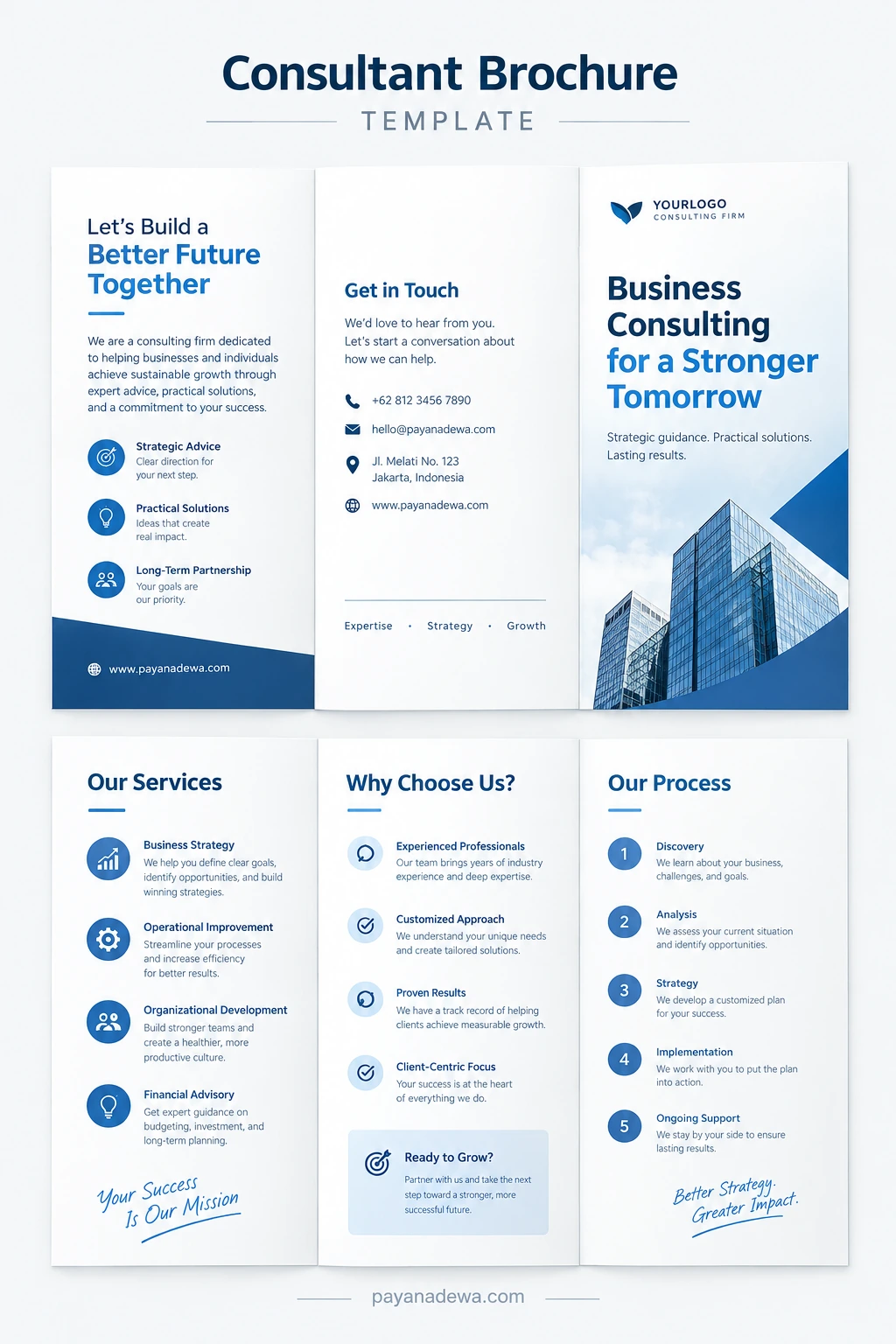
What Is a Consultant Brochure?
A consultant brochure is a marketing document used by an individual consultant or consulting firm to present professional services, expertise, solutions, and business information to potential clients. It may be created as a printed brochure, digital PDF, downloadable document, or presentation-ready marketing asset.
Unlike a simple business flyer, a consulting brochure usually provides more context. It gives readers enough information to understand the consultant’s capabilities while maintaining a professional and visually appealing presentation.
A strong brochure can answer several important questions quickly:
- What does the consultant or firm specialize in?
- Who are the ideal clients?
- What problems can the consultant solve?
- What services are available?
- What makes the consulting approach different?
- How can a potential client get in touch?
Why a Professional Consultant Brochure Matters
Consulting is a trust-based business. Prospective clients are often evaluating expertise before they are willing to discuss a project, share business challenges, or invest in professional advice. A thoughtfully created brochure can help establish credibility before the first meeting takes place.
Builds Professional Credibility
A polished brochure signals that your consulting practice takes communication and presentation seriously. Consistent branding, clear copy, professional typography, and an organized layout can make a strong first impression.
Explains Complex Services Clearly
Consulting services can be difficult to explain in a short conversation. A brochure gives you space to organize complicated offerings into understandable categories, making it easier for prospects to see how your expertise relates to their needs.
Supports Sales Conversations
A brochure can act as a useful reference during consultations, meetings, conferences, and networking events. Instead of relying entirely on verbal explanations, you can provide prospects with a concise overview they can review later.
Strengthens Brand Recognition
Your brochure can reinforce your consulting brand through consistent colors, typography, imagery, messaging, logo placement, and contact information. Repeated visual elements make your business easier to recognize across different marketing channels.
What to Include in a Consultant Brochure
The best brochure content depends on your industry and audience, but most effective consulting brochures contain several core sections.
1. A Strong Cover
The cover is the first thing readers see, so it should immediately communicate your consulting identity. Include your business name or logo, a concise headline, and a short value proposition.
Instead of using a generic statement such as “Professional Consulting Services,” consider a benefit-focused message that communicates the result you help clients achieve.
2. Company or Consultant Introduction
Use a short introduction to explain who you are and what your consulting practice does. Focus on relevance rather than writing a long biography.
For example, explain the industries you serve, the types of organizations you support, and the business challenges you typically address.
3. Consulting Services
Present your services in clearly defined categories. Depending on your specialization, these could include:
- Business strategy consulting
- Management consulting
- Financial advisory
- Marketing consulting
- Organizational development
- Operational improvement
- Technology consulting
- Human resources consulting
- Digital transformation consulting
Each service should have a short explanation that emphasizes client outcomes rather than simply describing internal processes.
4. Benefits and Differentiators
Tell readers why they should choose your consulting services. Your differentiators might include industry experience, a specialized methodology, customized strategies, measurable outcomes, or a client-centered approach.
Keep these statements specific and credible. Avoid exaggerated claims that cannot be supported.
5. Consulting Process
Showing your process can make your services feel more tangible. A simple five-step structure could include discovery, analysis, strategy, implementation, and ongoing support.
Explaining the process also helps potential clients understand what working with you may look like from the initial conversation through project completion.
6. Contact Information
Make contacting you easy. Include the information prospects need to take action, such as your website, email address, telephone number, social media profile, or business address where appropriate.
A clear call to action can be especially effective. Examples include “Schedule a Consultation,” “Discuss Your Project,” or “Get in Touch Today.”
How to Design an Effective Consultant Brochure
Good brochure design is not simply about making the document attractive. The visual structure should help readers understand the information quickly and move naturally toward the desired action.
Use a Clean Layout
A clean layout gives important information enough space to breathe. Avoid filling every section with text. Use headings, short paragraphs, icons, lists, and visual separation to create an easy reading experience.
Choose Professional Typography
Use one or two complementary typefaces and maintain consistent font sizes throughout the document. Headings should be easy to identify, while body text should remain comfortable to read in both print and digital formats.
Use a Consistent Color Palette
Professional consulting materials often benefit from a restrained color palette. Choose colors that match your brand and use accent colors strategically for headings, icons, buttons, or important calls to action.
Use Relevant Imagery
Images should support your message rather than simply fill empty space. Business environments, professional teams, abstract strategy imagery, architecture, technology, or industry-specific visuals can help reinforce the positioning of a consulting brand.
Tips for Writing Better Consultant Brochure Copy
The wording inside your brochure can be just as important as the design. Strong copy should be concise, specific, and focused on the client’s perspective.
- Lead with client needs: Explain the problems and goals your consulting services address.
- Focus on outcomes: Describe the value clients can gain rather than only listing activities.
- Keep paragraphs short: Short blocks of text improve readability, especially in brochure layouts.
- Use action-oriented language: Encourage readers to explore your services or start a conversation.
- Avoid unnecessary jargon: Use industry terminology only when it helps your target audience.
- Support claims: Where appropriate, use relevant credentials, experience, case studies, or measurable results.
Digital vs. Printed Consultant Brochures
A consultant brochure can be created for both print and digital use. Each format has different considerations.
Printed Brochures
Printed brochures are useful for conferences, client meetings, networking events, trade shows, and office presentations. Pay attention to paper quality, print resolution, margins, and the physical folding structure.
Digital Brochures
Digital brochures are commonly distributed as PDF files through websites, email, social media, and messaging platforms. A digital version should be optimized for screen viewing and should make important links and contact details easy to access.
For many consulting businesses, creating one flexible brochure design that works in both print and digital environments provides the best long-term value.
Common Consultant Brochure Mistakes to Avoid
Even a visually attractive brochure can become ineffective if it contains too much information or lacks a clear purpose.
- Too much text: A brochure should summarize key information rather than reproduce an entire website.
- Weak headlines: Generic headings can make the brochure feel interchangeable with competitors.
- Unclear positioning: Readers should quickly understand what type of consulting you provide.
- Missing call to action: Always give interested prospects a clear next step.
- Inconsistent branding: Different fonts, colors, or messaging can make the business appear less established.
- Poor contact visibility: Important contact details should never be difficult to find.
- Overdesigned layouts: Too many decorative elements can distract readers from your message.
How to Make Your Consultant Brochure More Persuasive
Once the basic structure is complete, review the brochure from the perspective of a potential client. Ask whether the document communicates value within the first few seconds.
One effective approach is to organize the brochure around a simple progression: problem, expertise, solution, benefit, and action. This creates a logical path for the reader and helps transform a collection of business information into a persuasive marketing tool.
You can also improve the brochure by adding carefully selected proof points. Client testimonials, industry certifications, years of experience, selected achievements, case study highlights, or measurable project outcomes can help strengthen credibility when they are genuine and relevant.
Final Checklist for a Consultant Brochure
Before publishing or printing your brochure, review the following checklist:
- Your consulting specialization is immediately clear.
- The target audience can identify how your services help them.
- Your main services are organized into easy-to-understand sections.
- Your value proposition is specific and compelling.
- The design uses consistent branding.
- The text is concise and easy to scan.
- Important credentials or proof points are included where relevant.
- Your contact information is accurate and easy to find.
- A clear call to action is included.
- The brochure has been proofread on both desktop and mobile screens.
Conclusion
A well-planned Consultant Brochure can become a powerful extension of your consulting brand. It provides potential clients with a clear overview of your expertise, services, approach, and value while giving them an easy path toward starting a conversation.
The most effective brochure is not necessarily the one with the most information. It is the one that communicates the right information clearly, professionally, and at the right moment. By combining concise copy, strong positioning, consistent branding, useful service descriptions, and a compelling call to action, you can create a consulting brochure that supports both credibility and business growth.