A well-designed Company Brochure is more than a collection of company information. It is a powerful marketing tool that introduces your brand, explains what you offer, and gives potential customers a reason to trust your business. When designed correctly, a brochure can communicate your values and services within just a few minutes.
Whether you run a startup, established company, creative agency, consulting firm, construction business, or professional service provider, a company brochure can help present your business in a clear and memorable way. It can be shared digitally, printed for meetings, displayed at events, or included in sales presentations.
The key is to combine strong content with an organized layout. A professional brochure should look attractive while making important information easy to find. This guide explains what a company brochure should contain, how to structure one, and how to create a design that supports your marketing goals.
What Is a Company Brochure?
A company brochure is a marketing document that provides an overview of a business, its products or services, values, achievements, and contact information. It is commonly used to introduce a company to prospective customers, partners, investors, or clients.
Unlike a simple flyer, a professional company brochure usually provides more detailed information. It can tell your brand story while also highlighting the specific benefits customers can expect from working with your company.
A brochure may be produced in several formats, including:
- Tri-fold brochures
- Bi-fold brochures
- Corporate presentation brochures
- Company profile brochures
- Service brochures
- Product brochures
- Digital PDF brochures
- Event and trade show brochures
The best format depends on your audience, content volume, distribution method, and branding requirements.
Why Does a Professional Company Brochure Matter?
First impressions can strongly influence how people perceive a business. A polished brochure can make your company appear organized, reliable, and professional before a sales conversation even begins.
A strong brochure also gives your audience something tangible or shareable. Instead of explaining every detail verbally, your sales team can provide a document that summarizes your business and services in a structured format.
Some important benefits include:
- Builds credibility: Professional design can reinforce confidence in your business.
- Explains your services: Customers can quickly understand what you offer.
- Strengthens branding: Consistent colors, typography, images, and messaging create a recognizable identity.
- Supports sales: Sales teams can use brochures during meetings, presentations, and follow-ups.
- Improves communication: Important information can be presented in a concise and organized way.
- Works across multiple channels: A brochure can be printed or converted into a digital document.
Essential Elements of a Company Brochure
A company brochure should not simply contain as much information as possible. Every section should have a purpose. The reader should be able to understand your company and its main advantages without feeling overwhelmed.
1. Company Introduction
Begin with a concise introduction that explains who you are and what your company does. Focus on the information that matters most to your target audience.
For example, instead of using a long corporate history, explain your expertise, market focus, and the type of value you provide to customers.
2. Company Mission and Values
Your mission and values help humanize your brand. They can also explain why customers should choose your company instead of another provider.
Keep this section concise. Highlight a few meaningful principles such as innovation, integrity, customer focus, sustainability, quality, or teamwork.
3. Products or Services
This is often the most important section of a company brochure. Clearly explain your main products or services and focus on customer benefits.
Use short descriptions, icons, supporting images, or simple visual sections. Avoid large blocks of technical information unless your audience specifically needs it.
4. Competitive Advantages
Tell readers what makes your company different. Your competitive advantages might include years of experience, specialized expertise, fast delivery, customized solutions, advanced technology, or exceptional customer support.
Use specific statements whenever possible. Clear evidence is more persuasive than vague claims.
5. Contact Information
Make it easy for readers to take the next step. Include relevant contact details such as your website, email address, phone number, office address, and social media channels when appropriate.
A strong call to action can also encourage readers to contact your team, request a quotation, schedule a consultation, or visit your website.
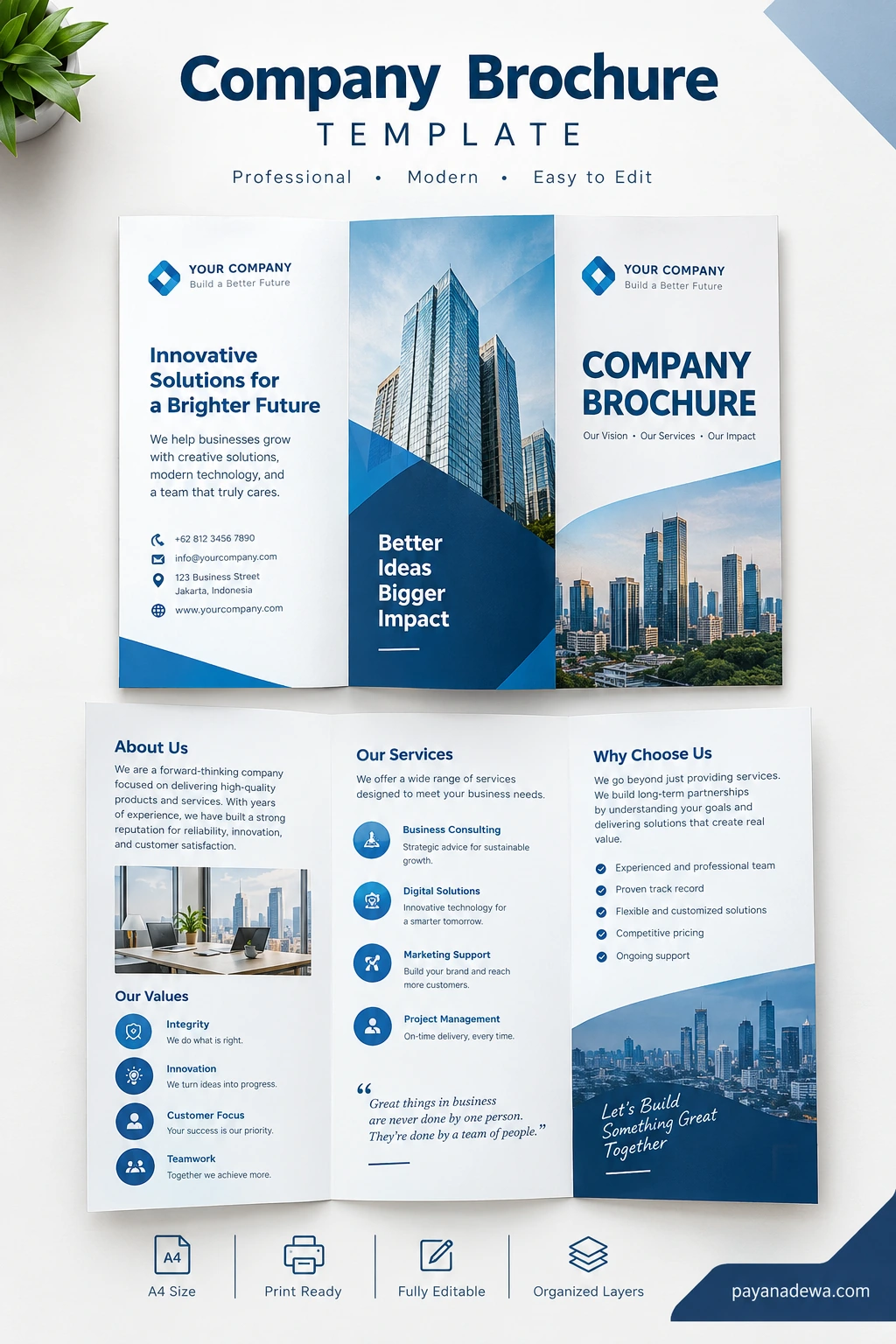
How to Design an Effective Company Brochure
Good brochure design starts with clarity. Your design should support the message instead of competing with it. A professional layout uses visual hierarchy to guide readers from the most important information to supporting details.
Choose a Consistent Brand Style
Use your existing brand colors, fonts, logo, and visual identity whenever possible. Consistency makes the brochure feel like a natural part of your overall marketing strategy.
If your business does not yet have an established visual identity, choose a simple color palette and a readable font combination. Two or three primary colors are often enough for a professional corporate design.
Use High-Quality Images
Images can communicate ideas faster than paragraphs of text. Use photographs that are relevant to your company, products, services, team, or industry.
Avoid using random stock images simply to fill empty space. Every visual element should support the message and create a consistent impression.
Create Strong Visual Hierarchy
Readers should immediately recognize the most important information. Use different font sizes, headings, spacing, icons, and image placement to establish hierarchy.
For example, the company name and main message can receive the strongest visual emphasis. Services and benefits can follow, while supporting information can use smaller text.
Keep the Layout Clean
White space is an important part of professional design. It gives the content room to breathe and makes the brochure easier to scan.
Do not fill every available space with text or graphics. A clean layout often communicates professionalism more effectively than a crowded design.
Tips for Writing Better Company Brochure Content
Design alone cannot make a brochure effective. The written content must also be clear, useful, and persuasive.
- Write for your audience: Focus on the needs and problems of your target customers.
- Use simple language: Avoid unnecessary jargon and complicated sentences.
- Focus on benefits: Explain how your products or services help customers.
- Use short paragraphs: Smaller blocks of text are easier to read.
- Add meaningful headings: Clear headings help readers find information quickly.
- Include a call to action: Tell readers what they should do next.
- Proofread carefully: Spelling and grammar mistakes can damage your professional image.
Print Brochure vs. Digital Company Brochure
Today, businesses often use both printed and digital brochures. Each format has its own advantages.
Printed Brochures
A printed brochure is useful for conferences, business meetings, exhibitions, retail locations, sales presentations, and networking events. Physical materials can also create a stronger personal connection during face-to-face interactions.
For print, pay attention to paper quality, resolution, color settings, margins, and bleed requirements. Always review a proof before ordering a large quantity.
Digital Brochures
A digital brochure is usually distributed as a PDF or another shareable document. It can be emailed to prospects, uploaded to a website, shared through messaging platforms, or included in online presentations.
Digital brochures should be easy to read on different screen sizes. Compress large images when necessary, but maintain sufficient quality for a professional appearance.
Common Company Brochure Mistakes to Avoid
Even a visually attractive brochure can become ineffective if it contains too much information or lacks a clear purpose.
- Too much text: Large paragraphs can discourage readers from continuing.
- Weak headlines: Generic headings may fail to capture attention.
- Inconsistent branding: Random fonts and colors can make the document look unprofessional.
- Poor-quality images: Blurry or irrelevant images can reduce perceived quality.
- Missing contact details: Readers should never have to search for a way to reach you.
- No clear call to action: A brochure should guide readers toward the next step.
- Crowded design: Too many elements can make important information difficult to find.
How to Make Your Company Brochure More Effective
Before publishing your brochure, review it from the perspective of a potential customer. Ask whether the main message is obvious within the first few seconds.
Next, check whether the services are clearly explained and whether the benefits are easy to understand. Make sure the contact information is accurate and the call to action is visible.
It is also useful to test the brochure with someone who is unfamiliar with your company. Ask them what they think your business does after looking at the brochure. Their answer can reveal whether your message is clear enough.
Finally, make sure your brochure works across the channels where you plan to use it. A print-focused layout may need adjustments before being converted into a digital PDF.
What Makes a Company Brochure Professional?
A professional company brochure combines several elements into one consistent experience. It should have a clear message, attractive visual design, useful information, strong branding, and an easy-to-follow structure.
Most importantly, the brochure should be designed around the reader. Instead of focusing only on what your company wants to say, explain why the information matters to your customers.
A successful brochure answers important questions quickly: Who are you? What do you offer? Who do you serve? Why should customers choose you? How can they contact you?
Conclusion
A well-planned Company Brochure can become a valuable part of your business marketing strategy. It gives potential customers a clear introduction to your brand, services, values, and competitive advantages while creating a professional first impression.
The most effective brochures are not simply beautiful documents. They combine purposeful content, strong visual hierarchy, consistent branding, useful imagery, and a clear call to action.
Whether you need a printed corporate brochure, a company profile, a service presentation, or a digital PDF, start with your audience and your marketing objective. Keep the message clear, make the design easy to scan, and provide readers with a simple next step. With the right approach, your company brochure can help build credibility, strengthen your brand, and support long-term business growth.