Starting a boutique can turn a passion for fashion into a rewarding business, but a great eye for style is only one part of the process. A clear boutique plan helps you define your target audience, choose the right products, manage startup costs, and build a brand customers remember. Whether you are opening a physical clothing shop, launching an online boutique, or combining both, planning gives you a practical roadmap from your first idea to your launch and beyond.
This guide explains how to create a boutique business plan that supports everyday decisions. You will learn how to develop your concept, research your market, estimate expenses, plan your inventory, and prepare a realistic launch strategy.
What Is a Boutique Plan?
A boutique plan is a written outline of your business concept, target customers, product range, marketing strategy, operating procedures, and financial goals. It helps you determine whether your idea is commercially realistic before investing significant money. It can also help you communicate your vision to lenders, business partners, suppliers, or potential investors.
Your plan does not need to be complicated. A concise document supported by research and measurable goals is often more useful than a lengthy report filled with assumptions. The important thing is to create a practical guide that you can update as your business develops.
1. Define Your Boutique Concept and Niche
Begin by describing what your boutique will sell and why customers should choose it. A focused concept makes it easier to select inventory, set prices, design your store, and communicate your brand identity.
Choose Your Product Focus
You might specialize in women’s everyday fashion, occasion wear, modest clothing, sustainable apparel, accessories, handmade products, or curated vintage pieces. Although you can expand your selection later, starting with a clear niche helps customers understand what makes your boutique distinctive.
Identify Your Unique Selling Proposition
Your unique selling proposition (USP) is the benefit that differentiates your boutique from competitors. It could be personalized styling, inclusive sizing, locally made products, carefully curated collections, affordable premium basics, or exceptional customer service.
- Describe your boutique in one or two sentences.
- Identify three qualities that distinguish your business.
- Choose a brand name and visual identity that appeal to your audience.
- Check business name, domain, and social media handle availability before investing in branding.
2. Research Your Target Market and Competitors
Understanding your customers reduces guesswork. Identify who is most likely to buy from you, what they value, and how they prefer to shop. Consider their location, budget, lifestyle, fashion preferences, and purchasing habits.
Avoid defining your audience as everyone who likes fashion. A more specific customer profile makes it easier to choose products, determine prices, and create effective promotional campaigns.
Validate Demand Before Investing
Research local shopping areas, online marketplaces, fashion communities, and competing boutiques. Read customer reviews to discover what shoppers appreciate and what they believe is missing from the market.
- Compare competitors’ products, price ranges, delivery options, and customer service.
- Look for gaps in product selection instead of copying another business.
- Ask potential customers about their shopping preferences and spending expectations.
- Test demand through a small collection, pop-up shop, or limited online launch.
Record your findings and use them to guide decisions about inventory, pricing, and marketing. Research conducted before launch can help you avoid spending money on products that your target audience does not want.
3. Create a Product and Inventory Plan
Your inventory directly affects customer satisfaction and cash flow. Choose products that match your boutique’s identity, target audience, and price range. Start with a manageable selection rather than spending your entire budget on a large collection of untested items.
Develop a Balanced Product Mix
Organize your inventory into categories such as clothing, footwear, bags, jewelry, and seasonal products. Determine which items will attract new customers, encourage repeat purchases, and increase the average order value.
Consider size availability, color options, seasonality, and changing fashion trends. A balanced product assortment gives customers useful choices while helping you manage stock more effectively.
Choose Reliable Suppliers
Compare suppliers based on product quality, wholesale prices, minimum order quantities, delivery times, shipping fees, and return policies. Request samples when possible, and verify product specifications before placing a large order.
Maintain an inventory record that includes purchase costs, selling prices, stock levels, and sales performance. This information helps you identify popular products, plan reorders, and reduce money tied up in slow-moving inventory.
4. Choose Your Boutique Location and Sales Channels
Decide whether your boutique will operate from a physical store, an online shop, a market stall, or a combination of channels. Each option has different startup costs, operational requirements, and opportunities for reaching customers.
Opening a Physical Boutique
Evaluate foot traffic, visibility, nearby businesses, parking, public transportation, rent, utilities, security, and lease conditions. Visit potential locations at different times to understand customer activity and the surrounding shopping environment.
Before signing a lease, investigate local zoning rules, business registration requirements, signage restrictions, and any permits that may apply. Include renovation costs, fixtures, and deposits in your startup budget.
Launching an Online Boutique
An online boutique can reduce certain location expenses, but it still requires investment in website development, product photography, packaging, payment processing, shipping, returns, and customer support.
Make product descriptions accurate, provide clear photographs, publish transparent shipping and return policies, and test the checkout process on mobile devices. A simple and trustworthy shopping experience can encourage customers to complete purchases.
If you operate both online and offline, maintain consistent pricing, product availability, and customer service wherever practical.
5. Develop a Realistic Boutique Financial Plan
A strong boutique business plan includes startup expenses, recurring operating costs, sales forecasts, and an emergency cash reserve. Estimate expenses using actual supplier quotes and local rental prices whenever possible. Include a contingency allowance for unexpected costs.
Calculate Your Startup Costs
- Initial inventory and supplier shipping fees.
- Rental deposits, renovations, furniture, and store fixtures.
- Website development, domain registration, and point-of-sale systems.
- Brand design, packaging, photography, and launch marketing.
- Business registration, permits, insurance, and professional services.
- Staff wages, utilities, delivery materials, and working capital.
Separate one-time expenses from recurring costs. This distinction helps you understand how much money you need before opening and how much revenue your boutique must generate to remain operational.
Set Prices and Calculate Your Break-Even Point
Pricing should account for more than the wholesale cost of a product. Consider freight, packaging, payment processing fees, discounts, returns, overhead, and the profit needed to sustain the business.
Gross profit is the difference between sales revenue and the direct cost of goods sold. Gross margin expresses that profit as a percentage of sales revenue. Monitoring both figures helps you evaluate product profitability and make informed pricing decisions.
To estimate your break-even sales volume, divide your fixed costs for a given period by your contribution per sale. Contribution per sale is the selling price minus variable costs per sale. This calculation provides a useful sales target, although you should update it whenever costs or business conditions change.
6. Create a Boutique Marketing Strategy
Your marketing strategy should communicate your boutique’s personality and give customers a reason to visit or shop online. Choose a few channels that you can maintain consistently instead of trying to promote your business everywhere at once.
Build a Recognizable Brand
Use a consistent business name, logo, color palette, tone of voice, photography style, and packaging. Your brand should reflect the products you sell and the experience customers can expect.
For example, a boutique specializing in sustainable fashion may emphasize quality, durability, and responsible sourcing. A boutique focused on contemporary occasion wear might highlight styling inspiration, product details, and special-event collections.
Promote Your Boutique Launch
- Share behind-the-scenes content about product selection and store preparation.
- Build an email list with permission and send useful updates, new arrivals, and special offers.
- Publish styling ideas, product demonstrations, and customer photos shared with permission.
- Collaborate with relevant local creators or complementary businesses.
- Improve local search visibility by maintaining accurate business information if you have a physical location.
- Encourage customers to leave honest reviews after making a purchase.
Measure results using website traffic, conversion rates, email subscriptions, repeat purchases, average order value, and marketing cost per customer. These metrics provide a clearer picture of performance than social media likes alone.
7. Organize Daily Operations and Customer Service
Reliable operations help turn first-time buyers into loyal customers. Document how you will receive stock, inspect products, update inventory, process orders, manage returns, record payments, and respond to customer questions.
Establish clear service standards for response times, packaging, order accuracy, and problem resolution. Make sure customers can easily find your contact information and understand your policies before purchasing.
You should also plan for bookkeeping, tax obligations, data protection, insurance, and employment requirements that apply in your location. Regulations vary, so confirm the relevant requirements with local authorities or a qualified professional.
Keep business and personal finances separate, maintain accurate records, and review income and expenses regularly. Good financial administration makes it easier to identify problems before they affect your business.
8. Build a Boutique Launch Timeline
A launch timeline turns your business goals into manageable tasks. Adjust the schedule to suit your budget, supplier lead times, location requirements, and website development process.
- Research: Validate your boutique concept, target audience, competitors, and estimated budget.
- Planning: Select suppliers, finalize your product mix, and complete required registrations.
- Setup: Prepare your store or website, payment systems, product photography, and customer policies.
- Pre-launch: Create marketing content, build an audience, and test the shopping experience.
- Launch: Open your sales channels, monitor feedback, and resolve operational problems quickly.
- Review: Compare actual results with your goals and adjust inventory, pricing, and marketing.
Assign a target date to each task and identify which activities depend on others. For example, product photography cannot be completed until your products arrive, while launch promotions should be prepared before your opening date.
9. Use a Boutique Plan Template to Stay Organized
A printable boutique planning template makes it easier to keep important information in one place. Rather than managing separate notes for inventory, marketing, expenses, and deadlines, you can use a structured worksheet to monitor progress.
A useful boutique plan template should include the following sections:
- Business overview: Record your boutique concept, unique selling proposition, target market, and sales location.
- Product plan: List product categories, supplier details, and launch priorities.
- Marketing plan: Outline branding, social media activities, promotions, and customer acquisition strategies.
- Financial plan: Estimate inventory costs, rent, equipment, marketing expenses, staffing, and total startup costs.
- Timeline: Set target dates for research, sourcing, store setup, marketing, and launch.
- Next steps: Create a checklist of tasks that must be completed before opening.
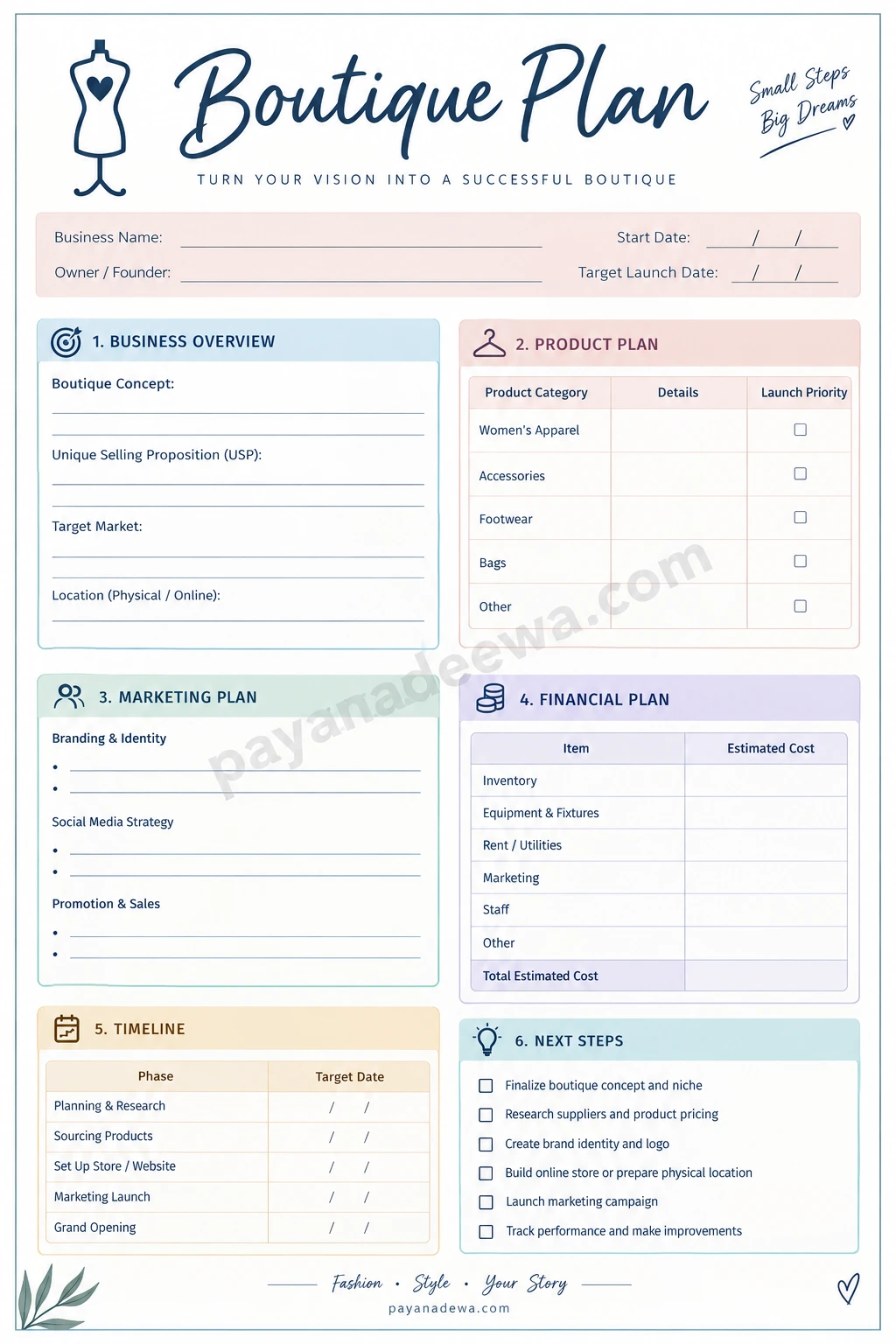
Review your worksheet regularly and update completed tasks, revised expenses, and new priorities. A planning template is most valuable when it reflects the current state of your business rather than an outdated idea of how the launch should proceed.
10. Practical Tips for a Successful Boutique
Even a well-written plan needs consistent execution. The following practices can help you make better decisions during the early stages of your business.
- Start small and test demand: Use customer feedback and sales data before expanding your product range.
- Protect your cash flow: Avoid tying up too much money in inventory that may sell slowly.
- Set measurable goals: Establish targets for revenue, gross margin, repeat purchases, and inventory turnover.
- Monitor product performance: Identify which products sell well and which require a pricing or marketing adjustment.
- Keep your plan updated: Review it monthly during the launch period and quarterly once operations stabilize.
- Prioritize customer trust: Provide accurate product information, transparent pricing, clear policies, and dependable service.
Remember that growth does not always mean adding more products or opening another location. Improving profitability, strengthening customer relationships, and managing inventory more efficiently can also contribute to a healthier boutique business.
Conclusion
A successful boutique begins with a clear concept, a well-defined customer, and a practical plan for products, finances, marketing, and operations. Research your market, validate demand, manage inventory carefully, and establish measurable goals before making major commitments.
Use a boutique plan template to organize your decisions, track your progress, and identify the next steps. As your business grows, review your assumptions and make adjustments based on customer feedback and actual sales data.
Your boutique plan should be a working guide rather than a one-time assignment. With thoughtful preparation, careful financial management, and a consistent shopping experience, you can build a boutique with a stronger foundation for long-term growth.