An assignment is an important part of the learning process. Whether you are a school student, college student, university learner, or professional taking an online course, assignments help you develop knowledge, improve critical thinking, and demonstrate your understanding of a particular subject.
However, completing an assignment is not always easy. You may need to understand complicated instructions, research reliable sources, organize information, and present your ideas clearly. Without proper planning, even a simple task can become stressful.
The good news is that having the right strategy can make a significant difference. With a suitable assignment template, an organized workflow, and effective writing techniques, you can complete your work more efficiently and produce better results.
In this guide, you will discover what an assignment is, the different types of assignments, how to create a well-structured document, and practical tips for completing your work successfully.
What Is an Assignment?
An assignment is a task or piece of work given to someone to complete within a specific period. In education, teachers and lecturers use assignments to evaluate students’ understanding of lessons, research abilities, problem-solving skills, and knowledge of a particular topic.
Assignments can take many forms. Some require students to write essays, while others involve answering questions, preparing presentations, conducting experiments, or completing practical projects.
The main purpose of an academic assignment is to encourage independent learning. It also allows students to explore subjects in greater detail and apply what they have learned in real situations.
A typical assignment includes several important elements:
- Title: The name or subject of the assignment.
- Introduction: A short explanation of the topic and its purpose.
- Main content: The explanations, arguments, research, or answers.
- Conclusion: A summary of the main findings or ideas.
- References: The sources used to prepare the assignment.
Different Types of Assignments
Before starting your work, it is important to understand what type of assignment you need to complete. Each format has different requirements, so identifying the task early will help you plan more effectively.
1. Essay Assignments
An essay assignment requires students to explain an idea, discuss an issue, or present an argument in written form. It usually contains an introduction, several body paragraphs, and a conclusion.
Essay assignments are useful for developing communication, research, and critical thinking skills.
2. Research Assignments
Research assignments involve collecting information from reliable sources and using that information to investigate a particular topic. Students may need to compare different perspectives, analyze evidence, and present their findings.
These assignments often require citations and a reference list to acknowledge the original sources.
3. Project Assignments
A project assignment involves completing a larger task over an extended period. It may include research, planning, teamwork, practical activities, and a final presentation.
Examples include science projects, business plans, design projects, and community research.
4. Presentation Assignments
Presentation assignments require students to communicate information to an audience. They may use slides, charts, photographs, or other visual materials to explain their ideas.
Clear organization and confident communication are important for delivering an effective presentation.
5. Practical Assignments
Practical assignments focus on applying knowledge rather than simply describing it. Examples include laboratory experiments, computer exercises, technical tasks, and creative activities.
They help learners understand how theoretical concepts work in real-world situations.
How to Write an Assignment Step by Step
Writing a successful assignment becomes easier when you divide the process into manageable steps. Instead of trying to complete everything at once, focus on one stage at a time.
Step 1: Understand the Instructions
Start by reading the assignment instructions carefully. Identify the topic, required format, word count, submission method, and deadline.
Pay attention to action words such as explain, compare, analyze, describe, and evaluate. These words indicate what your teacher expects you to do.
Step 2: Choose and Understand Your Topic
If you have the freedom to choose a topic, select something relevant to your course and interesting enough to research. A focused topic is usually easier to manage than a broad subject.
Make sure you understand the main question before collecting information. This will help you avoid including unnecessary details.
Step 3: Conduct Reliable Research
Research provides the information needed to support your ideas. Look for trustworthy academic materials, including textbooks, research papers, educational websites, and official publications.
While researching, take notes and record the details of your sources. This makes it easier to prepare citations and avoid accidental plagiarism.
Step 4: Create an Outline
An outline helps organize your thoughts before you start writing. Divide your assignment into logical sections and decide what information belongs in each part.
A simple outline might include:
- Introduction and background information.
- First main point and supporting evidence.
- Second main point and relevant examples.
- Additional analysis or discussion.
- Conclusion and references.
Step 5: Write the First Draft
Begin writing according to your outline. Focus on explaining your ideas clearly instead of trying to make every sentence perfect immediately.
Use short paragraphs, relevant examples, and clear transitions. Each paragraph should contribute something meaningful to the topic.
Step 6: Edit and Proofread
After completing your first draft, review the entire document. Check spelling, grammar, punctuation, sentence structure, and consistency.
Also verify that you have answered the assignment question and followed all formatting requirements.
Step 7: Submit Your Assignment
Before submission, confirm that your document has the correct file format and filename. Make sure all required sections are included and submit your work through the requested platform before the deadline.
Why Use an Assignment Template?
An assignment template is a pre-designed document that provides an organized structure for completing academic work. Instead of creating a new layout every time, you can use a ready-made format and focus more on the actual content.
A good template can help students maintain consistency, organize information, and avoid forgetting important details.
Here are some advantages of using an assignment template:
- Saves time: You do not need to design the document from scratch.
- Improves organization: Important sections are arranged in a logical order.
- Supports consistency: Your assignments can follow a similar professional layout.
- Reduces mistakes: Useful fields and checklists remind you of essential information.
- Easy to customize: You can adjust the layout to match different subjects and requirements.
Whether you need a school assignment template, college assignment format, or printable homework organizer, a simple document can make the entire process more manageable.
Free Assignment Template for Students
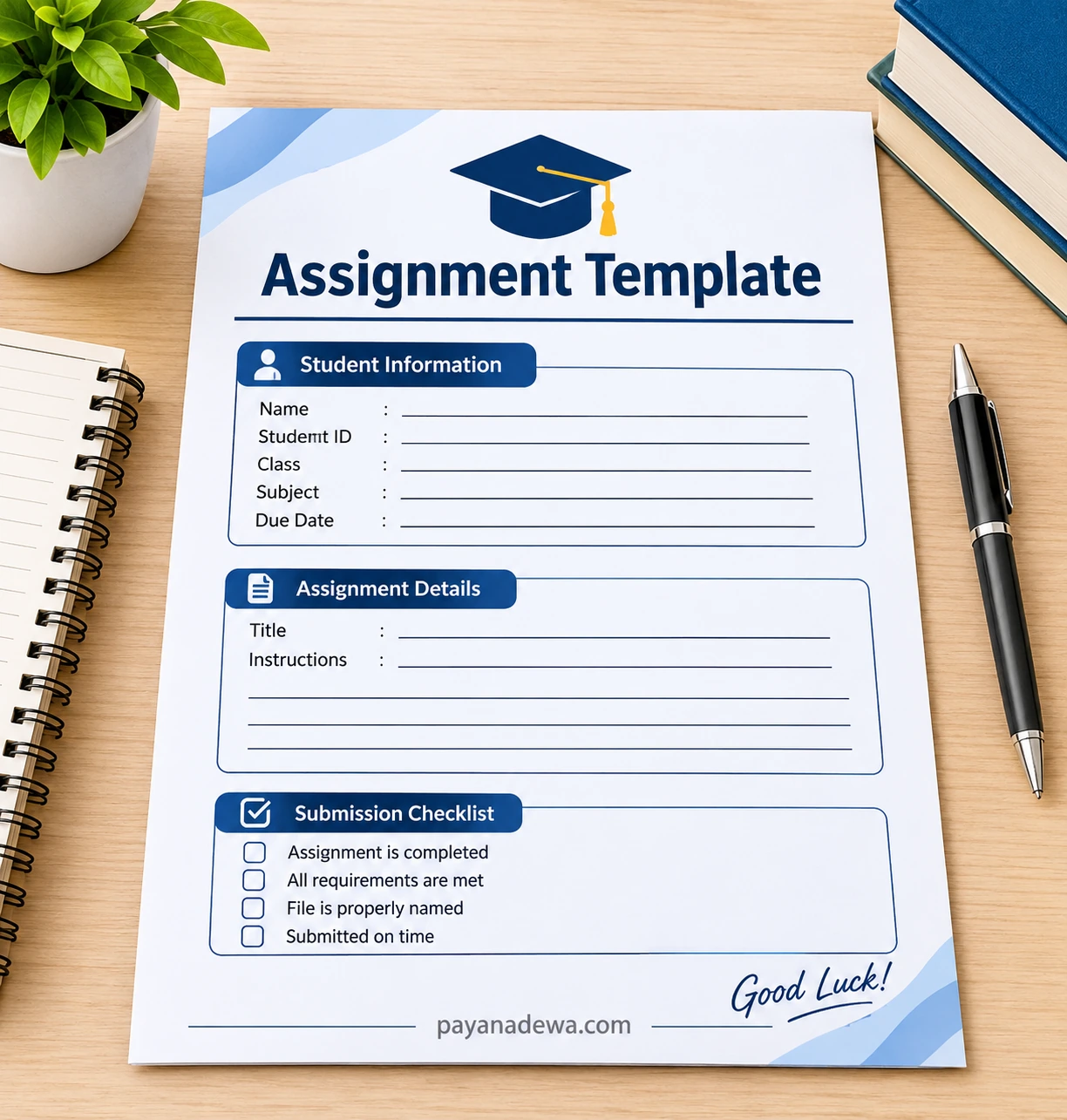
Using a printable assignment template is a convenient way to organize your academic tasks. The example below provides a clean layout for recording student information, assignment details, and submission requirements.
You can use this template for homework, classroom activities, research tasks, and other educational projects. Simply print the document or use it as a reference when creating your own digital assignment sheet.
What Should an Assignment Template Include?
A useful assignment organizer should contain the essential information needed to identify and complete a task.
- Student name and identification number.
- Class, course, or subject name.
- Assignment title and topic.
- Instructions and important requirements.
- Submission deadline.
- A checklist for reviewing completed work.
You can add extra sections depending on the assignment. For example, research projects may need a reference section, while group projects may require space for team members and individual responsibilities.
Practical Tips for Completing Assignments Successfully
Good academic results are not only about writing well. They also depend on time management, preparation, and attention to detail.
Manage Your Time Effectively
Do not wait until the last minute to begin an assignment. Divide larger tasks into smaller activities and give yourself enough time for research, writing, and editing.
A simple schedule can help you stay focused and reduce unnecessary stress.
Use Reliable Sources
Always check the quality of the information you use. Prefer academic publications, official websites, and reputable educational resources over unverified online content.
Write in Your Own Words
Understand the information before explaining it in your assignment. Use your own sentences and provide citations whenever you refer to someone else’s ideas, research, or published work.
Academic integrity is essential. Never present copied material as your original work.
Follow the Required Formatting
Different schools and universities may have different formatting standards. Check whether your instructor requires a particular font, spacing, margin, citation style, or document structure.
Review Your Work Before Submission
Give yourself enough time to check the final document. A careful review can help identify missing information, unclear explanations, and small formatting errors that might affect your result.
Common Assignment Mistakes to Avoid
Even well-prepared students can make mistakes when completing academic tasks. Knowing what to avoid can help you improve the quality of your work.
- Ignoring instructions: Always read the requirements before beginning.
- Starting too late: Poor planning can lead to rushed and incomplete work.
- Using unreliable information: Check the credibility and accuracy of your sources.
- Copying content: Avoid plagiarism and acknowledge original authors.
- Writing without structure: Organize your ideas into clear sections and paragraphs.
- Forgetting proofreading: Review spelling, grammar, and formatting before submitting.
- Missing deadlines: Use a calendar or checklist to monitor important dates.
Conclusion
Completing an assignment successfully requires more than simply writing down information. It involves understanding instructions, conducting research, organizing ideas, presenting clear explanations, and reviewing the final document.
Using an assignment template can make these steps easier by providing a consistent and organized structure. It is a practical solution for students who want to manage homework, school projects, college tasks, and research activities more effectively.
Start with a clear plan, use reliable resources, manage your time wisely, and always check your work before submission. With these simple habits and the right assignment organizer, you can approach every academic task with greater confidence and improve the quality of your results.