A Hold Harmless Agreement is a legal document that explains how certain risks and liabilities will be handled between two or more parties. It can help define who is responsible for specific claims, losses, damages, or expenses.
These agreements are common in business, construction, property use, events, and service arrangements. They can also be used when one party allows another person or organization to participate in a potentially risky activity.
However, a hold harmless agreement is more than a simple form. The wording can affect the rights and responsibilities of everyone involved. Therefore, it is important to understand the main clauses before signing the document.
Fortunately, a well-organized template can make the process easier. It gives you a clear structure for identifying the parties, describing the activity, defining responsibilities, and adding important contract terms.
What Is a Hold Harmless Agreement?
A Hold Harmless Agreement is a contract that assigns responsibility for certain risks. One party agrees to protect another party from specific claims, losses, damages, or liabilities covered by the agreement.
The agreement usually identifies two main parties. The first party may be called the indemnifying party. The second party may be called the indemnified party.
In simple terms, the agreement explains which party will bear responsibility for certain problems. For example, a contractor may agree to handle specific claims connected with its work.
Still, the exact legal effect depends on the contract wording and applicable law. Therefore, parties should avoid assuming that every hold harmless clause provides unlimited protection.
How Does a Hold Harmless Agreement Work?
First, the parties identify the activity or relationship covered by the agreement. Next, they describe the risks and liabilities that one party will assume.
The agreement then sets out the responsibilities of each party. It may also include exclusions, time limits, insurance requirements, and procedures for handling claims.
For example, suppose a company hires a contractor to perform work on its property. The contract could include a hold harmless provision covering certain claims that result from the contractor’s activities.
As a result, both parties have a written record of their agreed responsibilities. This can reduce uncertainty and make the business relationship easier to manage.
Why Is a Hold Harmless Agreement Important?
Risk is part of many business and personal activities. Accidents, property damage, injuries, and third-party claims can create unexpected costs.
A Hold Harmless Agreement helps address those risks before they occur. Instead of leaving responsibility unclear, the parties can define their obligations in advance.
Common purposes include:
- Defining responsibility for specific risks
- Allocating certain liabilities between parties
- Addressing third-party claims
- Clarifying responsibilities during an event
- Managing risks related to property use
- Supporting contractor and service agreements
- Documenting indemnification obligations
Furthermore, these agreements can work alongside other risk-management tools. For example, businesses may also use insurance, safety procedures, licenses, and written operating policies.
When Should You Use a Hold Harmless Agreement?
Construction Projects
Construction projects often involve multiple contractors and subcontractors. Each party may have different responsibilities and risks.
Therefore, a hold harmless clause can help define responsibility for specific claims related to construction work, property access, equipment, or subcontractor activities.
Business Services
Businesses may use hold harmless provisions when working with consultants, suppliers, contractors, and other service providers.
The agreement can explain which party is responsible for specific losses or claims arising from the services. However, the language should match the actual relationship between the parties.
Events and Activities
Event organizers may use these agreements when participants, vendors, volunteers, or contractors take part in an activity with identifiable risks.
Examples include sports events, workshops, private events, recreational activities, and facility rentals.
Property Use
A property owner may require an agreement when another person or organization uses the property for a particular purpose.
The document can address risks involving the activity, property damage, or specified third-party claims.
Key Parts of a Hold Harmless Agreement
A good agreement should be clear and specific. While requirements vary, several sections are commonly useful.
1. Names of the Parties
Start by identifying everyone involved. Use the correct legal names of the individuals or organizations.
Also, include addresses or business details when appropriate. Clear identification helps prevent confusion later.
2. Purpose of the Agreement
Next, explain why the agreement exists. Describe the activity, service, event, property, or transaction involved.
A clear description helps define the scope of the agreement. It also makes the document easier to review.
3. Hold Harmless Clause
This is one of the most important sections. It should explain what claims, damages, losses, costs, or expenses are covered.
The clause should not rely on vague language when specific details are available. Instead, describe the relevant risks as clearly as possible.
4. Indemnification Terms
An indemnification provision may require one party to compensate another for certain covered losses or claims.
Depending on the agreement, it may also address legal costs, defense obligations, or third-party claims.
5. Exceptions and Limitations
Some agreements include specific exceptions. For instance, the parties may exclude certain types of conduct or liabilities from the protection.
These provisions are important because not every liability can necessarily be transferred by contract. Applicable law may also limit certain clauses.
6. Agreement Term
State when the agreement becomes effective. If necessary, include an expiration date.
Some obligations may continue after the agreement ends. If so, the contract should state this clearly.
7. Governing Law
A governing law clause identifies which jurisdiction’s law will be used to interpret the agreement.
This section is especially important when the parties operate in different locations.
8. Signatures
Finally, include signature sections for the parties. Add printed names, titles, and dates when appropriate.
A properly completed signature section helps document that the parties accepted the agreement.
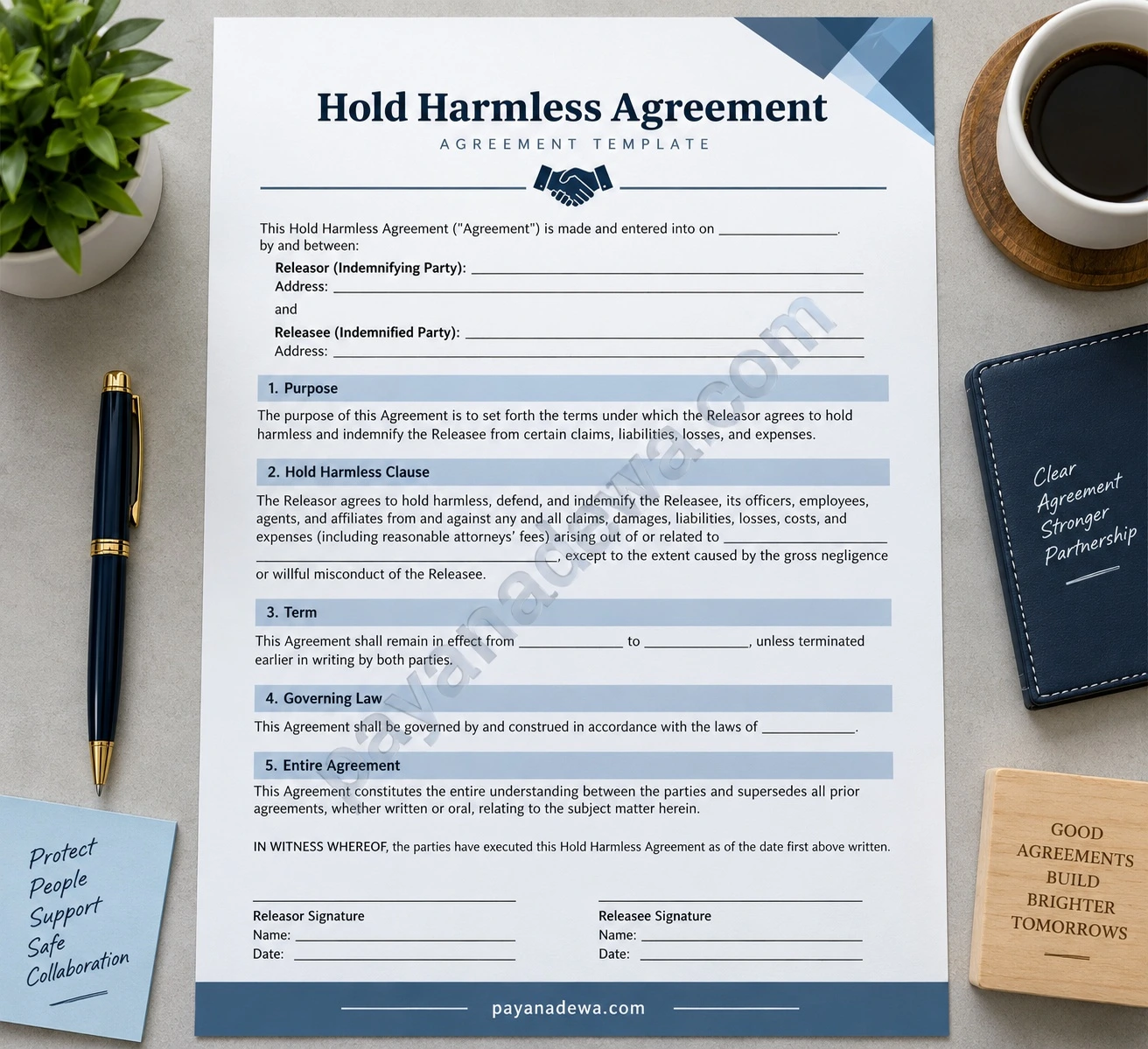
Hold Harmless Agreement Template
A Hold Harmless Agreement Template provides a practical starting point for creating this type of document. Instead of starting with a blank page, you can work from an organized structure.
A typical template may contain sections for:
- Agreement date
- Party information
- Purpose of the agreement
- Covered activity
- Hold harmless provisions
- Indemnification obligations
- Term and termination
- Governing law
- Entire agreement
- Signatures
However, a template should not be treated as a universal legal solution. Every situation can have different risks and legal requirements.
Therefore, review the template carefully. Replace every placeholder with accurate information. Then make sure the language reflects the actual agreement between the parties.
For agreements involving significant financial or legal risks, professional legal advice can provide additional protection.
Hold Harmless vs Indemnification
People often use the terms “hold harmless” and “indemnification” together. However, they can address different contractual concepts.
A hold harmless provision may state that one party will not hold another party responsible for specified claims. An indemnification provision may require one party to compensate another for certain covered losses.
In practice, a contract may contain both provisions. The actual effect depends on the wording and applicable law.
For this reason, do not judge a contract based only on its title. Read the complete provisions and understand what each party is agreeing to do.
Common Mistakes to Avoid
Even a simple agreement can create problems when it is poorly drafted. Fortunately, several common mistakes are easy to identify.
Using Vague Language
Vague wording can make the scope of an agreement unclear. Instead, identify the activity and covered risks as specifically as possible.
Making the Clause Too Broad
An overly broad clause may create legal or practical problems. The parties should consider whether the proposed protection is appropriate for the transaction.
Ignoring Local Laws
Contract laws can vary between jurisdictions. Some liability waivers and indemnification provisions may be restricted or interpreted differently.
Therefore, applicable local law should always be considered before relying on a hold harmless provision.
Forgetting Insurance
A contractual promise is not the same as insurance coverage. Insurance can provide a different type of financial protection.
As a result, parties should review insurance requirements separately when appropriate.
Not Reading the Entire Contract
A hold harmless clause does not always operate by itself. Other provisions can affect its meaning and practical effect.
Therefore, review the entire contract. Pay attention to definitions, limitations of liability, insurance, termination, and dispute-resolution clauses.
How to Create a Hold Harmless Agreement
Creating an agreement becomes easier when you follow a clear process.
Step 1: Identify the Parties
Write down the correct legal names of all parties. Confirm that the information is accurate before continuing.
Step 2: Describe the Activity
Explain the service, event, property use, or transaction covered by the agreement.
Step 3: Identify the Risks
Consider the realistic risks connected with the activity. Think about property damage, injuries, third-party claims, and financial losses.
Step 4: Define Responsibility
Clearly state which party will handle each covered risk. Avoid unnecessary ambiguity.
Step 5: Add Limitations
Include appropriate exclusions, exceptions, or limits where necessary.
Step 6: Review the Agreement
Read the complete document from beginning to end. Check names, dates, obligations, and signatures.
Step 7: Obtain Legal Review When Appropriate
If the agreement involves substantial liability, complex business arrangements, or important legal rights, consider having a qualified attorney review it.
Tips for Using a Hold Harmless Agreement
Before signing the document, take time to review the details. A few simple checks can prevent avoidable mistakes.
- Check the parties: Make sure every name is correct.
- Review the activity: Confirm that the description matches the real situation.
- Read the liability clause: Understand which risks are being transferred.
- Check exclusions: Look for important exceptions and limitations.
- Review insurance: Confirm that insurance requirements are consistent.
- Check the dates: Make sure the effective period is accurate.
- Review governing law: Confirm that the stated jurisdiction is appropriate.
- Keep a copy: Store the signed agreement in a secure location.
Frequently Asked Questions
Is a Hold Harmless Agreement legally binding?
A Hold Harmless Agreement can be legally binding when it meets applicable contract requirements. However, enforceability depends on the wording, circumstances, and applicable law.
Does a Hold Harmless Agreement prevent a lawsuit?
Not necessarily. A contract may affect the rights and responsibilities associated with certain claims. However, it does not automatically prevent someone from filing a lawsuit.
Can a Hold Harmless Agreement cover negligence?
Some agreements address negligence. However, the enforceability of such provisions varies by jurisdiction and by the specific language used.
For that reason, important negligence-related provisions should be reviewed carefully before signing.
Can businesses use a Hold Harmless Agreement?
Yes. Businesses commonly use hold harmless and indemnification provisions in contracts involving contractors, vendors, property use, services, and events.
The specific wording should match the business relationship and applicable legal requirements.
Should a lawyer review a Hold Harmless Agreement?
Legal review can be helpful when the agreement involves significant financial exposure or complex responsibilities.
A qualified attorney can review the document based on the relevant facts, contract terms, and jurisdiction.
Conclusion
A Hold Harmless Agreement can help parties clearly allocate specific risks and responsibilities. It is often used for construction, business services, property use, events, and other activities where liability needs to be addressed.
The key is clarity. Identify the parties, describe the activity, define the covered risks, explain indemnification obligations, and include appropriate limitations.
In addition, review governing law, insurance requirements, contract duration, and signature requirements. Most importantly, do not assume that a generic template will fit every situation.
A well-structured Hold Harmless Agreement Template can save time and provide a useful starting point. However, important agreements should be reviewed carefully before they are signed or relied upon.