A Funding Agreement is an important document that establishes the terms between a person, organization, investor, lender, donor, or other funding provider and the party receiving financial support. Whether the funding is intended for a business, project, nonprofit organization, research initiative, property development, or another purpose, a well-prepared agreement helps both parties understand their responsibilities before money is transferred.
A clear funding contract can reduce misunderstandings by documenting the funding amount, purpose, payment schedule, conditions, reporting requirements, deadlines, and other important obligations. It can also provide a useful written reference if questions arise during the funding period.
For businesses and organizations that regularly handle financial arrangements, using a structured Funding Agreement template can make document preparation easier. However, a template should be customized to match the specific transaction, applicable laws, funding structure, and requirements of the parties involved.
Tip: Always review important funding documents carefully before signing them, especially when they involve substantial amounts of money or complex legal obligations.
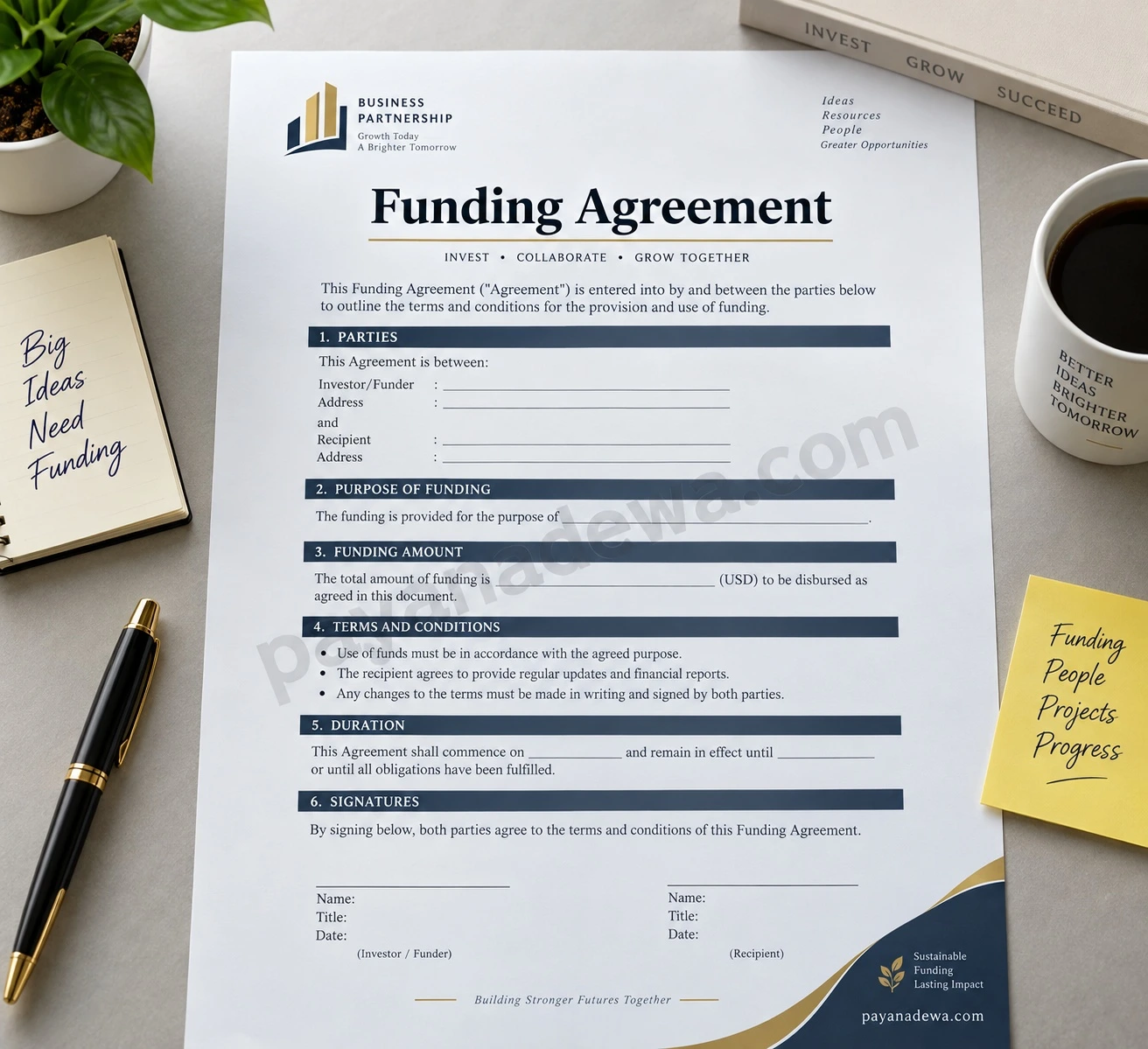
What Is a Funding Agreement?
A Funding Agreement is a written contract that explains how financial resources will be provided and used. Depending on the arrangement, the funding may come from an investor, company, government program, nonprofit organization, financial institution, private individual, or other funding source.
The agreement normally identifies the parties, explains the purpose of the funding, states the amount involved, and establishes conditions that apply to the financial arrangement. It may also explain how and when funds will be released, what information the recipient must provide, and what happens if an obligation is not fulfilled.
The exact structure varies according to the type of funding. For example, an investment agreement can have very different terms from a grant agreement or a business funding contract.
Why Is a Funding Agreement Important?
Financial arrangements can involve significant expectations from both sides. Putting those expectations into a written agreement creates a clearer framework for the relationship and helps establish what each party has agreed to do.
1. Clarifies the Funding Purpose
The document can explain exactly why the funds are being provided. A business might receive funding for equipment, expansion, inventory, marketing, research, or another defined purpose. Clearly documenting the intended use can help prevent disputes about how the money should be spent.
2. Documents Financial Terms
A written agreement can specify the funding amount, currency, payment schedule, installments, conditions for disbursement, repayment provisions, or other financial terms applicable to the arrangement.
3. Defines Responsibilities
Both parties can understand their obligations more easily when responsibilities are written down. The funding provider may have obligations concerning payment, while the recipient may need to provide reports, meet milestones, maintain records, or use funds according to agreed conditions.
4. Reduces Misunderstandings
Verbal agreements can be difficult to interpret later. A detailed funding contract provides a reference that the parties can review when questions arise about the original arrangement.
Key Elements of a Funding Agreement
A useful Funding Agreement should contain enough information to clearly describe the financial relationship. The following sections are commonly relevant, although the exact contents depend on the transaction.
- Parties: Identify the funding provider and recipient using their correct legal names and relevant contact information.
- Purpose of Funding: Explain how the funding is intended to be used.
- Funding Amount: State the total amount of money covered by the agreement.
- Disbursement Schedule: Explain when and how funds will be provided.
- Terms and Conditions: Establish the rules and requirements attached to the funding.
- Reporting Requirements: Specify whether financial statements, progress reports, receipts, or other documentation must be provided.
- Duration: State when the agreement begins and when it ends or how completion is determined.
- Amendments: Explain how changes to the agreement must be approved and documented.
- Termination: Describe circumstances and procedures for ending the agreement.
- Signatures: Provide appropriate signature fields for authorized representatives.
Common Types of Funding Agreements
The phrase Funding Agreement can describe several different financial arrangements. Understanding the basic differences can help you select an appropriate document structure.
Business Funding Agreement
A business funding agreement can establish terms for capital provided to a company or business project. Depending on the structure, the funding may involve investment, repayment, milestones, or other conditions.
Grant Funding Agreement
A grant agreement generally describes financial support provided for an approved purpose. Grant arrangements may include detailed requirements for eligible expenses, project milestones, reporting, compliance, and return of unused funds.
Project Funding Agreement
A project funding agreement can be used when money is allocated to a specific project. It may connect funding releases to milestones, deliverables, budgets, or progress reports.
Research Funding Agreement
Research funding arrangements may include additional provisions covering project objectives, reporting, intellectual property, publications, eligible expenses, and ownership of research results.
How to Create a Funding Agreement
Creating a funding contract does not simply mean filling in names and amounts. The document should reflect the actual arrangement between the parties.
Step 1: Identify the Parties
Start by recording the legal names and relevant details of everyone entering the agreement. If an organization is involved, identify the entity and the authorized representative who will sign on its behalf.
Step 2: Define the Funding Purpose
Describe the specific reason for providing the funds. Avoid vague language when the funding has restrictions or project-specific requirements. A clearly defined purpose makes later administration easier.
Step 3: Record the Financial Terms
State the total funding amount and explain the payment or disbursement process. If funding will be provided in installments, identify the applicable dates, milestones, or conditions.
Step 4: Establish Responsibilities
List the obligations of the funding provider and recipient. Consider reporting deadlines, permitted uses of funds, documentation requirements, project milestones, and communication responsibilities.
Step 5: Add Important Conditions
Include provisions addressing amendments, termination, confidentiality, dispute resolution, applicable law, compliance requirements, and other issues relevant to the specific transaction.
Step 6: Review Before Signing
Both parties should carefully review the completed document before signing. For significant or complex funding arrangements, obtaining advice from an appropriately qualified legal or financial professional can help identify issues that a general template may not address.
Tips for Using a Funding Agreement Template
A Funding Agreement template can save time because it provides a starting structure. Nevertheless, the template should be treated as a framework rather than a complete solution for every transaction.
- Customize every important field: Replace placeholders with accurate information.
- Define financial terms clearly: Avoid ambiguous descriptions of amounts, dates, or payment obligations.
- Match the agreement to the funding type: Grant, investment, loan, and project funding arrangements can have different requirements.
- Document reporting expectations: Explain what reports are required, when they are due, and who receives them.
- Keep supporting records: Store invoices, approvals, receipts, reports, and other relevant documents with the agreement.
- Review local requirements: Applicable laws and regulatory obligations may differ by jurisdiction and transaction type.
- Use clear language: Simple and precise wording can make contractual responsibilities easier to understand.
Funding Agreement vs. Other Financial Documents
A Funding Agreement should not automatically be treated as interchangeable with every other type of financial contract. The document’s purpose and legal structure depend on the transaction.
For example, a loan agreement generally focuses on borrowed money and repayment obligations, while an investment agreement may address ownership interests or investment rights. A grant agreement may focus on the approved use of funds and program requirements. A sponsorship agreement may instead establish funding in exchange for defined promotional or other benefits.
Because these documents can create different obligations, selecting the appropriate agreement structure is important before completing the template.
Common Mistakes to Avoid
Even a professional-looking funding contract can create problems if important details are missing or unclear. Several common mistakes are worth avoiding.
- Leaving important blanks or placeholders in the final document
- Failing to clearly state the total funding amount
- Using vague language about how funds may be used
- Ignoring reporting or documentation requirements
- Failing to explain how amendments will be approved
- Not identifying authorized signatories
- Using a generic template without adapting it to the actual transaction
- Overlooking applicable legal, tax, regulatory, or organizational requirements
When Should You Use a Funding Agreement?
A written funding agreement can be particularly useful whenever money is provided with specific expectations, conditions, restrictions, milestones, or obligations. Businesses, nonprofits, project teams, researchers, community organizations, and individuals may all encounter situations where documenting the arrangement is appropriate.
The more complex the financial relationship becomes, the more important it is to define the terms precisely. Large funding amounts, multiple payment stages, performance requirements, restricted expenses, intellectual property, or termination provisions may require a more detailed agreement than a simple template can provide.
Final Checklist Before Signing
Before finalizing a Funding Agreement, review the document carefully and confirm that the key information is complete and consistent.
- Are all parties correctly identified?
- Is the funding purpose clearly stated?
- Is the funding amount accurate?
- Are payment dates or disbursement conditions documented?
- Are responsibilities clearly assigned?
- Are reporting requirements understandable?
- Are the start and end dates clear?
- Are amendment and termination procedures included?
- Have applicable requirements been considered?
- Have all authorized parties signed and dated the agreement?
Conclusion
A well-structured Funding Agreement provides a practical way to document the relationship between a funding provider and recipient. By clearly defining the parties, funding purpose, financial terms, responsibilities, reporting requirements, duration, and other conditions, the agreement gives both sides a shared written reference.
A Funding Agreement template can make the drafting process faster and more organized, but it should always be adapted to the specific funding arrangement. Careful review, accurate information, clear language, and appropriate professional advice when necessary can help create a document that better reflects the actual transaction.