A compliance checklist helps a business confirm that its policies, processes, and daily activities meet the laws, regulations, and internal standards that apply to its operations. Whether you manage a small company, lead a department, or oversee a growing organization, a clear checklist makes compliance easier to organize, review, and document.
Compliance is more than completing paperwork before an audit. It helps protect employees, customers, business information, finances, and the organization’s reputation. Requirements vary by industry and location, so a useful checklist should reflect the rules that actually apply to your business rather than rely on a generic list alone.
This guide explains what to include in a compliance checklist, how to build one, and how to use it as part of an ongoing compliance program. You can also adapt the printable template to assign responsibilities, record findings, and track corrective actions.
What Is a Compliance Checklist?
A compliance checklist is a structured list of requirements or controls that an organization reviews to determine whether it is meeting applicable obligations. Each item can be marked as complete, incomplete, not applicable, or requiring follow-up. Supporting notes and evidence help reviewers understand why an item received a particular status.
A checklist may cover legal obligations, workplace health and safety, data protection, environmental rules, financial controls, human resources, or industry-specific standards. The scope depends on the organization’s size, activities, locations, and risk exposure.
Why Is a Compliance Checklist Important?
- Reduces avoidable risk: Regular reviews can identify gaps before they lead to penalties, incidents, disputes, or customer concerns.
- Creates consistency: Teams follow a repeatable process instead of relying on memory or informal instructions.
- Improves accountability: Assigning an owner and due date makes it clear who must resolve each issue.
- Supports audits: Organized records make it easier to show what was reviewed, when it was reviewed, and what action followed.
- Encourages continuous improvement: Findings can reveal recurring problems and help leaders improve policies and training.
A checklist does not guarantee compliance by itself. It is a practical control that works best alongside current policies, knowledgeable staff, reliable records, and a process for escalating serious concerns.
Key Areas to Include in a Compliance Checklist
Use the following categories as a starting point. Confirm the exact obligations with qualified legal, compliance, safety, tax, or privacy professionals when necessary.
1. Legal and Regulatory Requirements
- Confirm that required registrations, licenses, and permits are valid.
- Identify the laws, regulations, and contractual obligations that apply to each business location and activity.
- Review regulatory updates and document changes that affect operations.
- Keep required records, policies, approvals, and reports organized and accessible.
- Check whether filings and regulatory submissions are completed by their deadlines.
2. Workplace Safety and Health
- Conduct appropriate workplace hazard assessments and document findings.
- Maintain required safety equipment, signs, and emergency supplies.
- Provide role-appropriate safety training and retain training records.
- Review emergency procedures, evacuation routes, and incident-reporting processes.
- Record incidents and near misses, investigate causes, and track corrective actions.
3. Data Protection and Privacy
- Identify the personal and confidential information the organization collects and stores.
- Limit access to sensitive information according to job responsibilities.
- Use appropriate safeguards, backups, and access-review procedures.
- Review privacy notices, data retention practices, and third-party data arrangements.
- Maintain a process for responding to data requests, suspected breaches, and security incidents.
4. Environmental Compliance
- Identify environmental permits and reporting obligations relevant to operations.
- Store, handle, and dispose of waste according to applicable requirements.
- Monitor emissions, water use, energy use, or other regulated activities where required.
- Keep inspection logs, disposal records, and environmental reports.
- Investigate environmental incidents and document preventive measures.
5. Financial and Business Practices
- Maintain accurate accounting records and supporting documentation.
- Review expense approvals, purchasing controls, and payment authorization.
- Check tax reporting and payment deadlines with the appropriate adviser.
- Apply anti-fraud, anti-bribery, and conflict-of-interest policies where relevant.
- Separate duties appropriately and review unusual transactions.
6. Employee and Human Resources Compliance
- Review employment contracts, personnel records, and required notices.
- Check payroll, benefits, working hours, and leave practices against applicable rules.
- Maintain fair hiring, anti-harassment, and non-discrimination procedures.
- Provide required workplace conduct and role-specific training.
- Protect employee information and restrict access to authorized personnel.
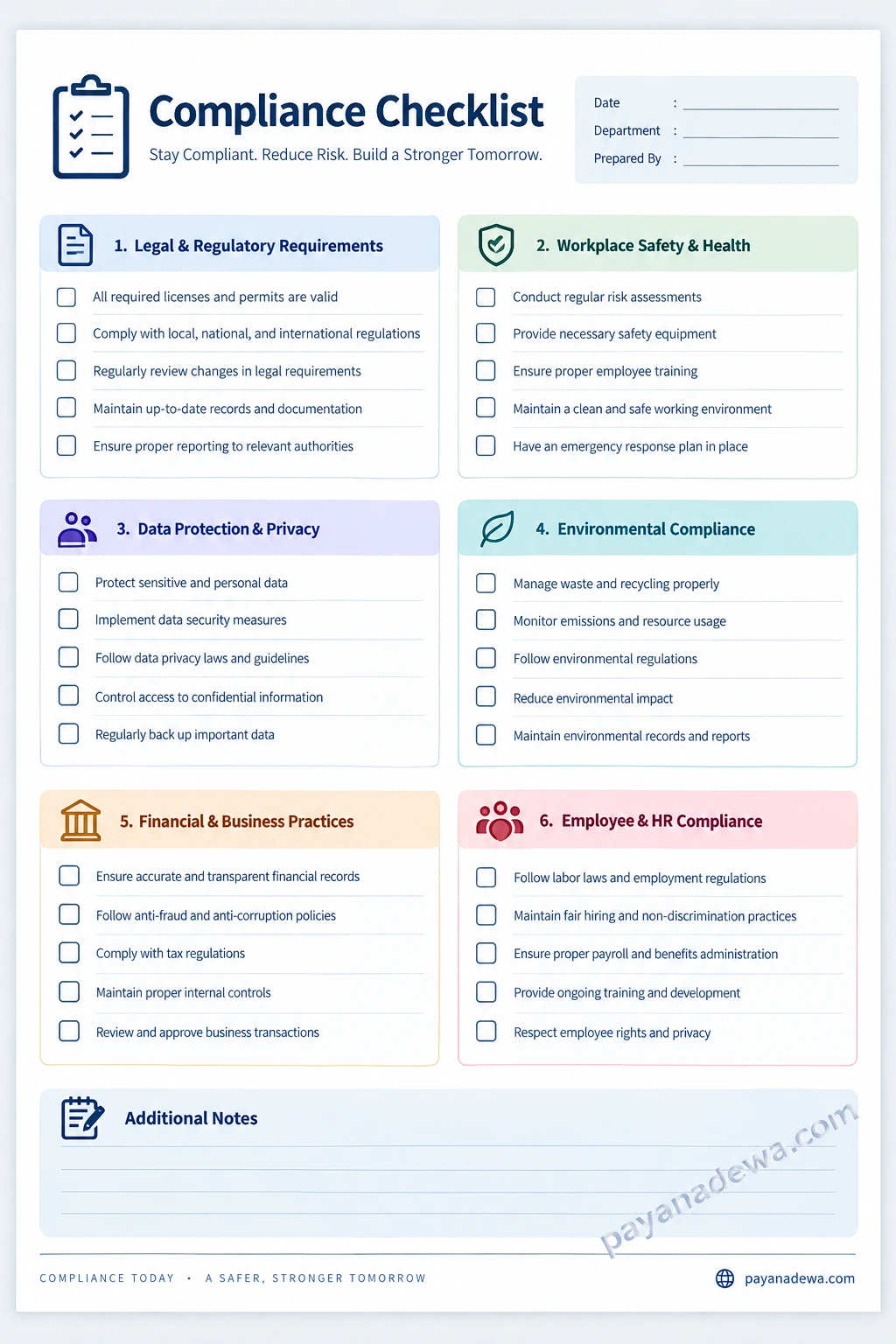
How to Create an Effective Compliance Checklist
Step 1: Define the Scope
Start by deciding what the checklist needs to cover. A company-wide review may include legal, safety, privacy, finance, and HR requirements, while a focused review might address one process, facility, project, or regulation. A clearly defined scope prevents the checklist from becoming too broad to manage.
Step 2: Identify Applicable Requirements
Gather the laws, regulations, permits, contracts, internal policies, and recognized standards that apply. Verify the current version and the relevant jurisdiction. Avoid copying another organization’s checklist without checking whether its requirements fit your operations.
Step 3: Turn Requirements into Clear Questions
Write each checklist item so a reviewer can assess it consistently. For example, replace “manage data securely” with “Are access permissions reviewed at the required interval, and is the review documented?” Clear questions make evidence easier to verify and reduce subjective interpretations.
Step 4: Assign Owners and Deadlines
Give each item a responsible person or team. Include review frequency and a due date for any outstanding action. Some requirements need continuous monitoring, while others may be checked monthly, quarterly, annually, or whenever a significant change occurs.
Step 5: Record Evidence and Findings
For each requirement, record its status and identify supporting evidence, such as a policy, training log, permit, inspection record, or approval. Do not record an item as complete merely because a document exists; confirm that the document is current and that the required process is actually followed.
Step 6: Correct Gaps and Verify Completion
Document each gap, assess its potential impact, and set a practical corrective-action plan. Include the action owner, target date, and evidence needed to close the issue. Higher-risk findings may require immediate escalation. After the action is completed, verify that it addresses the underlying problem rather than only its visible symptoms.
Best Practices for Maintaining Compliance
- Keep the checklist current. Review it when laws change, the organization enters a new market, a process changes, or an incident reveals a missing control.
- Use simple status labels. Options such as Complete, In Progress, Not Applicable, and Needs Attention make progress easy to understand.
- Store evidence securely. Use a consistent location and naming method, while limiting access to confidential records.
- Train employees. Explain relevant responsibilities and give staff a safe way to ask questions or report concerns.
- Track recurring issues. Repeated findings may point to unclear procedures, inadequate training, or weak controls.
- Make reviews proportionate to risk. Focus more attention on obligations that could cause serious harm, significant financial loss, or major legal consequences.
Common Compliance Checklist Mistakes to Avoid
One common mistake is treating the checklist as a one-time task. Requirements and business operations change, so a checklist should have a review schedule and a named owner. Another mistake is using vague items that cannot be tested consistently. Replace broad statements with observable requirements and specify what evidence demonstrates completion.
It is also risky to mark every item complete without checking the underlying evidence. A signed policy does not prove that employees understand it or follow it in practice. Finally, avoid ignoring unresolved findings. An issue should remain open until an appropriate person verifies that the corrective action has been completed and is effective.
How Often Should You Review a Compliance Checklist?
The right frequency depends on the requirement, the level of risk, and applicable deadlines. Some controls should be monitored continuously or reviewed monthly; other areas may be suitable for quarterly or annual checks. Conduct an additional review after major organizational changes, new technology deployments, incidents, audit findings, or changes in relevant law.
Build a calendar that lists each review, its owner, and its deadline. If a requirement has a legally mandated frequency, follow that schedule rather than a general recommendation. Keep a record of the review date, reviewer, evidence examined, findings, and follow-up actions.
Conclusion
A well-designed compliance checklist gives an organization a practical way to identify obligations, assess controls, document evidence, and follow through on problems. Start with the legal, safety, privacy, environmental, financial, and HR areas relevant to your business, then tailor each item to your actual requirements. Assign clear ownership, keep records current, and revisit the checklist whenever operations or regulations change.
Use the printable compliance checklist template as a starting point, not a substitute for professional advice or a complete assessment of applicable laws. With regular reviews and timely corrective action, your checklist can support a more accountable, organized, and resilient compliance program.
Howdy just wannted to gve yoou a brief heads up and llet yoou know a few off the
picyures aren’t loading correctly. I’m not sure why
but I think its a linkijng issue. I’ve tried it in two different browsers aand both showw the same results.
xnxx