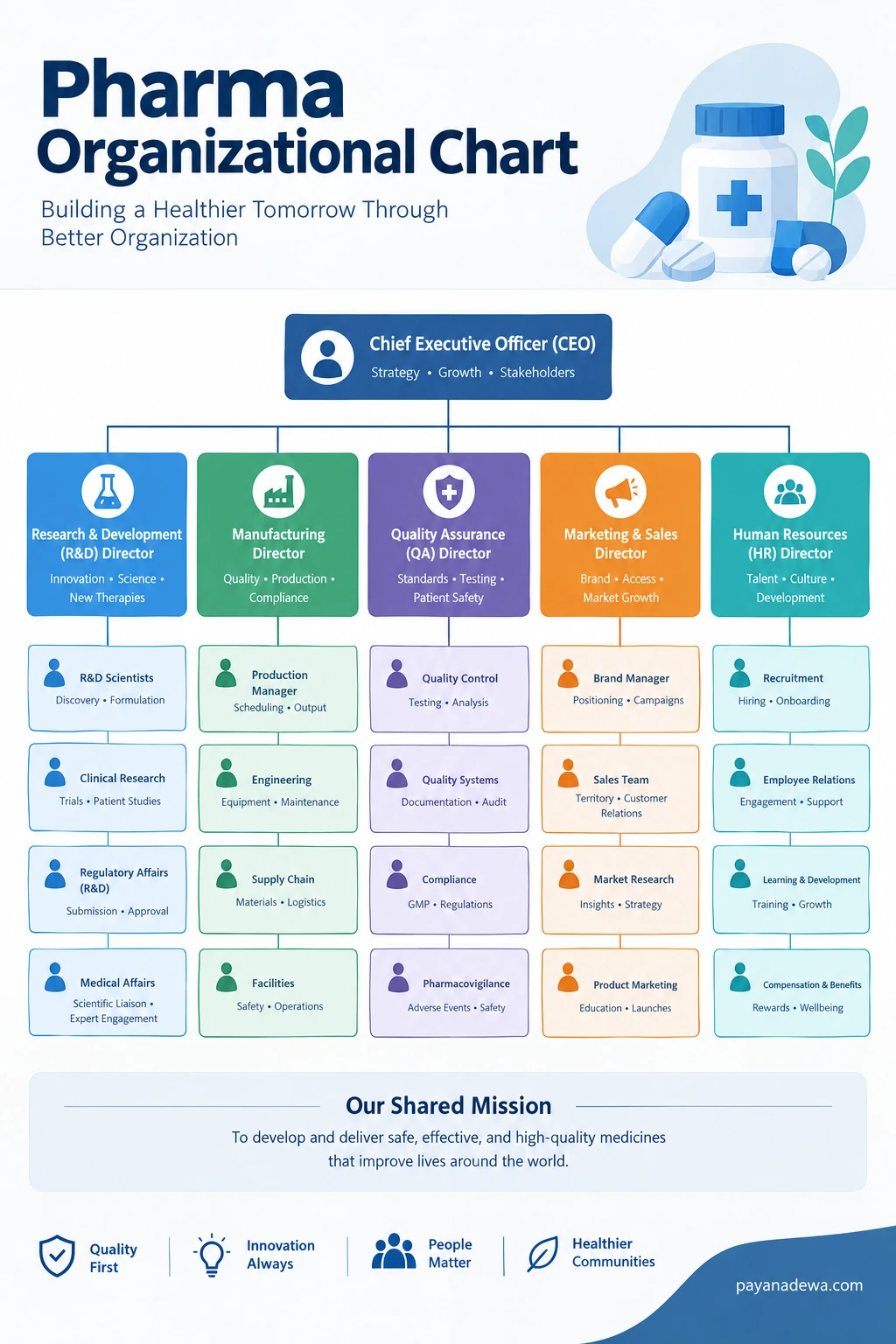
A pharma organizational chart shows how a pharmaceutical company is arranged, who leads each function, and how teams work together to develop, manufacture, test, approve, and distribute medicines. A clear structure helps employees understand responsibilities, supports effective communication, and makes it easier to maintain quality and regulatory compliance. Although every company has a different structure, most pharmaceutical organizations bring together leadership, research and development, manufacturing, quality, regulatory affairs, commercial teams, and business support functions.
Whether you are planning a new pharmaceutical business, reviewing an existing team, or creating a visual template for a presentation, understanding the typical reporting lines is a useful starting point. The best chart reflects the company’s size, product portfolio, operating model, and applicable regulations rather than copying a single standard structure.
What Is a Pharma Organizational Chart?
A pharma organizational chart is a visual representation of the reporting relationships and functional teams within a pharmaceutical company. It commonly starts with the chief executive officer or general manager and branches into major departments. Each department may then be divided into teams, managers, and specialist roles.
The chart is more than a list of job titles. It helps clarify decision-making authority, shows where specialist expertise sits, and identifies the people responsible for key activities. In a regulated industry, it can also support role clarity by showing how quality oversight, production, regulatory submissions, and safety monitoring are organized.
Typical Structure of a Pharmaceutical Company
Many pharmaceutical companies use a functional structure, with leaders responsible for specific areas of the business. Smaller companies may combine several functions under one leader, while large multinational organizations may add regional, product, site, or business-unit layers.
1. Executive Leadership
The chief executive officer (CEO), managing director, or general manager sets business priorities and is accountable for overall performance. Depending on the organization, executive leaders may include a chief operating officer, chief financial officer, chief medical officer, or chief commercial officer. Their responsibilities typically include strategy, resource allocation, risk oversight, and stakeholder relationships.
2. Research and Development (R&D)
Research and development teams discover potential medicines, study how they work, and help move promising candidates through development. Common functions include:
- Discovery and formulation: Identifies candidate compounds and develops suitable dosage forms.
- Preclinical research: Evaluates relevant safety and biological activity before human studies.
- Clinical development: Plans and oversees clinical trials in accordance with applicable requirements.
- Medical and scientific affairs: Provides scientific expertise and supports accurate medical communication.
R&D works closely with regulatory affairs, quality, manufacturing, and external research partners. The exact division of responsibilities depends on whether the company develops its own products, licenses medicines, or mainly manufactures products for other organizations.
3. Manufacturing and Operations
Manufacturing teams convert approved product specifications into medicines at the required quality and scale. Their work may cover production planning, equipment, facilities, engineering, packaging, warehousing, and supply chain management. Typical roles include a manufacturing director, production managers, process engineers, maintenance specialists, and materials planners.
Operations teams need clear procedures, trained personnel, reliable equipment, and controlled records. Where applicable, production activities must follow good manufacturing practice (GMP) and other relevant local requirements. The chart should make operational accountability clear without suggesting that production teams can bypass independent quality decisions.
4. Quality Assurance and Quality Control
Quality is central to pharmaceutical operations, but quality assurance (QA) and quality control (QC) have different emphases. QA focuses on the systems that help ensure processes are consistently controlled, such as document management, audits, training, deviations, and change control. QC performs or oversees testing of materials, samples, and finished products using approved methods.
Depending on the company, quality systems, compliance, validation, supplier quality, and batch disposition may sit within the broader quality organization. The chart should show clear authority for quality decisions and appropriate independence from production pressures. Specific legal responsibilities and release arrangements vary by jurisdiction and product type.
5. Regulatory Affairs and Pharmacovigilance
Regulatory affairs coordinates interactions with health authorities and manages activities such as product registrations, variations, labeling, and regulatory submissions. Pharmacovigilance monitors and evaluates information about suspected adverse effects and other medicine-safety concerns after and, where applicable, during development. These functions may report to separate leaders or sit within a broader regulatory or medical organization.
For companies operating in several countries, regional regulatory teams may support local submissions and help maintain product information in line with national requirements. Safety reporting responsibilities should be assigned explicitly, with documented processes for collecting, assessing, escalating, and reporting relevant information within required timelines.
6. Marketing, Sales, and Market Access
Commercial teams communicate product information, manage customer relationships, and support appropriate access to medicines. Their structure may include brand management, sales, market research, market access, pricing, and distribution partnerships. Medical affairs may collaborate with commercial colleagues but should retain appropriate scientific independence and follow applicable rules governing promotion and medical communication.
In a pharmaceutical organization, commercial plans must align with approved product information and local laws. A chart can help distinguish commercial responsibilities from medical, regulatory, and quality oversight.
7. Human Resources, Finance, IT, and Legal
Corporate support functions enable the organization to operate effectively. Human resources manages recruitment, onboarding, learning, employee relations, and compensation. Finance oversees budgeting, accounting, forecasting, and financial controls. IT supports business systems, data security, and digital infrastructure, while legal and compliance teams advise on contracts, governance, privacy, and relevant obligations.
These departments may report directly to the CEO or through a chief financial officer, chief operating officer, or another executive. Their placement should reflect the company’s governance model and the level of specialist oversight required.
How to Create a Pharma Organizational Chart
Build the chart from real responsibilities and reporting relationships, not from job titles alone. These steps can help create a practical, easy-to-maintain structure.
Step 1: Define the Scope
Decide whether the chart covers the whole company, a manufacturing site, an R&D unit, a country office, or a specific product division. A single chart can become crowded if it tries to show every employee across a large organization. Use a high-level chart for executives and separate detailed charts for departments when needed.
Step 2: Confirm Roles and Reporting Lines
Ask department leaders to confirm job titles, direct managers, key responsibilities, and any dotted-line relationships. Distinguish direct reporting from collaboration or functional oversight. Avoid drawing a reporting line simply because two teams work closely together.
Step 3: Show Critical Quality and Compliance Responsibilities
Identify who owns quality systems, product release decisions, regulatory submissions, safety reporting, data integrity, and compliance escalation. Check that the arrangement supports applicable regulations and the company’s quality management system. An organizational chart supports governance, but it does not replace procedures, job descriptions, delegation records, or formal regulatory assessments.
Step 4: Choose a Clear Visual Layout
Use consistent shapes, readable labels, and a clear hierarchy. Group related teams by function and use colors sparingly to help readers scan the page. Include a document owner, version number, and effective date if the chart is controlled within a quality or document-management system.
Step 5: Review and Update Regularly
Ask HR and department heads to review the chart after restructures, acquisitions, leadership changes, or changes in regulated responsibilities. Assign an owner to maintain the approved version and remove outdated copies from shared locations. The review frequency should match the company’s governance and document-control procedures.
Common Mistakes to Avoid
- Making the chart too complicated: Keep the main view focused and move detailed team structures to separate pages.
- Using unclear job titles: Choose consistent titles and define specialist abbreviations where needed.
- Confusing collaboration with authority: Use different line styles or a legend to explain dotted-line relationships.
- Overlooking quality independence: Make quality responsibilities and escalation routes clear and appropriate to the business.
- Leaving outdated versions in circulation: Add version control and identify the official source.
- Copying a generic template without adapting it: Confirm that each role and reporting line reflects actual operations and applicable requirements.
Benefits of a Well-Designed Pharma Organizational Chart
A well-maintained chart helps new employees understand who does what and where to direct questions. It can improve cross-functional coordination, clarify accountability, support workforce planning, and make gaps or duplicated responsibilities easier to identify. For leadership teams, it provides a quick overview of how business, scientific, operational, and compliance functions fit together.
However, the chart should be treated as one part of a wider management system. Clear job descriptions, training, standard operating procedures, documented delegations, and effective communication are also essential. No single organizational design fits every pharmaceutical company.
Conclusion
A pharma organizational chart gives pharmaceutical teams a shared view of leadership, reporting lines, and core responsibilities. Most charts include executive leadership, R&D, manufacturing, quality, regulatory affairs, pharmacovigilance, commercial teams, and corporate support functions, but the right arrangement depends on the organization’s size, products, locations, and obligations. Start with confirmed reporting relationships, make quality and safety responsibilities explicit, and review the chart whenever the business changes. With regular maintenance, the chart becomes a practical tool for communication, accountability, and effective pharmaceutical operations.