A pedigree chart is a clear, organized way to record family relationships across several generations. Whether you are beginning a genealogy project, preparing a family history scrapbook, or documenting information for future relatives, this chart helps you see how parents, grandparents, and earlier ancestors connect. Instead of keeping names and dates in scattered notes, you can place them in one visual family tree and spot missing details more easily.
You do not need to be an experienced genealogist to make one. With a few reliable records, a consistent layout, and a little patience, you can build a useful chart on paper or digitally. This guide explains what a pedigree chart is, how it differs from other family tree diagrams, what information to include, and how to create an accurate chart you can update over time.
What Is a Pedigree Chart?
A pedigree chart is a diagram that traces a person’s ancestry, usually starting with one individual and moving backward through their parents, grandparents, great-grandparents, and earlier generations. The person at the starting point is often called the subject or root person. Each generation branches into the two biological parents, creating a structure that is easy to follow.
Traditional genealogy charts often use a standard numbering system. The subject is assigned number 1, their father number 2, and their mother number 3. The father’s parents are numbered 4 and 5, while the mother’s parents are numbered 6 and 7. This system can help researchers refer to people consistently as a chart expands.
A pedigree chart is useful for family history research, school projects, heritage activities, and organizing information before entering it into genealogy software. It can also help identify which relatives or records you still need to investigate.
Pedigree Chart vs. Family Tree
The terms are sometimes used interchangeably, but the layouts can serve slightly different purposes. A pedigree chart focuses mainly on a person’s ancestors and typically moves backward through generations. A broader family tree may include siblings, cousins, spouses, children, and other branches of an extended family.
- Pedigree chart: Best for tracing ancestry from one person to parents, grandparents, and earlier generations.
- Family tree: Useful for showing a wider network of relatives, including descendants and collateral family branches.
- Family group sheet: Often records detailed information about one couple and their children, such as birth dates, marriage details, and places.
Choose the format that matches your goal. If you want to research where your ancestors came from, a pedigree chart is a practical starting point. If you want to show how a large family is connected today, a more expansive family tree may be a better fit.
What Information Should You Include?
The best chart is one that is readable and supported by evidence. Begin with the information you know, then add details as you confirm them. Avoid filling gaps with guesses simply to make the chart look complete.
Essential details
- Full name: Record the name used by the person, and note alternate spellings when relevant.
- Birth information: Include the date and place of birth if known.
- Marriage information: Add a marriage date or location when it helps explain family relationships.
- Death information: Record the date and place of death, if applicable and verified.
- Sources or notes: Keep a reference to the document, interview, or record that supports an important fact.
For a simple printable pedigree chart, names and birth dates may be enough. For serious genealogy research, maintain a separate research log or notes document for source citations, conflicting evidence, name changes, and uncertain dates. You can use terms such as “about 1880” or “unknown” when appropriate, rather than presenting an estimate as an exact fact.
How to Make a Pedigree Chart Step by Step
1. Start with yourself or the person you are researching
Write the subject’s name in the first box or at the base of the chart. Confirm the spelling and any relevant dates before moving backward. If the chart is for another relative, clearly identify that person so readers understand whose ancestry is being traced.
2. Add the parents
Place the subject’s parents in the next generation and connect them with lines. Use the same layout throughout the chart so relationships remain easy to understand. If a parent is unknown, leave the space open or label it “unknown” rather than inventing a name.
3. Record the grandparents and earlier generations
Continue by adding each parent’s parents. Every new generation typically doubles the number of ancestor positions: two parents, four grandparents, eight great-grandparents, and sixteen great-great-grandparents. In practice, the number of distinct people may be lower because of repeated ancestors in some family histories.
4. Verify each relationship
Do not rely only on family stories or online trees copied from other users. Compare information with birth, marriage, and death certificates, census records, church registers, cemetery records, immigration documents, newspaper notices, and family correspondence. A single record may contain an error, so use multiple independent sources when possible.
5. Make the chart readable
Use a consistent font, adequate writing space, and clear connecting lines. Keep dates in one format, such as “14 March 1924,” and use the same convention for locations. If you are building a large chart, consider a landscape page or a digital tool that lets you zoom in and print across multiple pages.
6. Add sources and update the chart
Keep a separate list of sources or add short reference numbers to the chart. Save an editable digital copy, even if you prefer a printed version. As new evidence appears, update the chart and note what changed so that future readers can understand the research trail.
How to Use a Printable Pedigree Chart Template
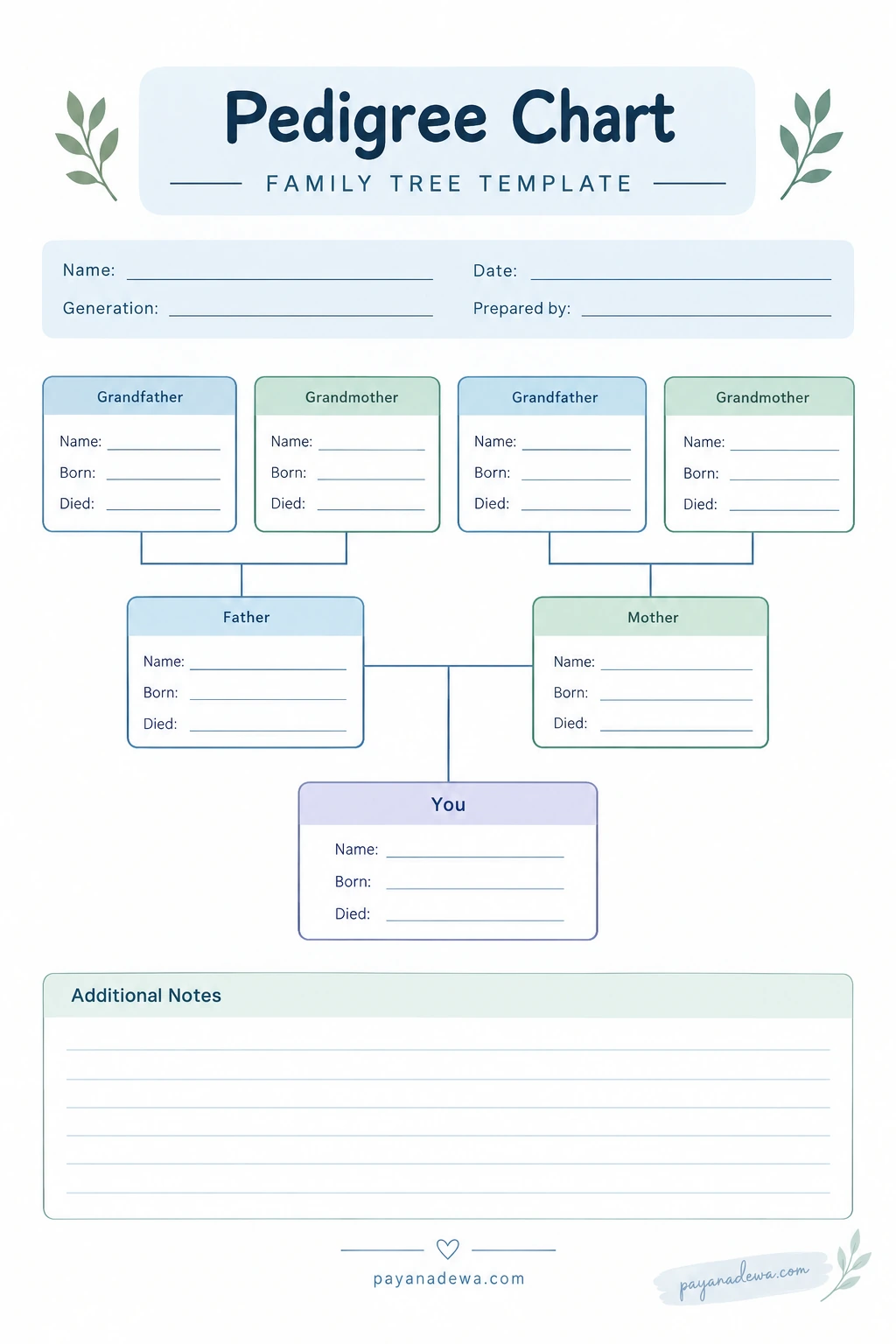
A printable pedigree chart template gives you a ready-made structure, so you can spend more time researching and less time drawing boxes. Before printing, check that the page size fits your printer and that the fields provide enough room for names and dates. Standard letter or A4 paper works for a small number of generations; larger charts may need landscape orientation or a larger sheet.
Use a dark pen for permanent entries and pencil for details that still need verification. If several relatives are helping, agree on a shared format for dates, place names, and uncertain information. You may also keep a digital master file so corrections do not require starting over.
Tips for Accurate Family History Research
- Work from the known to the unknown. Begin with recent generations where documents and living relatives may be easier to access.
- Interview relatives respectfully. Ask open questions, record names and places, and confirm whether they are comfortable with information being shared.
- Track every source. Note where a fact came from, when you accessed the record, and whether it directly supports the relationship.
- Keep uncertainty visible. Use question marks or a research note for unconfirmed relationships instead of treating assumptions as facts.
- Protect living people’s privacy. Ask permission before publishing personal details, and avoid sharing sensitive information about living relatives without consent.
- Back up your work. Keep copies of your chart and source notes in more than one secure location.
Common Pedigree Chart Mistakes to Avoid
One common mistake is copying an online family tree without checking its evidence. Online trees can be valuable clues, but their details may be incomplete or incorrect. Another is mixing up people who share the same name. Include dates, locations, and spouse or parent details where available to distinguish individuals.
Researchers may also assume that every family follows a simple two-parent pattern. Real family histories can include adoption, stepfamilies, donor conception, unknown parentage, and other circumstances. Choose labels that reflect the purpose of your chart and the evidence you have, and use a separate note when a standard layout cannot tell the full story. A pedigree chart is a research aid, not a complete description of every family relationship.
Finally, do not force every blank space to be filled. A clear, honest chart with documented gaps is more useful than a polished chart containing unsupported claims.
Frequently Asked Questions
How many generations can a pedigree chart show?
It depends on the page size and layout. A basic chart may show three or four generations, while a larger digital or printable chart can include many more. As the chart grows, use multiple pages or a genealogy program to keep names legible.
Is a pedigree chart only for biological ancestors?
Traditional pedigree charts usually trace biological ancestry, but you can adapt a chart to document adoptive or other family relationships. Label the relationship clearly and respectfully so readers do not confuse different types of connections.
Can I create a pedigree chart online?
Yes. You can build one in a spreadsheet, drawing application, word processor, or genealogy platform. Choose a tool that allows you to edit entries, preserve source notes, and export or print the chart in a readable format.
What should I do if I do not know a relative’s name?
Leave the field blank or write “unknown.” Add a research note describing what you have checked and what evidence might help you identify the person. An unknown ancestor is a useful research question, not a reason to guess.
Conclusion
A pedigree chart turns family history details into a visual record that is easier to understand, share, and expand. Start with the person you are researching, work backward one generation at a time, and verify relationships with reliable sources. Keep your layout consistent, document uncertainty, and protect the privacy of living relatives. With a printable pedigree chart template and a careful research process, you can create a family ancestry chart that remains useful as your knowledge grows.