A well-designed Property Management Brochure can be one of the most effective marketing tools for a property management company. It gives potential clients a quick overview of your services, communicates your professionalism, and helps property owners understand why they should trust your team with their investment.
Whether you manage residential rentals, commercial buildings, apartments, condominiums, or vacation properties, a professional brochure can make your business easier to understand and remember. The right combination of clear information, attractive visuals, strong branding, and a compelling call to action can turn a simple printed document into a powerful lead-generation tool.
In this guide, you will learn what to include in a property management brochure, how to structure it effectively, what design elements matter most, and how to create brochure content that builds trust and encourages potential clients to take the next step.
What Is a Property Management Brochure?
A property management brochure is a marketing document designed to introduce a property management company and explain the services it provides. It is commonly used to reach property owners, landlords, real estate investors, developers, and other clients who need professional assistance managing their properties.
A brochure can be printed and distributed at real estate events, offices, property viewings, networking meetings, and community events. It can also be converted into a digital PDF and shared through websites, email, social media, or messaging platforms.
A strong brochure should answer several important questions quickly:
- Who is your property management company?
- What types of properties do you manage?
- What property management services do you offer?
- What makes your company different?
- How can a property owner contact you?
- Why should a potential client trust your team?
Why a Professional Property Management Brochure Matters
Property owners want to know that their investment will be handled responsibly. They are often looking for a management company that can reduce their workload, protect their property, communicate effectively with tenants, and help maintain consistent rental income.
A professional brochure helps communicate these benefits before a sales conversation even begins. It can also reinforce your brand when a potential client is comparing several property management companies.
Builds Trust and Professionalism
First impressions matter. A clean and organized brochure can make your company appear established, reliable, and prepared. Professional photography, consistent branding, concise copy, and clear contact information all contribute to a stronger impression.
Explains Your Services Clearly
Property management can involve many different responsibilities. A brochure gives you space to organize those services into easy-to-understand sections. This helps property owners quickly identify whether your company can meet their needs.
Supports Your Marketing Strategy
A brochure can work alongside your website, social media profiles, email campaigns, business cards, and other marketing materials. Using consistent colors, fonts, logos, and messaging across these channels creates a recognizable brand identity.
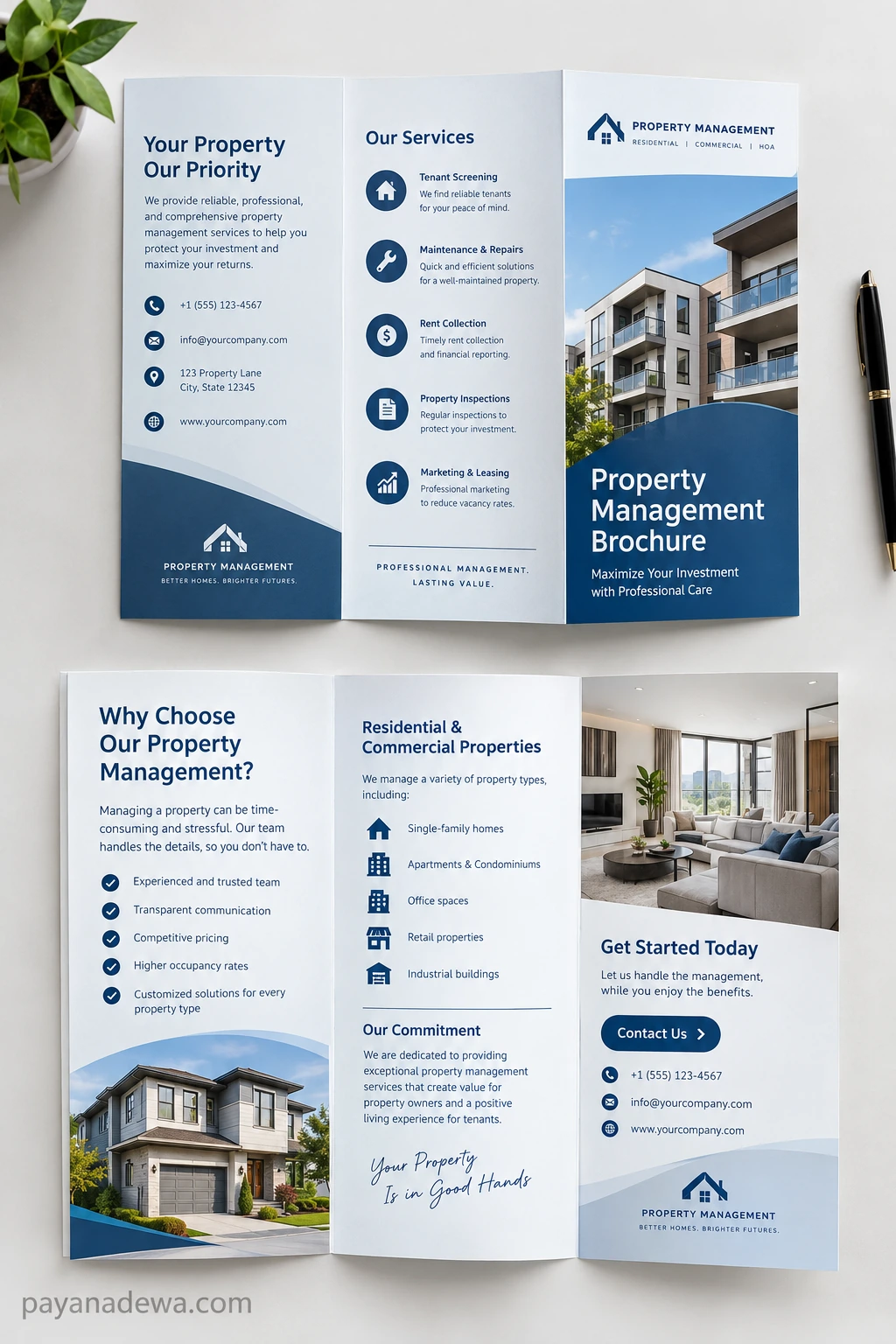
What to Include in a Property Management Brochure
The best brochure is not necessarily the one with the most information. Instead, it should present the most important information in a logical order that is easy to scan.
1. Company Introduction
Start with a short introduction that explains who you are and what your company does. Keep the message focused on the needs of property owners rather than simply describing your company history.
For example, you might explain that your team provides reliable property management solutions designed to protect investments, improve tenant satisfaction, reduce vacancies, and simplify day-to-day property operations.
2. Property Management Services
Your services should be one of the most prominent sections of the brochure. Use short descriptions so readers can understand your capabilities without reading large blocks of text.
- Tenant Screening: Help identify qualified and reliable tenants through a structured screening process.
- Rent Collection: Manage rent payments and provide organized financial reporting.
- Property Marketing: Promote available properties using professional listings and targeted marketing.
- Maintenance and Repairs: Coordinate routine maintenance and respond to property repair needs.
- Property Inspections: Conduct regular inspections to help identify potential problems early.
- Lease Management: Assist with leases, renewals, documentation, and important rental deadlines.
- Tenant Communication: Handle routine tenant questions and property-related communication.
3. Types of Properties You Manage
Clearly identify the types of properties your company serves. This allows potential clients to determine immediately whether your expertise matches their property.
- Single-family homes
- Multi-family properties
- Apartments and condominiums
- Townhouses
- Commercial properties
- Office buildings
- Retail properties
- Vacation and short-term rentals
4. Benefits for Property Owners
Do not focus only on what you do. Explain why your services matter to the client. Property owners generally want to save time, minimize risk, protect their assets, and maintain healthy occupancy and rental performance.
Your brochure might highlight benefits such as reduced management workload, professional tenant communication, organized maintenance coordination, improved property presentation, transparent reporting, and personalized management solutions.
How to Design an Effective Property Management Brochure
Good brochure design should make information easier to understand. The layout should guide the reader naturally from the company introduction to the services, benefits, and final call to action.
Use a Clean Visual Hierarchy
Give the most important information the strongest visual emphasis. Your company name, main benefit, services, and contact details should be easy to locate.
Use clear headings, short paragraphs, bullet points, sufficient spacing, and consistent typography. Avoid filling every available space with text or graphics.
Choose Professional Property Photography
High-quality property photography can make a brochure significantly more appealing. Use images that represent the type of properties you manage and support the message of your business.
For example, a residential property management brochure might feature attractive homes, modern apartments, clean interiors, or well-maintained outdoor spaces. Commercial property managers can use professional images of offices, retail locations, or commercial buildings.
Maintain Consistent Branding
Your brochure should look like part of your overall brand. Use your established logo, brand colors, typography, and visual style whenever possible.
Consistent branding helps potential clients recognize your company across different marketing channels. It also creates a more polished and trustworthy appearance.
Writing Property Management Brochure Content That Converts
Brochure copy should be concise, useful, and focused on the reader. Instead of using complicated industry terminology, explain your services in language that property owners can understand quickly.
Focus on Client Benefits
Compare these two approaches:
- Feature-focused: “We provide monthly property inspections.”
- Benefit-focused: “Regular inspections help identify maintenance issues early and protect the long-term condition of your property.”
The second version explains why the service matters. This approach makes your brochure more persuasive without sounding overly promotional.
Use Strong Calls to Action
Every brochure should tell readers what to do next. A clear call to action can encourage them to request a consultation, call your office, visit your website, or ask for a management proposal.
Examples include:
- Request a Property Management Consultation
- Get Your Free Management Quote
- Talk to Our Property Management Team
- Discover a Better Way to Manage Your Property
- Contact Us Today to Get Started
Property Management Brochure Layout Ideas
There are several formats you can use depending on how much information you need to present.
Tri-Fold Brochure
A tri-fold brochure is a popular choice because it provides multiple panels while remaining compact and easy to distribute. It works well for presenting your company introduction, services, property types, benefits, and contact information.
Bi-Fold Brochure
A bi-fold format provides larger content areas and a more spacious appearance. It can be useful when your company wants to showcase fewer services with larger photographs and stronger visual elements.
Digital Property Management Brochure
A digital brochure can be created as a PDF and shared through your website, email, social media, and online advertising. Make sure the digital version includes clickable contact information and a clear website or consultation link.
Practical Tips for Creating a Better Brochure
Before sending your brochure to print or publishing it online, review the content and design carefully.
- Keep the most important message visible immediately.
- Use short paragraphs and easy-to-scan sections.
- Proofread every heading, phone number, email address, and website URL.
- Use high-resolution images suitable for your chosen format.
- Make sure the text is readable on both printed and digital versions.
- Include a clear and prominent call to action.
- Use consistent branding throughout the brochure.
- Explain benefits rather than listing features alone.
- Update pricing, contact information, and services regularly.
- Test the digital brochure on desktop and mobile devices.
How to Use Your Brochure for Marketing
A property management brochure becomes more valuable when it is integrated into a broader marketing strategy. Do not limit it to your office reception area.
Give brochures to prospective property owners during consultations and property evaluations. Bring them to real estate networking events and local business meetings. You can also provide a digital brochure after a discovery call so potential clients have a convenient reference when making their decision.
Your brochure can also support your website content. For example, a visitor who discovers your property management company through search can download the brochure to learn more about your services before scheduling a consultation.
Common Property Management Brochure Mistakes to Avoid
Even a visually attractive brochure can fail if the information is unclear or the design becomes too crowded.
- Too much text: Readers should be able to scan the brochure quickly.
- Weak contact information: Make it easy for potential clients to reach you.
- Generic messaging: Explain what makes your management service valuable.
- Poor-quality images: Blurry or unrelated photographs can reduce credibility.
- No call to action: Tell readers exactly what step they should take next.
- Inconsistent branding: Keep your visual identity consistent with your website and other marketing materials.
Final Thoughts on Creating a Property Management Brochure
A professional Property Management Brochure is more than a collection of services and photographs. It is a compact representation of your company, your expertise, and the value you provide to property owners.
The strongest brochures combine clear messaging, professional design, relevant property photography, useful service information, and a compelling call to action. Whether you choose a tri-fold printed brochure, a digital PDF, or a combination of both, focus on making the information easy to understand and directly relevant to your target audience.
When designed strategically, a property management brochure can strengthen your brand, build credibility, support sales conversations, and help turn interested property owners into long-term clients.