An HR Meeting Invitation is an important part of professional workplace communication. A well-prepared invitation helps employees understand why the meeting is being held, when it will take place, where they need to attend, and what they should prepare in advance.
Human resources meetings can cover many subjects, including employee development, company policies, workplace concerns, performance discussions, recruitment planning, benefits, training programs, and organizational changes. Because these topics can affect employees directly, the invitation should be clear, professional, and easy to understand.
A good HR meeting invitation does more than announce a date and time. It sets expectations for participants and gives them enough information to arrive prepared. When employees understand the purpose of a meeting before it begins, discussions can become more focused and productive.
Whether you are organizing a formal HR meeting, employee discussion, staff meeting, training session, or virtual HR conference, using a structured invitation template can save time while maintaining a professional appearance.
What Is an HR Meeting Invitation?
An HR Meeting Invitation is a formal or semi-formal message used by a human resources department to invite employees, managers, candidates, or other relevant participants to an HR-related meeting. The invitation can be delivered through email, printed documents, messaging platforms, calendar applications, or internal communication systems.
Purpose of an HR Meeting Invitation
The main purpose is to provide essential meeting information in one convenient message. A complete invitation normally identifies the meeting topic, date, time, location, participants, and agenda.
Depending on the situation, the invitation may also include preparation instructions, required documents, meeting objectives, contact information, and expectations for participation.
A professional invitation also helps prevent confusion. Employees can check the information later instead of relying on verbal instructions or incomplete messages.
- Meeting title and purpose
- Date and time
- Physical or virtual meeting location
- List of participants
- Meeting agenda
- Preparation requirements
- Contact information for questions
Why a Professional HR Meeting Invitation Matters
The quality of a meeting often begins before participants enter the meeting room. A clear invitation establishes the context and gives participants an opportunity to prepare their questions, documents, or ideas.
For HR departments, professional communication is especially important because HR frequently handles sensitive workplace matters. A carefully written invitation can create an organized and respectful tone from the beginning.
Improving Employee Preparation
When employees know what will be discussed, they can prepare relevant information in advance. For example, an employee development meeting may require participants to review performance goals, training needs, or career objectives.
Providing this information in the invitation reduces unnecessary delays and allows the meeting to focus on meaningful discussion.
Creating a Professional Impression
A polished HR meeting invitation demonstrates attention to detail. Consistent formatting, concise wording, and accurate meeting information can make internal communication easier to understand.
This is particularly useful for organizations that want their HR communications to maintain a consistent professional identity.
Essential Elements of an HR Meeting Invitation
A strong invitation should provide enough information for recipients to understand the meeting without making the message unnecessarily long. The following elements are useful for most HR meeting invitations.
Meeting Title and Purpose
Start with a clear title that immediately tells recipients what the meeting is about. Examples include “Employee Development Meeting,” “HR Policy Update,” “Annual Performance Discussion,” or “Staff Benefits Meeting.”
The purpose should then be explained in one or two concise sentences. Avoid vague statements that leave participants wondering why they have been invited.
Date, Time, and Duration
Always include the exact date and starting time. Adding the expected duration is also helpful because employees can plan their schedules accordingly.
If participants work across different locations or time zones, include the relevant time zone to prevent scheduling mistakes.
Meeting Location
For an in-person meeting, provide the building, room name, floor, or other useful location details. For virtual meetings, include the appropriate online meeting information through the organization’s approved communication system.
If the meeting uses a hybrid format, clearly explain which participants are expected to attend in person and which can participate remotely.
Agenda and Discussion Topics
An agenda helps participants understand what will be covered. It can be presented as a short bullet list rather than a long paragraph.
- HR policy updates
- Employee development initiatives
- Upcoming training programs
- Workplace concerns and feedback
- Questions and discussion
A short agenda can also help the meeting organizer stay focused and manage the available time effectively.
How to Write an Effective HR Meeting Invitation
Writing an HR meeting invitation does not have to be complicated. The most effective approach is to provide the necessary information in a logical order and use language that matches the workplace environment.
Use a Clear and Direct Opening
Begin by stating that the recipient is invited to the meeting. For example, you can write, “You are invited to attend our upcoming HR meeting to discuss employee development initiatives and important workplace updates.”
This immediately establishes the purpose of the message without unnecessary introductory text.
Explain Why Attendance Matters
When appropriate, briefly explain why the recipient’s participation is valuable. This is especially useful when the meeting involves employee feedback, policy discussions, planning, or collaborative decision-making.
The explanation should remain factual and professional rather than creating unnecessary pressure.
Keep the Language Professional
An HR meeting invitation should generally use respectful and easy-to-understand language. Avoid complicated terminology when a simpler phrase communicates the same information.
For internal meetings, the tone can be friendly while remaining professional. For sensitive or formal meetings, use more precise wording and avoid language that could be misunderstood.
HR Meeting Invitation Template Example
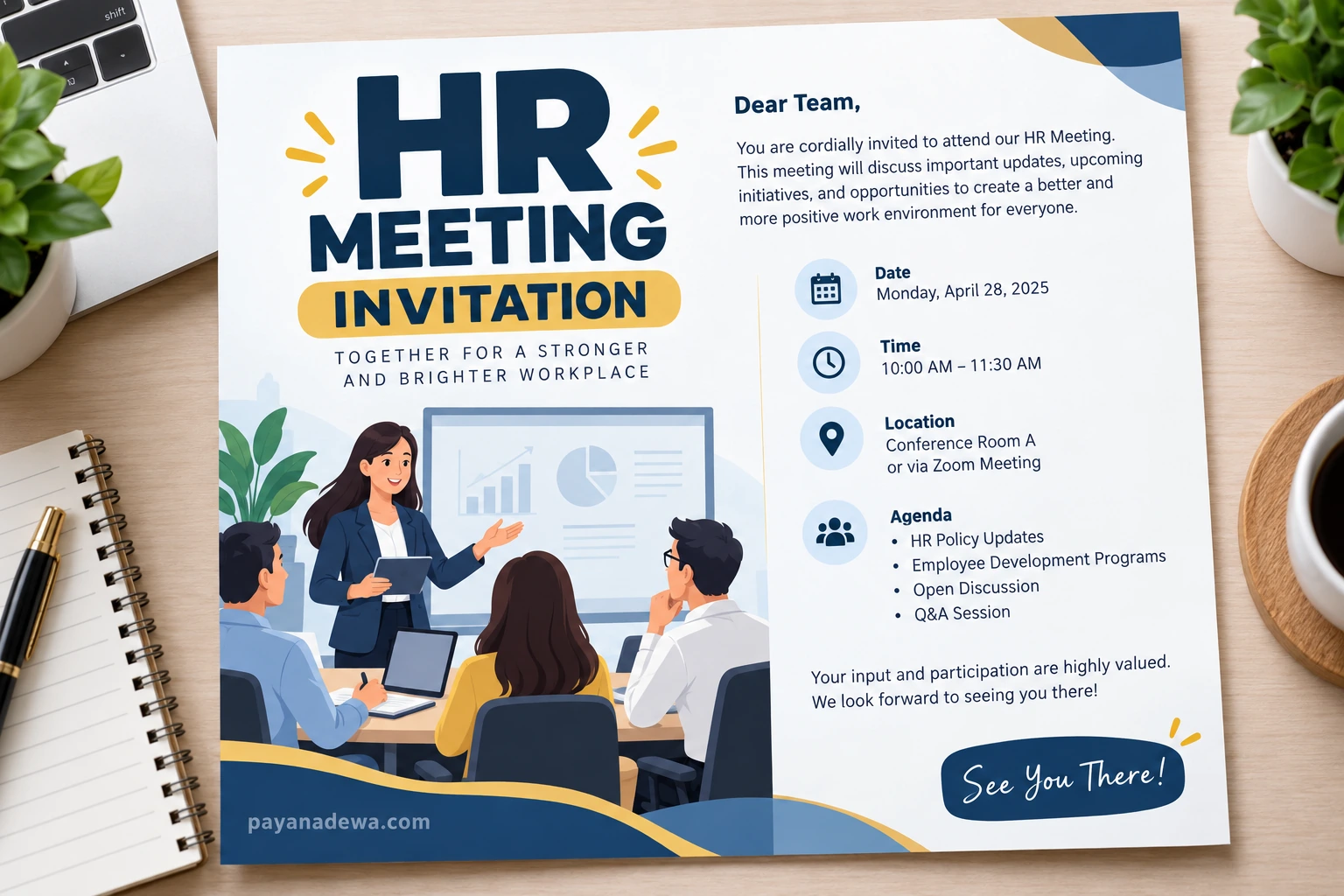
A reusable template can make the invitation process faster, especially for HR teams that organize meetings regularly. The following structure can be adapted for different workplace situations.
Simple HR Meeting Invitation Structure
Start with a greeting, followed by the invitation and purpose. Then provide the meeting details, agenda, preparation requirements, and closing statement.
- Meeting: HR Team Meeting
- Date: Monday, April 28, 2025
- Time: 10:00 AM – 11:30 AM
- Location: Conference Room A / Virtual Meeting
- Purpose: Discuss HR updates and upcoming employee initiatives
- Agenda: Policy updates, employee development, training, and open discussion
This structure can be adjusted for a department meeting, employee consultation, performance discussion, recruitment meeting, or HR training session.
Different Types of HR Meeting Invitations
Not every HR meeting has the same objective. The wording and level of detail should therefore be adjusted according to the meeting type.
Employee Performance Meeting
A performance meeting invitation may be used for a regular performance review, goal-setting session, or development discussion. It should clearly state the purpose and provide enough information for the employee to prepare.
For example, participants may be asked to review previous goals, prepare questions, or bring relevant performance information.
HR Policy Meeting
An HR policy meeting can be used to explain updates to workplace procedures, employee guidelines, benefits, or organizational policies. The invitation should identify the topic so employees know what information will be discussed.
Employee Training Meeting
Training invitations should include the training subject, expected duration, location, and any materials participants need to prepare. If completion is required, that information should also be communicated clearly.
HR Team Meeting
An internal HR team meeting may cover recruitment, employee relations, workforce planning, upcoming projects, or administrative priorities. A concise agenda is particularly useful for recurring HR meetings.
Tips for Making Your HR Meeting Invitation More Effective
A few simple improvements can make an invitation easier to read and more useful for employees.
Keep Important Information Easy to Find
Use headings, short paragraphs, and bullet points for meeting details. Recipients should be able to find the date, time, location, and agenda quickly.
Send the Invitation Early
Whenever possible, send the invitation far enough in advance for participants to organize their schedules. The appropriate notice period depends on the importance and urgency of the meeting.
Check Every Detail
Before sending the invitation, verify the date, time, location, participant list, agenda, and meeting access information. A small scheduling error can cause unnecessary confusion.
Use a Consistent Template
A standardized HR meeting invitation template can help HR teams maintain consistent communication. Templates also reduce repetitive work because commonly used sections can be reused and customized.
Digital HR Meeting Invitations
Modern organizations often combine email invitations with digital calendars and collaboration platforms. This approach can make meeting management more convenient for distributed and hybrid teams.
Email and Calendar Invitations
An email can provide context while a calendar invitation can help participants reserve the correct time. Using both can be useful for important meetings.
Virtual Meeting Invitations
For remote meetings, clearly identify the online meeting platform and access instructions. Participants should not have to search through multiple messages to find the information they need.
It is also useful to include the expected meeting duration and agenda so participants can prepare their workspace and schedule accordingly.
Common Mistakes to Avoid
Even a simple meeting invitation can become confusing when important details are missing or poorly organized. Avoid these common mistakes when preparing an HR invitation.
- Leaving out the meeting purpose
- Using an unclear or overly generic subject line
- Forgetting the time zone for international teams
- Providing incomplete location information
- Sending a virtual meeting invitation without access details
- Writing a long message without clear sections
- Failing to identify required preparation
- Using inconsistent dates or meeting times
Reviewing the invitation before sending it can prevent most of these issues.
How an HR Meeting Invitation Template Saves Time
Creating every invitation from scratch can consume valuable administrative time. A reusable template allows HR professionals to maintain a consistent structure while changing only the information that is specific to each meeting.
Easy Customization
A good template can contain placeholders for the meeting title, date, time, location, agenda, participants, and organizer. HR staff can update these fields without rebuilding the entire document.
Consistent Communication
Templates also create consistency across departments. Employees become familiar with the structure and can quickly identify important meeting information.
A professionally designed HR Meeting Invitation Template can therefore function as both a practical communication tool and part of an organization’s internal communication system.
Final Checklist Before Sending an HR Meeting Invitation
Before sending your invitation, take a moment to review the essential information. A simple checklist can help ensure that nothing important has been missed.
- Is the meeting purpose clear?
- Is the date correct?
- Is the starting and ending time accurate?
- Is the location or virtual access information included?
- Are the correct participants invited?
- Is the agenda easy to understand?
- Do participants need to prepare anything?
- Is the contact person identified for questions?
- Has the invitation been checked for spelling and formatting?
Conclusion
A professional HR Meeting Invitation provides employees with the information they need to attend and prepare for an HR meeting effectively. By including a clear purpose, accurate schedule, location, participant information, and concise agenda, HR teams can make workplace communication more organized.
Using an HR Meeting Invitation Template can make the process even easier. A reusable format saves time, supports consistent communication, and can be customized for employee meetings, HR policy discussions, training sessions, performance reviews, and other workplace events.
The key is to keep every invitation clear, relevant, professional, and easy to scan. When participants understand what to expect before a meeting begins, everyone has a better opportunity to contribute productively.