An eye chart is one of the most familiar tools used to measure visual acuity. Whether you are preparing for an eye exam, learning about vision testing, or looking for a printable eye chart for educational purposes, understanding how these charts work can help you make better decisions about your eye health.
Eye charts display letters, numbers, or symbols in different sizes. During a vision test, a person reads or identifies these characters from a specified distance. The results help an eye care professional evaluate how clearly someone can see at that distance.
Although an eye chart can be useful for learning about visual acuity, it does not replace a comprehensive eye examination. In this guide, you will discover the different types of eye charts, how to read vision test results, how to use a printable chart responsibly, and when to seek professional eye care.
What Is an Eye Chart?
An eye chart is a visual testing tool designed to measure how clearly a person can recognize letters, numbers, or symbols at a particular distance. Eye care professionals commonly use these charts during routine vision screenings and eye examinations.
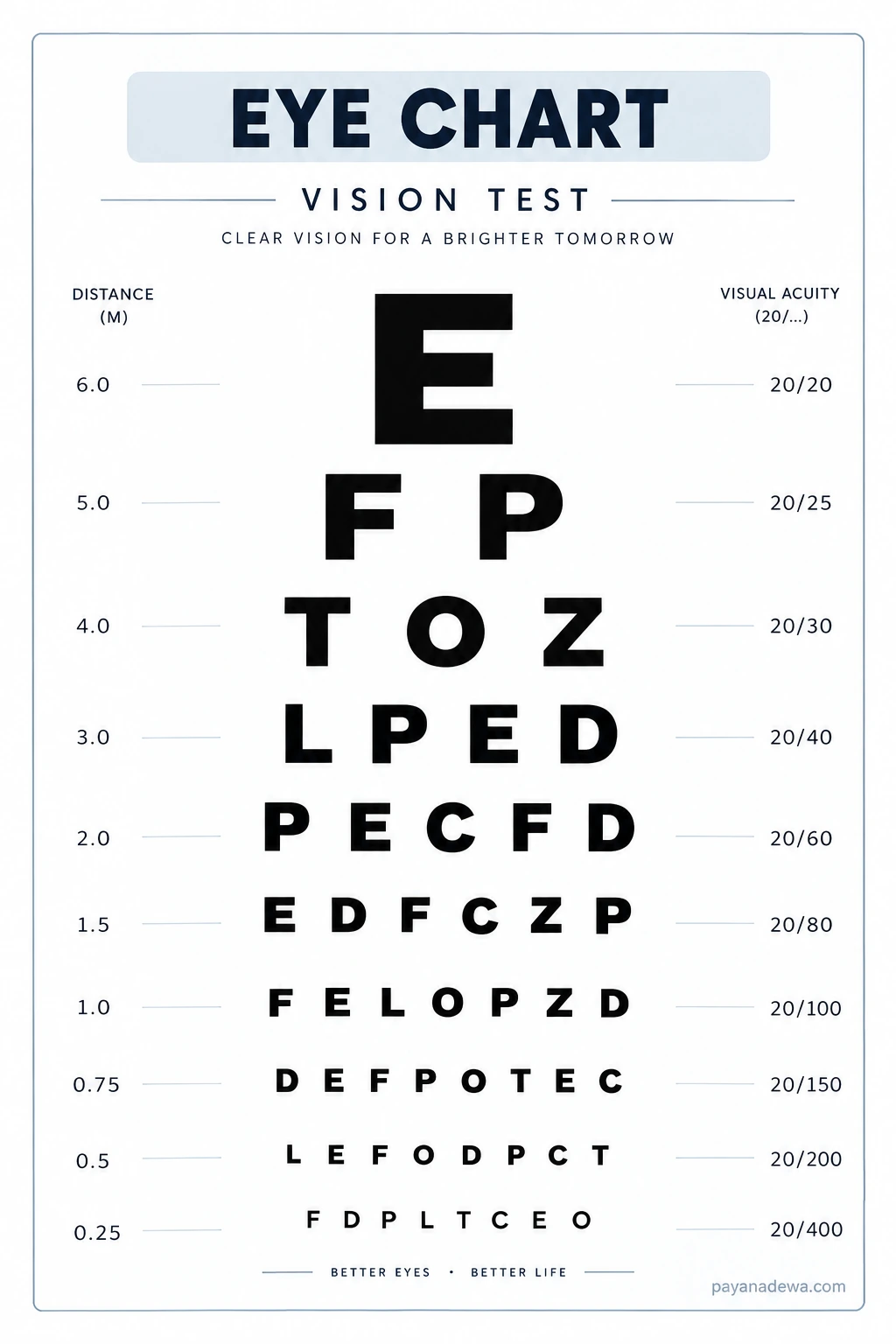
The traditional eye chart is called a Snellen eye chart. It typically displays a large letter at the top, followed by rows of progressively smaller letters. Each row represents a different level of visual acuity.
As the letters become smaller, identifying them becomes more challenging. The smallest line a person can read accurately helps determine their visual acuity under the test conditions.
Eye charts are used for several purposes, including:
- Screening distance vision in adults and older children.
- Assessing changes in visual acuity over time.
- Supporting routine eye examinations.
- Helping determine whether further vision assessment may be necessary.
- Teaching students and families how basic vision testing works.
However, a standard eye chart measures only certain aspects of vision. It cannot independently diagnose every eye condition or determine the complete health of your eyes.
Types of Eye Charts
Different eye charts are designed for different ages, testing distances, and visual abilities. Therefore, the most suitable chart depends on the person being tested and the purpose of the assessment.
1. Snellen Eye Chart
The Snellen eye chart is widely recognized because it uses rows of letters that decrease in size from top to bottom. Common versions include letters such as E, F, P, T, and Z.
This chart is generally used to measure distance visual acuity. The results are often expressed as a fraction, such as 20/20 in the United States or 6/6 in countries that use meters.
For a valid measurement, the chart must be displayed at the distance specified for that particular chart. Lighting, chart dimensions, and testing procedures also affect the result.
2. Tumbling E Eye Chart
A Tumbling E eye chart uses the letter E in different orientations. The person being tested indicates which direction the open ends of the letter face.
This design is helpful for people who cannot read standard letters, including some young children and individuals who use a different writing system. It can also be useful in educational settings where letter recognition is not the main objective.
3. LEA Symbols Eye Chart
LEA symbol charts use simple shapes, such as circles, houses, apples, or other recognizable symbols, depending on the chart design.
These charts are commonly used for young children who have not yet learned the alphabet. The examiner asks the child to identify the symbols or match them to corresponding pictures.
4. Near Vision Eye Chart
A near vision eye chart measures the ability to see objects or text at a closer distance. It is particularly useful when evaluating reading vision and difficulties with close-up tasks.
Near vision charts are often used to investigate symptoms such as blurred reading material, difficulty focusing on small print, or visual discomfort during close work.
5. Digital and Printable Eye Charts
Digital eye charts appear on computer screens, tablets, or specialized testing equipment. Printable eye charts provide a physical alternative for demonstrations, educational activities, and certain screening situations.
Nevertheless, a chart displayed on a screen or printed at home may not be calibrated correctly. Screen size, zoom settings, printer scaling, and viewing distance can change the apparent size of the letters. Consequently, these charts should not automatically be treated as clinically accurate testing tools.
How to Read an Eye Chart
Reading an eye chart is straightforward when you understand how the rows and visual acuity measurements work.
Understand the Letter Rows
Most traditional eye charts place the largest characters at the top and smaller characters below. During testing, you identify the characters on each line until you reach a row that is difficult to read accurately.
The examiner records the smallest line you can identify according to the testing protocol. This result provides information about your distance visual acuity.
Understand 20/20 Vision
A common eye chart result is 20/20 vision. This measurement means that, under standardized testing conditions, a person can resolve details at 20 feet that are expected to be visible to a person with standard visual acuity at the same distance.
In countries using meters, the equivalent notation is commonly expressed as 6/6.
Other results have different interpretations:
- 20/20 vision: Indicates standard distance visual acuity under the testing conditions.
- 20/40 vision: Indicates that a person sees at 20 feet what a reference observer with standard visual acuity could see at 40 feet.
- 20/100 vision: Indicates that a person sees at 20 feet what a reference observer with standard visual acuity could see at 100 feet.
A smaller denominator generally indicates better distance visual acuity when comparing these conventional measurements. However, visual acuity is only one component of overall eyesight.
For example, someone with 20/20 vision may still have difficulties with peripheral vision, color perception, focusing, or other aspects of visual function.
How to Use a Printable Eye Chart at Home
A printable eye chart can help you understand the basic principles of vision testing. It can also serve as a useful classroom resource or educational reference.
For a simple demonstration, follow these steps:
- Choose a suitable chart: Select a chart designed for the intended age group and testing purpose.
- Check the dimensions: If the chart specifies a printing scale, follow those instructions. Avoid stretching or shrinking the page.
- Prepare the space: Choose an area with even lighting and enough room to position the chart and viewer.
- Follow the specified distance: Use the distance indicated by the chart manufacturer rather than assuming every chart is designed for the same distance.
- Keep the chart straight: Position it at approximately eye level and avoid tilting the page.
- Test one eye at a time: In a supervised screening, each eye may be assessed separately while the other eye is covered without pressure.
- Record observations: Note any difficulty identifying the characters, but do not treat a home result as a medical diagnosis.
For children, keep the activity relaxed and age-appropriate. Use symbol charts when necessary, and avoid suggesting that an incorrect answer means a child has an eye problem.
Important: A home eye chart cannot reliably confirm that your vision is normal unless the entire testing process is appropriately standardized. If you notice blurred vision, persistent difficulty seeing, or a difference between your eyes, arrange a professional eye examination.
Why Is an Eye Chart Important?
Eye charts provide a quick and practical way to assess one important aspect of vision. They help identify people who may need additional evaluation and allow clinicians to document visual acuity during an eye examination.
For example, a change in visual acuity may indicate that someone needs a more detailed assessment. Depending on the findings, an eye care professional may investigate refractive errors, eye health concerns, or other factors affecting vision.
Eye charts can also support regular monitoring. When measurements are taken using comparable methods, changes in visual acuity may become easier to identify.
However, the results must be interpreted in context. A chart alone cannot determine why vision is reduced, whether corrective lenses are needed, or whether an eye condition is present.
Common Mistakes When Using an Eye Chart
Although eye charts look simple, several common mistakes can affect their usefulness.
- Using the wrong distance: A chart designed for one distance may produce misleading results when viewed from another distance.
- Printing at the wrong scale: Automatic page fitting can change letter dimensions and affect the test.
- Ignoring lighting: Poor or uneven illumination can make characters harder to identify.
- Testing only one eye: One eye may see differently from the other, so professional assessments often measure each eye separately.
- Assuming 20/20 means perfect eyesight: Standard distance visual acuity does not evaluate every aspect of visual function.
- Using the chart to diagnose an eye condition: An eye chart is a screening tool, not a substitute for an eye examination.
To avoid these mistakes, follow the chart’s instructions and seek professional guidance whenever a reliable assessment is needed.
When Should You Get a Professional Eye Exam?
Consider scheduling an eye examination if you frequently experience blurred vision, headaches associated with visual tasks, difficulty reading signs, or trouble seeing clearly at a distance.
Routine eye care is also important even when your vision seems normal. Some eye conditions may develop without obvious early symptoms, so appropriate examinations can help identify problems that a basic chart cannot detect.
Seek urgent medical assessment if you experience sudden vision loss, a sudden change in vision, severe eye pain, or new flashes and floaters, particularly when accompanied by a shadow or curtain across your vision. These symptoms can indicate a serious problem that requires prompt attention.
An optometrist or ophthalmologist can perform additional tests, evaluate the health of your eyes, and recommend appropriate treatment when necessary.
Frequently Asked Questions About Eye Charts
What does an eye chart measure?
An eye chart primarily measures visual acuity, which describes how clearly a person can distinguish details at a specified distance under particular testing conditions.
Is a printable eye chart accurate?
A printable eye chart can be useful for education and demonstrations. However, accuracy depends on correct chart dimensions, viewing distance, lighting, and standardized testing procedures. A typical home setup should not replace a professional vision assessment.
What is the difference between 20/20 and 20/40 vision?
With 20/20 vision, a person can see at 20 feet details that a reference observer with standard visual acuity can see at that distance. With 20/40 vision, the person needs to be at 20 feet to see details that the reference observer can see at 40 feet.
Can an eye chart detect every eye problem?
No. An eye chart measures visual acuity, but it does not comprehensively evaluate eye pressure, retinal health, peripheral vision, color vision, or every possible eye condition. Additional examinations may be necessary.
How often should I check my eyesight?
The appropriate frequency depends on your age, symptoms, medical history, risk factors, and previous examination results. Follow the schedule recommended by your eye care professional rather than relying solely on occasional home chart tests.
Conclusion
An eye chart is a valuable tool for understanding visual acuity and learning how basic vision screenings work. From the traditional Snellen chart to symbol-based charts and near vision tests, different designs serve different purposes.
Understanding measurements such as 20/20 and 20/40 vision can help you interpret common eye examination results. In addition, following the correct viewing distance and printing instructions can make an educational chart easier to use.
However, a printable eye chart cannot provide a complete assessment of eye health. If you notice changes in your vision or need an accurate measurement, consult a qualified eye care professional. Regular examinations remain an important part of protecting your eyesight and maintaining long-term visual health.