The Cornell Note-taking method works for students, teachers, professionals, and anyone who needs to learn information efficiently. You do not need special equipment or an expensive planner. A notebook page or printable Cornell notes template is enough to get started. The key is to use each section with a clear purpose and review your notes regularly.
What Is the Cornell Note Method?
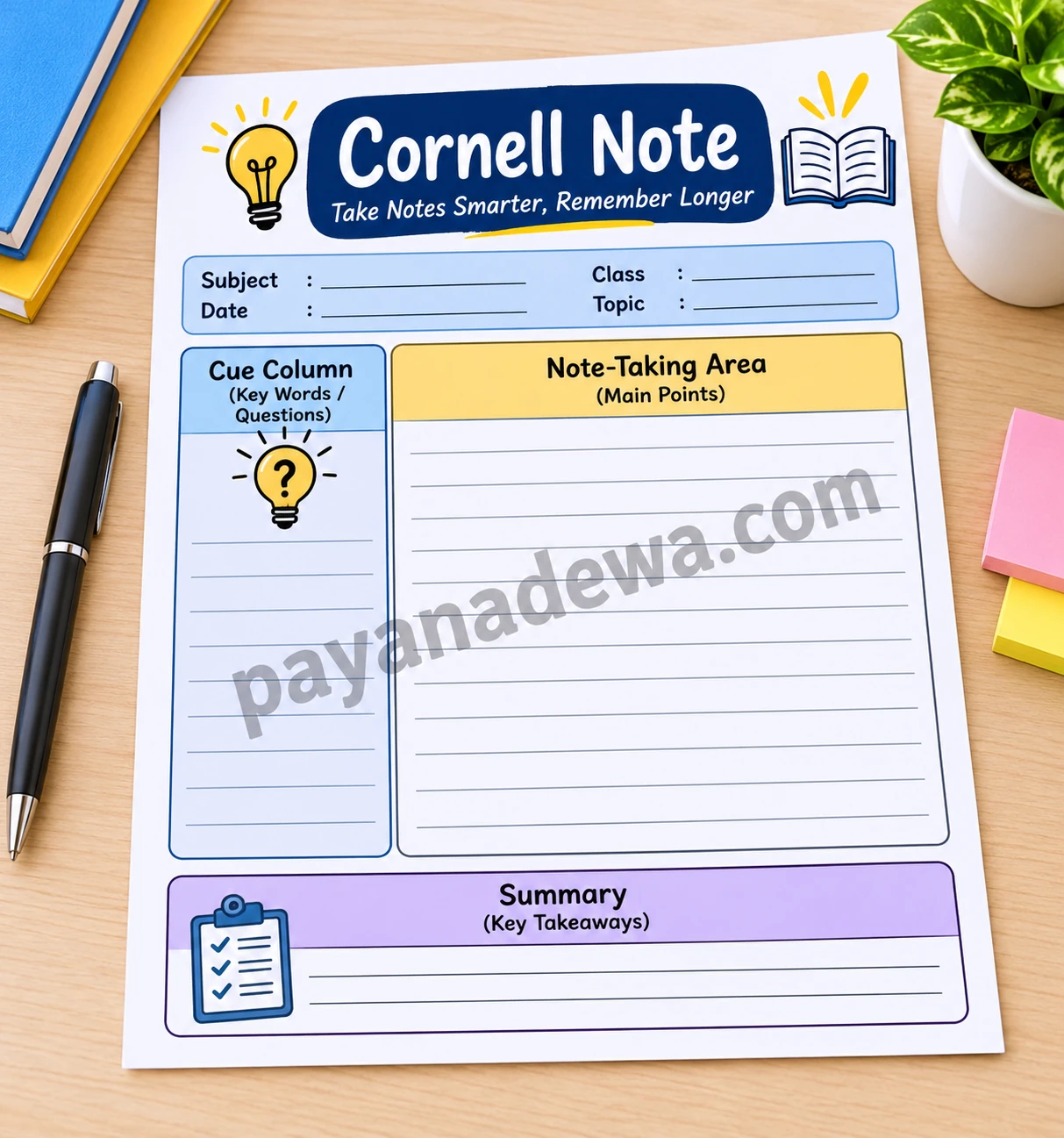
The Cornell Note method is a structured way to record and review information. It was developed at Cornell University by education professor Walter Pauk. Instead of writing everything in one continuous column, you divide a page into three main areas: a narrow cue column, a wider note-taking area, and a summary section at the bottom.
Each area supports a different stage of learning. The main notes capture important information during a class, meeting, reading session, or lecture. The cue column helps you identify key ideas and create questions. The summary section encourages you to explain the topic in your own words. Together, these steps make your notes easier to study than an unstructured page of text.
Understanding the Three Sections of Cornell Notes
1. The Note-Taking Area
The large right-hand section is where you record the main information. Focus on important ideas rather than trying to write every word. Use short sentences, headings, bullet points, examples, and simple diagrams where they make the information clearer.
- Write down key concepts, facts, definitions, and explanations.
- Use abbreviations that you can understand later.
- Leave space between topics so you can add details during review.
- Mark information that seems especially important or confusing.
2. The Cue Column
The narrow left-hand section is usually completed after the lesson or reading session. Add keywords, short prompts, names, formulas, or questions that connect to the notes on the right. For example, if your notes explain photosynthesis, a useful cue might be, “How do plants make food?”
Good cues do more than label a topic. They encourage you to retrieve information from memory. Whenever possible, turn headings into questions that you can answer without looking at the main notes.
3. The Summary Section
Use the space at the bottom of the page to write a brief explanation of the most important ideas. Aim for two to five sentences, depending on the topic. Avoid copying entire lines from the note-taking area. Instead, describe the main lesson in your own words and show how the ideas fit together.
How to Take Cornell Notes Step by Step
You can use the Cornell system in a classroom, during online lessons, while reading a textbook, or in a work meeting. Follow these steps to build a consistent routine.
Step 1: Prepare Your Page
Start with a blank sheet or printable Cornell Note template. Add your name or subject, the date, and the topic at the top. Draw a vertical line to create a cue column on the left and a larger note-taking area on the right. Leave a horizontal space at the bottom for your summary.
Step 2: Record the Main Ideas
During the lesson or reading session, listen or read for structure. Record central ideas, supporting details, useful examples, and questions that need clarification. Keep your notes concise. If you miss a detail, leave a blank space and return to it later rather than losing track of the discussion.
Step 3: Add Cues and Questions
As soon as practical after taking notes, review the page and write cues in the left column. Turn important points into questions, identify key terms, and group related ideas. This step helps transform passive notes into prompts for active recall.
Step 4: Write a Short Summary
Cover the details and look at the page as a whole. Write a concise summary that answers: What was the main topic? What are the most important points? How are they connected? If you cannot summarize the material, identify the section you need to review or ask about.
Step 5: Review Using Active Recall
Cover the right-hand notes with a sheet of paper. Read each cue in the left column and try to answer it from memory. Then uncover the notes to check your answer and correct any gaps. Repeat this process over several study sessions instead of waiting until the night before an exam.
Benefits of Using a Cornell Notes Template
A Cornell notes template gives your study routine a repeatable structure. It can be especially helpful when you have several subjects or need to review a large amount of information.
- Better organization: Main ideas, prompts, and summaries have clearly defined places.
- More active learning: Writing questions encourages you to engage with the material.
- Easier revision: The cue column makes it simple to test your memory without rereading every line.
- Clearer understanding: Summarizing helps you identify relationships and explain ideas in your own words.
- Flexible use: The method works for lectures, books, online courses, workshops, and meetings.
Practical Tips for More Effective Cornell Notes
Keep Your Notes Clear and Concise
A page packed with every sentence can be difficult to review. Prioritize information that supports the lesson’s main objective. Use headings and bullet points to make the structure visible, and write complete explanations only when they are necessary for understanding.
Make Cues Specific
Broad prompts such as “Chapter 4” do not test your understanding. More useful cues include “What caused the change?”, “How does this process work?” or “What is the difference between these two terms?” Specific questions make self-testing more meaningful.
Review Soon and Revisit Regularly
Complete your cues and summary while the lesson is still fresh. Then revisit the page the next day and again later in the week. Short, spaced review sessions are often more manageable than one long rereading session.
Adapt the Layout to the Subject
For mathematics, include worked examples and formulas in the main section, with cues that ask when or why to use each formula. For history, use dates, causes, and consequences. For science, add labeled diagrams and process questions. Keep the three-part structure, but adjust the content to suit the subject.
Common Cornell Note-Taking Mistakes to Avoid
- Writing everything down: This makes it harder to identify the most important information.
- Leaving the cue column blank: Without prompts, you lose one of the method’s most useful review features.
- Skipping the summary: A short explanation helps you check whether you understand the overall topic.
- Only rereading: Test yourself by answering the cues before checking the notes.
- Never revisiting the page: Notes become more useful when you review them consistently.
When Should You Use the Cornell Note Method?
This method is a strong choice when information is presented in a sequence, when a topic has clear concepts and supporting details, or when you need to prepare for tests and discussions. It is useful for lectures, textbook chapters, professional training, webinars, and project meetings.
It may be less suitable for sessions that depend heavily on rapid visual sketching, brainstorming, or complex diagrams. In those situations, combine Cornell notes with mind maps, flowcharts, or dedicated diagram pages. The goal is not to force every type of information into one format, but to choose a structure that helps you understand and retrieve it.
Conclusion: Make Every Note Easier to Review
The Cornell Note method is more than a neat page layout. It is a learning routine that connects recording information with questioning, summarizing, and active recall. By separating the main notes, cue column, and summary, you create material that is easier to understand and review.
Start with one lesson and a simple Cornell notes template. Write concise main points, add useful questions, summarize the topic, and test yourself with the cue column. With regular practice, this approach can help you build more organized notes and a more effective study habit.