A compliance certificate is an official document that confirms a person, business, product, process, or project meets specified rules, standards, or regulatory requirements. Organizations may need one to demonstrate that they follow industry standards, satisfy a contract, pass an inspection, or meet a buyer’s requirements. The exact meaning depends on the industry and the authority that issues the certificate.
Understanding what a compliance certificate proves—and what it does not prove—can help you prepare the right documents, avoid delays, and maintain good records. This guide explains common certificate types, the application process, the information a certificate should contain, and practical ways to verify whether a certificate is valid.
What Is a Compliance Certificate?
A compliance certificate is written evidence that specified requirements have been assessed and found to be met within a defined scope. Depending on the situation, it may be issued by a regulator, an accredited certification body, an inspection provider, a manufacturer, or another authorized organization.
The document usually identifies the person or organization being assessed, the applicable standard or regulation, the scope of the assessment, and the date of issue. Some certificates also include an expiry date, certificate number, conditions, or a link to a public verification register.
Important: A compliance certificate is not automatically proof that a company meets every law or standard. It only supports the claims covered by its stated scope, assessment method, and issuing authority. Always check the requirements that apply to your specific activity and location.
Why Is a Compliance Certificate Important?
A valid certificate can help an organization show customers, business partners, regulators, and procurement teams that it has addressed defined requirements. It can also make compliance checks easier when several parties need consistent evidence.
- Regulatory and contractual assurance: It can help demonstrate that relevant obligations have been assessed.
- Customer confidence: Buyers may request certificates before approving a supplier, product, or service.
- Market access: Certain industries or markets require specific conformity documents before a product or activity can proceed.
- Risk management: The assessment process can identify gaps that need corrective action.
- Record keeping: A certificate creates a traceable record of the assessment, its scope, and its issue date.
Requirements differ by country, sector, and product category. Before treating a certificate as mandatory—or assuming that one certificate satisfies every requirement—confirm the applicable rules with the responsible regulator or qualified adviser.
Common Types of Compliance Certificates
The phrase “compliance certificate” can refer to different documents. The correct type depends on what must be demonstrated and who has authority to assess it.
Regulatory Compliance Certificate
This document may show that an organization, facility, or activity has met specified regulatory conditions. The name, issuing authority, and legal effect vary across jurisdictions, so verify the exact local requirement.
Product Compliance or Conformity Certificate
Product-related certificates can provide evidence that a product has been assessed against particular technical, safety, performance, or quality requirements. Depending on the product and market, evidence may instead take the form of a declaration of conformity, test report, inspection report, or registration. These documents are not interchangeable.
Quality, Environmental, or Information Security Certification
Businesses may seek certification against recognized management-system standards covering areas such as quality management, environmental management, or information security. A management-system certificate generally applies to the defined organization, sites, and activities in its scope; it does not automatically certify every product or guarantee that no incident will occur.
Construction and Project Compliance Documents
Construction projects may require certificates or inspection records relating to building work, fire safety, electrical systems, structural requirements, or occupancy. The required document and responsible professional depend on local building codes and project circumstances.
Tax, Employment, and Supplier Compliance Documents
In some settings, a “compliance certificate” may refer to evidence relating to tax status, employment obligations, licensing, or supplier eligibility. Because terminology varies, confirm the document name and acceptance criteria with the requesting organization.
What Information Should a Compliance Certificate Include?
A well-prepared certificate should be clear, traceable, and specific. Review the following details before accepting or issuing one:
- Certificate title: A clear name that identifies the document’s purpose.
- Certificate or reference number: A unique identifier that helps with verification and record keeping.
- Holder’s legal name: The exact name of the individual, company, facility, or product covered.
- Scope of compliance: The activities, sites, products, services, or requirements included in the assessment.
- Applicable standard or regulation: The specific requirement or version used for the assessment, where relevant.
- Issuing organization: The name and contact details of the authorized issuer.
- Issue and expiry dates: Include expiry or review dates when the scheme requires them.
- Authorization: The signature, seal, digital signature, or other validation method required by the issuer.
- Verification details: A registry entry, QR code, or official contact channel, if available.
Do not add claims, accreditation marks, regulator logos, or signatures without authorization. A polished design does not make a document legally valid; the issuer’s authority and the underlying assessment are what matter.
How to Get a Compliance Certificate
The process varies, but the following steps provide a useful starting point for most applications.
1. Identify the Exact Requirement
Ask the regulator, customer, certification body, or contracting party which certificate is required. Confirm the applicable jurisdiction, standard, scope, and accepted issuer. If a buyer has provided a checklist, use it as a starting point and clarify any unclear items.
2. Choose an Appropriate Issuing Body
Check that the organization is authorized to issue the specific certificate. Where accreditation is required, verify the issuer’s accreditation and whether it covers the relevant standard, product, or activity. Use official directories or the regulator’s own guidance whenever possible.
3. Prepare Supporting Documents
Depending on the certificate, you may need registration details, technical specifications, test reports, inspection records, procedures, training records, risk assessments, or evidence of corrective actions. Keep file names consistent and ensure that company names and addresses match across documents.
4. Complete the Assessment
The process may involve a document review, product testing, site inspection, interview, audit, or a combination of methods. Answer questions accurately and make relevant records available. If the assessor identifies gaps, request clear findings and agree on the evidence needed to close them.
5. Review the Certificate Before Using It
When the certificate is issued, check every key detail: legal name, scope, standard, issue date, expiry date, and certificate number. Correct errors promptly. Store the certificate with the supporting assessment records and share it only for the purposes covered by its scope.
6. Track Renewal and Ongoing Duties
Set reminders well before any expiry or surveillance audit. Some certificates require periodic reviews, continuing controls, or notification of significant changes. Update your compliance records when the organization, product, site, or process changes.
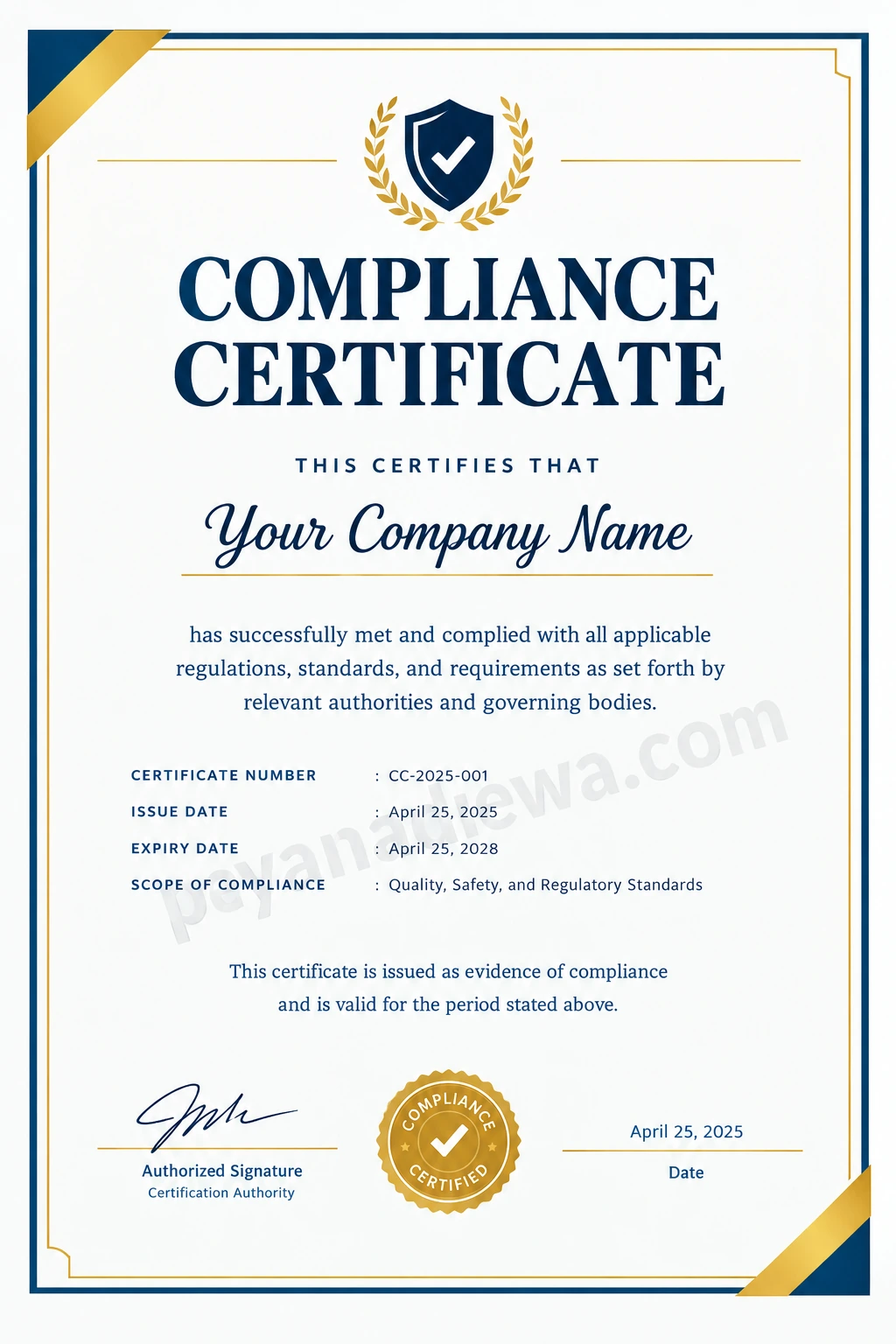
Compliance Certificate Template: What to Include
A template can help organize the information in a certificate, especially for internal records or preliminary document design. However, a generic template is not a substitute for an official form or an assessment by an authorized body. Before using a template for a formal purpose, confirm that the receiving authority accepts that format.
A basic layout may include the following fields:
- Certificate title and unique reference number
- Legal name of the certificate holder
- Statement describing the specific requirements assessed
- Applicable standard, regulation, or scheme
- Scope, locations, products, or activities covered
- Issue date and expiry or review date, where applicable
- Name of the issuing body and authorized signatory
- Verification instructions or official registry reference
Use precise wording. For example, “The assessment found that the activities listed in the certificate scope met the requirements of [specified standard] as of [date]” is more limited and transparent than a broad claim that an organization complies with all laws. Only use a statement that accurately reflects the actual assessment and the issuer’s authority.
How to Verify a Compliance Certificate
Verification is important because a certificate may be expired, altered, issued by an unauthorized organization, or unrelated to the product or activity being reviewed.
- Contact the issuing body through independently verified contact details.
- Search the issuer’s official certificate register if one is available.
- Match the certificate number, holder name, scope, and dates against the issuer’s records.
- Check that any accreditation applies to the specific certification activity, not merely to a different service offered by the same organization.
- Review exclusions, limitations, conditions, and suspension notices.
- Ask for supporting test, inspection, or audit reports when the decision depends on details that the certificate does not show.
Do not rely only on a logo, stamp, QR code, or scanned signature. These elements can be copied. Confirm the document with the issuing organization, especially when it affects safety, procurement, legal duties, or market access.
Common Mistakes to Avoid
- Using the wrong certificate: A document accepted in one market or industry may not meet another party’s requirements.
- Assuming one certificate covers everything: Certification scope is limited and may exclude sites, products, or activities.
- Ignoring expiry dates: An expired certificate may no longer be accepted, even if the organization’s processes have not changed.
- Submitting inconsistent information: Differences in legal names, addresses, or product identifiers can delay review.
- Using an unverified issuer: Confirm the issuer’s authority and relevant accreditation before paying fees or relying on the certificate.
- Making unsupported claims: Never describe a business or product as certified beyond what the certificate actually confirms.
Frequently Asked Questions
Is a compliance certificate the same as a certificate of conformity?
Not always. A certificate of conformity usually relates to whether a product or other specified subject meets defined requirements. “Compliance certificate” is a broader phrase that can refer to several types of evidence. The terms may overlap in some schemes, so check the exact legal or contractual definition.
Who can issue a compliance certificate?
The issuer depends on the requirement. It may be a regulator, an accredited certification body, an inspection organization, a qualified professional, or another authorized entity. Confirm which issuers are accepted for your particular purpose.
Does a compliance certificate expire?
Some certificates have a fixed expiry date or require periodic surveillance and renewal. Others may remain valid only while specific conditions continue to be met. Read the certificate and the rules of the issuing scheme rather than assuming it remains valid indefinitely.
Can I create my own compliance certificate?
You can create a template for internal documentation or for a process in which self-declaration is permitted. However, you should not present a self-created document as an official certification unless the applicable scheme explicitly allows it and you meet its requirements. Never imitate an official seal or claim endorsement from an authority that has not granted it.
Conclusion
A compliance certificate can provide useful evidence that defined requirements have been assessed, but its value depends on the scope, the issuing body, and the supporting process. Start by confirming exactly what is required, select an authorized issuer, prepare consistent records, and check the certificate carefully when it arrives. Keep track of renewals and verify certificates before relying on them.
Because requirements vary across industries and jurisdictions, treat templates as organizational aids—not as proof of compliance on their own. When the certificate affects legal obligations, product safety, or market access, consult the responsible authority or a qualified professional to confirm the correct route.